


Table of Contents
NEURA Robotics has launched 4NE1 Gen 4, a lighter humanoid powered by its Neuron AI model, as it opens a joint robot-training center with the Technical University of Munich. The launch connects a new hardware generation with a facility that teaches robots industrial work and collects the physical-interaction data needed to improve their skills.
The TUM RoboGym powered by NEURA opened on October 22 at LabCampus near Munich Airport. Built with TUM’s Munich Institute of Robotics and Machine Intelligence, or MIRMI, it covers more than 2,300 square meters. Initially, around 100 humanoid and service robots will learn tasks in 48 training cells.
The partners are investing roughly €17 million over an initial three-year term, including about €11 million from NEURA. Companies have been training workflows there since September, with the current focus on industrial applications and intralogistics, the movement of materials within a facility.
A Lighter Humanoid With Local AI and Limb-Level Reflexes
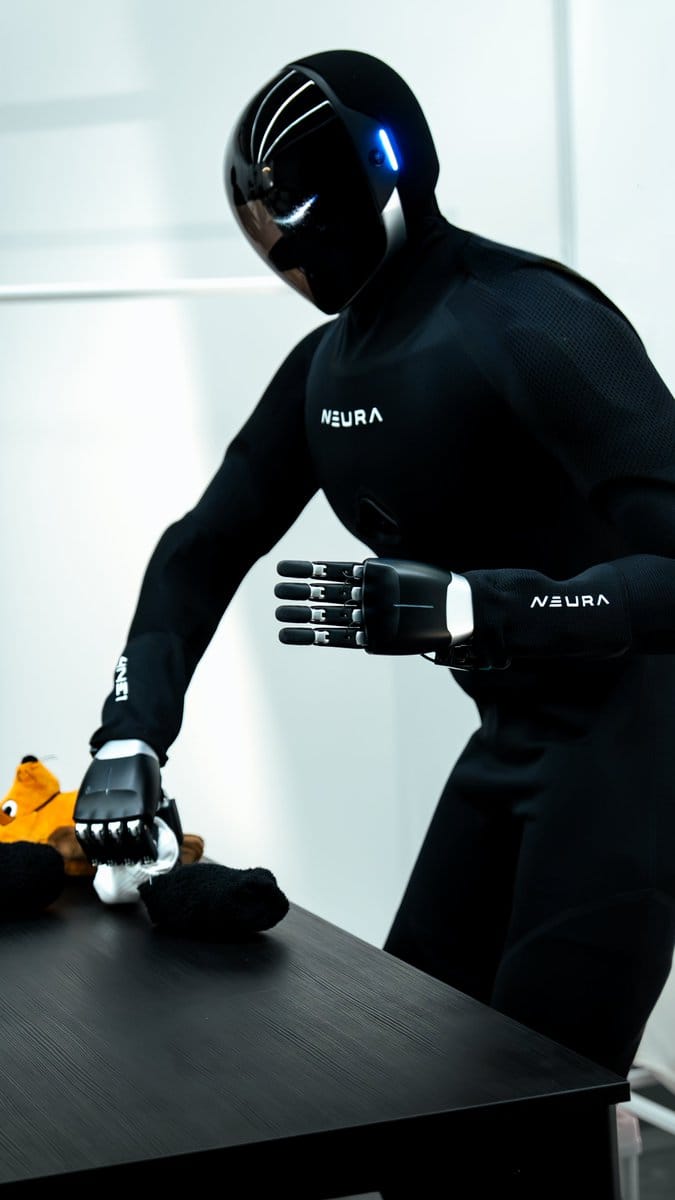
4NE1 Gen 4 is 20% lighter than its predecessor and has a slimmer body covered in black textile. NEURA is preparing the robot for series production, and the new generation is already operating in its training facilities, where participating companies can work with it.
The redesign includes more advanced hands for precise gripping and a control system called Smart Limbs. Reflexes are built into individual limbs so they can respond independently to changing conditions. NEURA says that arrangement enables quicker reactions and smoother movement.
The robot runs Neuron AI, NEURA’s Physical AI foundation model. Its Perception-Language-Action architecture combines visual information with touch, force, sound, and the robot’s own state to produce movements. In assembly work, the model can use physical feedback, such as whether a fastener has clicked into place, rather than relying on an image alone.
Neuron AI runs locally on the robot. Its training draws on robot experience, human demonstrations, and simulation, while NEURA’s Neuraverse software ecosystem makes skills learned by one robot available to other connected robots.
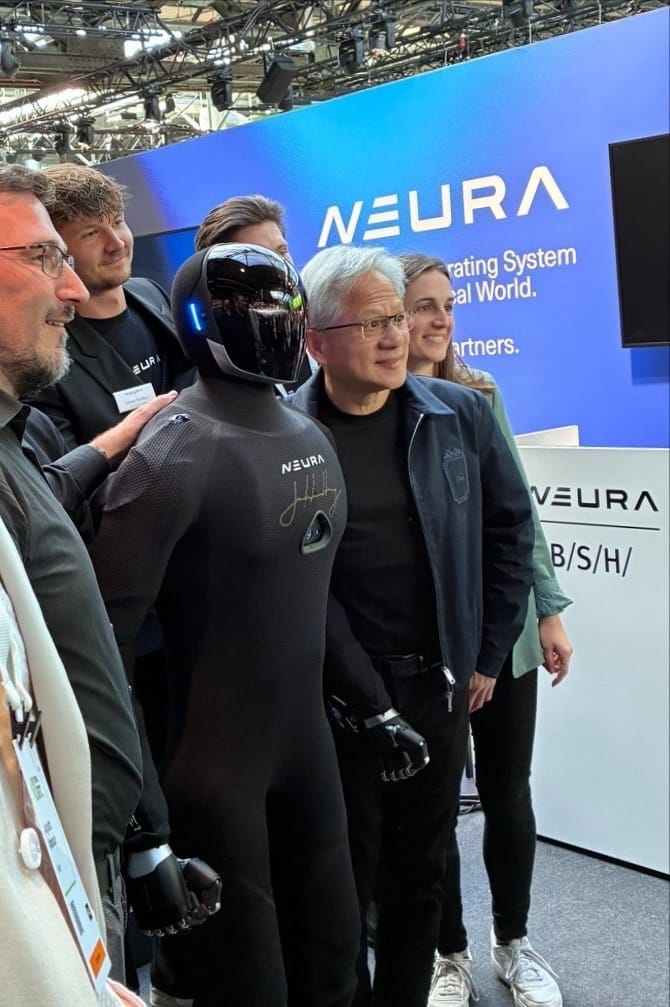
NEURA also showed Gen 4 at NVIDIA GTC in Berlin, where Jensen Huang signed the robot. The appearance coincided with a conference whose physical-AI announcements included robotics and simulation platforms.
Industrial Work Becomes Robot Training Data
The RoboGym gives companies a place to bring actual processes into robot development. Participants contribute tasks and operational knowledge; researchers and engineering teams study how different robots can learn the work and execute it reliably. Companies can test applications and assess which platforms suit their needs before extending their use into their own operations.
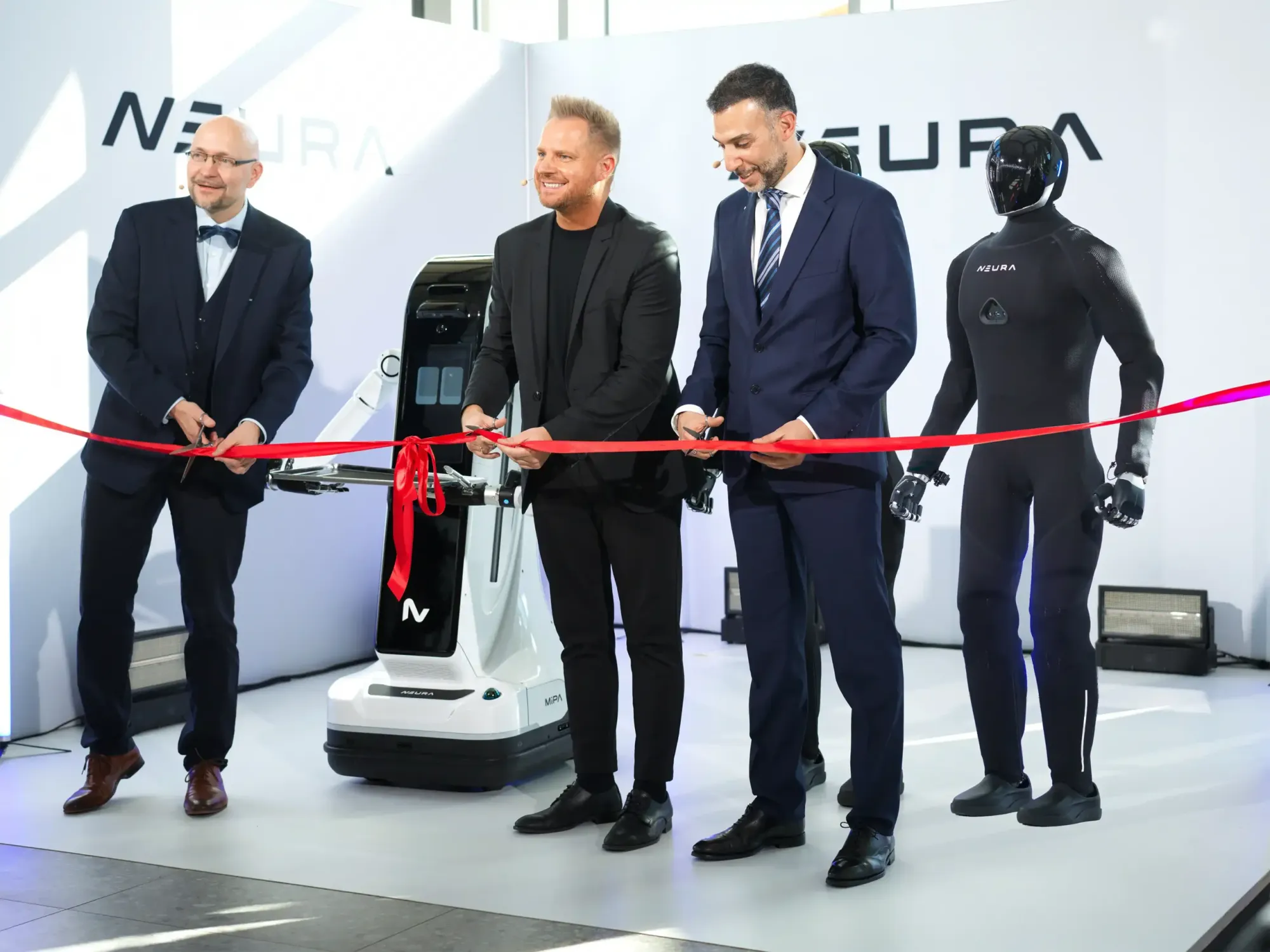
Partners come from more than 10 industries, including automotive, pharmaceuticals, medical technology, packaging, logistics, agriculture, and care. Training tasks include handling cardboard boxes, filling bottles, and loading and unloading wooden components. Alongside humanoids, the facility uses mobile assistance robots such as MiPA and cognitive robot arms.
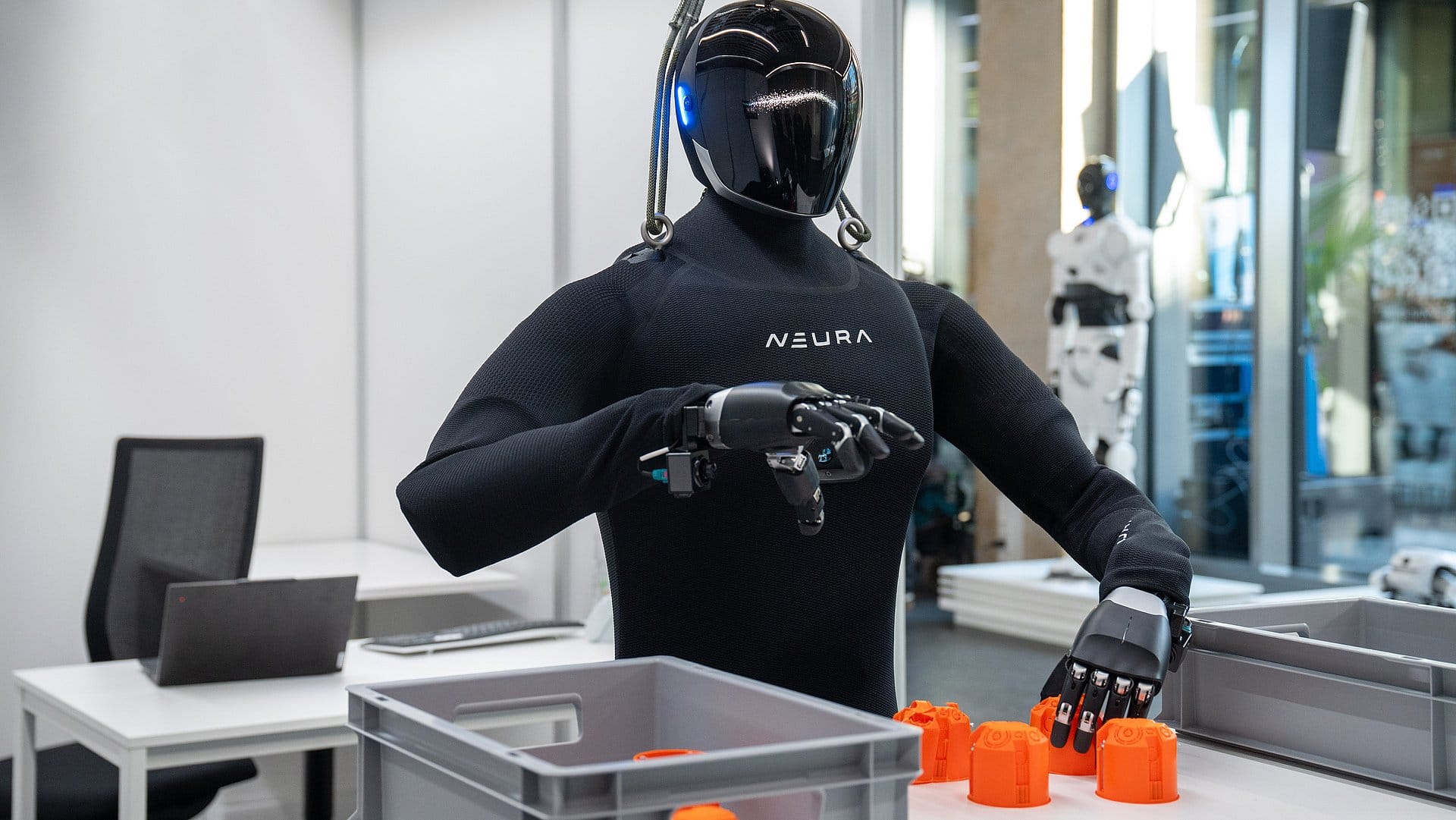
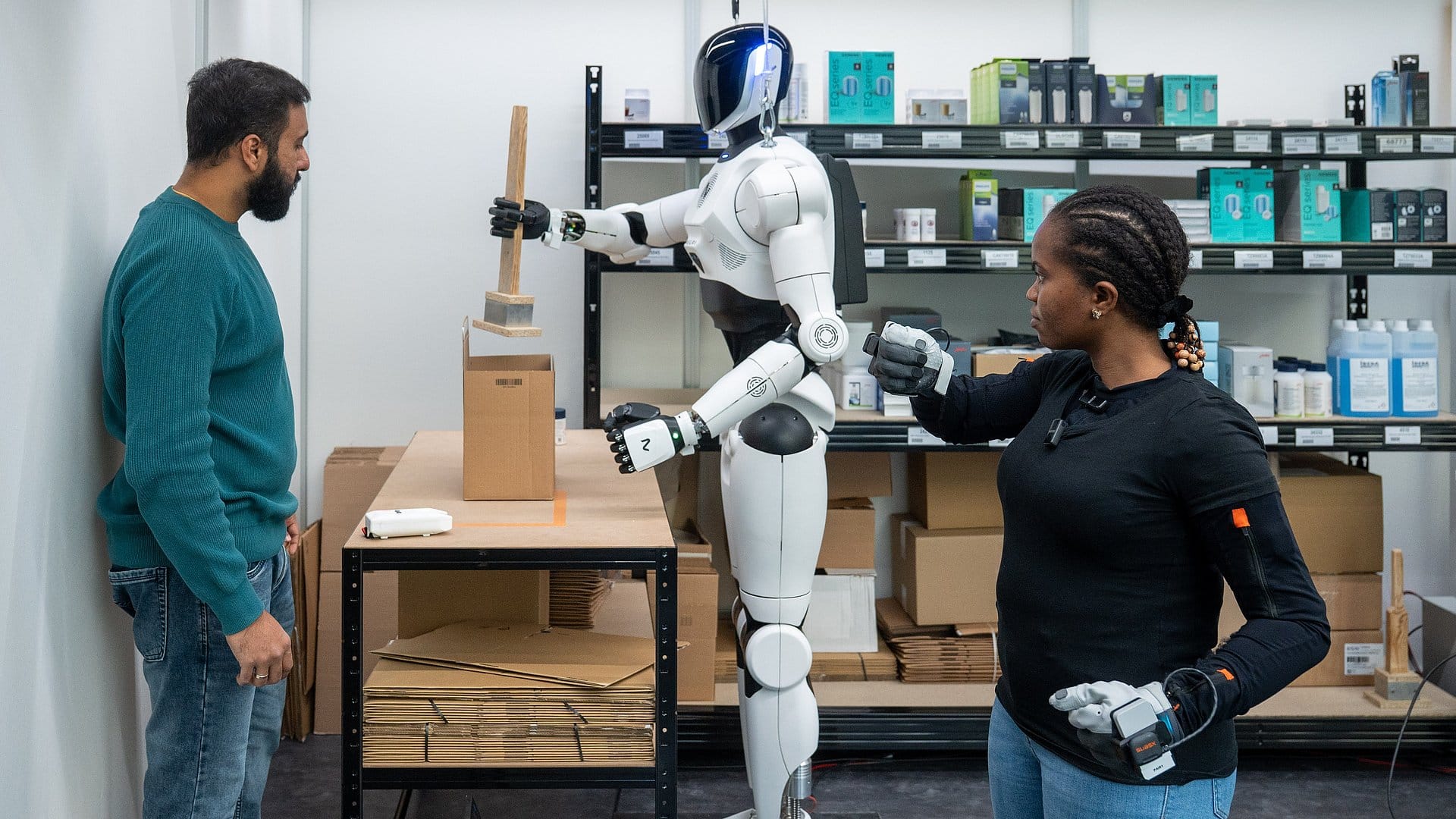
TUM’s training cells also support box folding, component assembly, and tool use. Examples shown by the university include a humanoid identifying defective parts and sorting them into a container, and 4NE1 learning to fold a box and place parts inside it.
These interactions supply a different kind of training material from the text and images available online. A robot learning assembly needs observations of movement, contact, force, and the results of its actions. TUM identifies the scarcity of that physical-interaction data as a central problem the facility addresses.
Demonstration, Simulation, and Real-World Validation
The training system combines three sources of experience. Robots performing tasks generate sensor records of movements, contacts, and outcomes. People demonstrate workflows through sensor-equipped suits, motion capture, and teleoperation, translating human actions into usable training examples. Simulation then expands those examples with additional situations and variations through NEURA’s Data Amplifier.
Skills trained under changed virtual conditions are subsequently validated on physical robots. This connects simulation to the same practical tasks being studied in the training cells, rather than treating virtual performance as the endpoint.
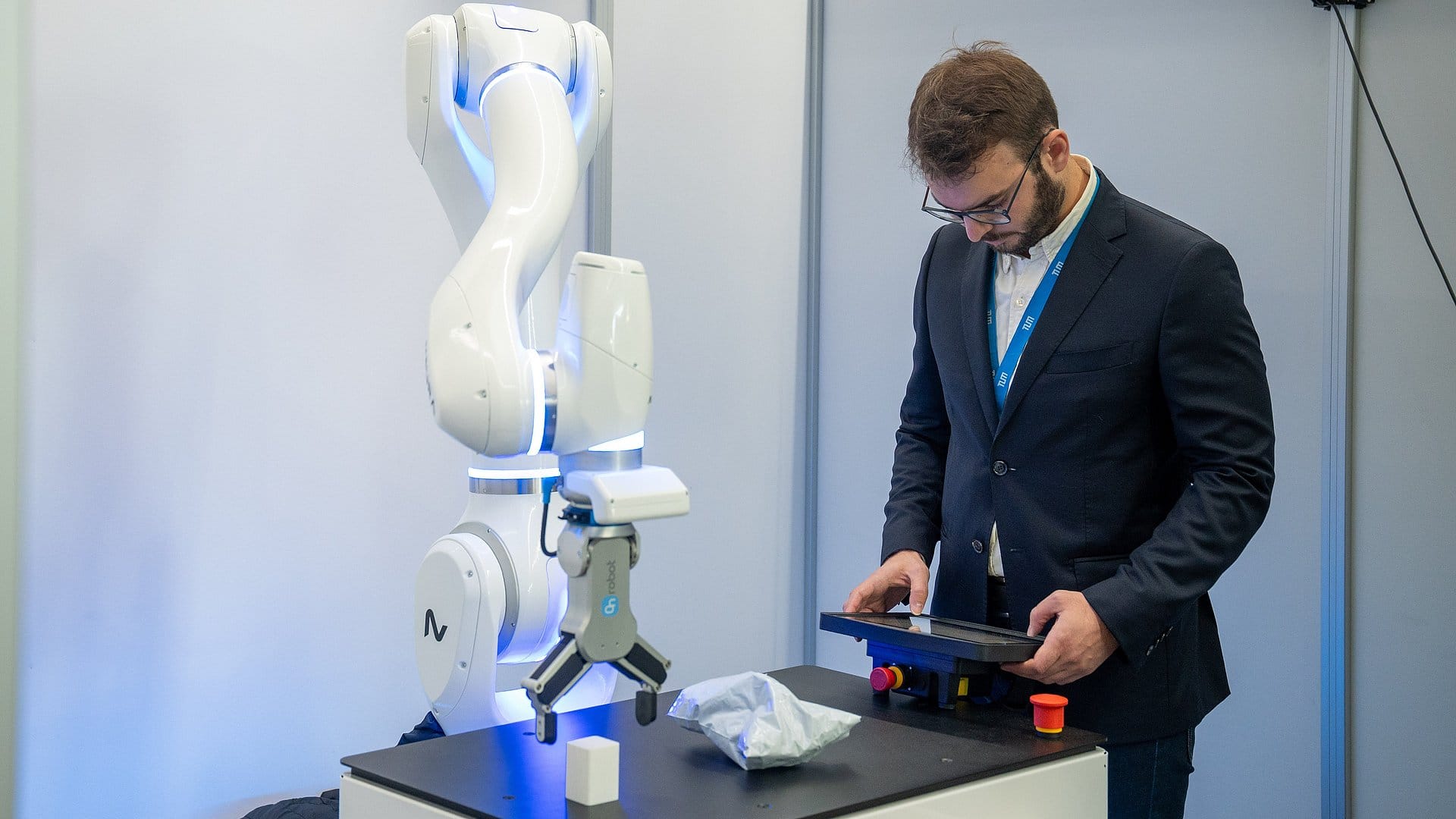
The supporting infrastructure includes motion-capture systems for recording movement and tracking objects, service and maintenance areas, and cloud computing for simulation, reinforcement learning, and large-model training. Reinforcement learning improves behavior through trial and error, using feedback on the results of an action. GPU compute nodes, networking, and storage are integrated with Neuraverse.
Data from the facility flows into a cloud data lake for research on generalizable robotic skills, safe human-robot interaction, and AI models for robotics. The shared infrastructure lets researchers study how skills transfer beyond a single narrowly configured task while companies assess performance on their own workflows.
A Three-Year Partnership and a Wider Gym Network
NEURA supplies robots, technical infrastructure, computing power, and operating staff. TUM contributes space, scientific expertise, and resources for research and operations. MIRMI Executive Director Lorenzo Masia heads the RoboGym, with Achim Lilienthal as scientific coordinator.
“Close, continuous and flexible collaboration with the robotics industry is essential for research in physical AI,” Lilienthal said. The partnership is intended to shorten the path from research prototypes to practical products by keeping scientific work connected to industrial requirements.

The opening follows NVIDIA and Germany’s agreement to develop Physical AI models, another initiative linking AI development with the country’s manufacturing and engineering expertise. That industrial knowledge enters the RoboGym through companies teaching robots specific production processes.
Munich is the first site in NEURA’s planned international gym network. Further locations are being established in Europe, the United States, and China, including another German facility being built with RWTH Aachen. In Munich, companies already using the training center are among the first to train tasks with 4NE1 Gen 4 as NEURA prepares the humanoid for series production.


