

Table of Contents
SubQuery just kicked off 2026 with a bang, launching two new products designed to work together to "unlock AI-powered blockchain experiences at scale."
The first, Hermes, is a Bittensor-based subnet for training AI agents that specialize in blockchain data. AskSubQuery, the closely-linked second product, is a natural-language interface that lets developers and users query onchain information through simple conversational prompts.
The tools are intended to reduce the cost, complexity, and latency of building AI-powered Web3 applications.
"Together, they form a powerful new stack: Hermes is the engine. AskSubQuery is the car... The launches were intentionally connected." - SubQuery
The launches mark SubQuery’s latest effort to extend its role beyond blockchain data indexing and into the emerging world of AI-native decentralized applications, where intelligent agents can interpret, retrieve, and act on onchain data, making it interactive, conversational, and accessible for users.
Hermes: A Bittensor Subnet For GraphQL AI Agents
Hermes is SubQuery’s new Bittensor-based subnet (Subnet 82) designed to train and evaluate AI agents that specialize in querying blockchain data through GraphQL.
Instead of relying on general-purpose language models, Hermes focuses on building agents that understand blockchain schemas, retrieve accurate onchain information, and respond with low latency.
Within the Hermes subnet, AI agents compete to solve synthetic challenges generated by validators. These challenges test how well agents can compose GraphQL queries, interpret blockchain data, and deliver concise, correct answers. Performance is scored based on accuracy and response time, with the best-performing agents earning higher rewards through Bittensor’s incentive system.
This competitive structure allows Hermes to continuously improve the quality of blockchain-aware AI. As agents learn from real-world data and evaluation cycles, they become faster, cheaper, and more reliable for production use in Web3 applications.
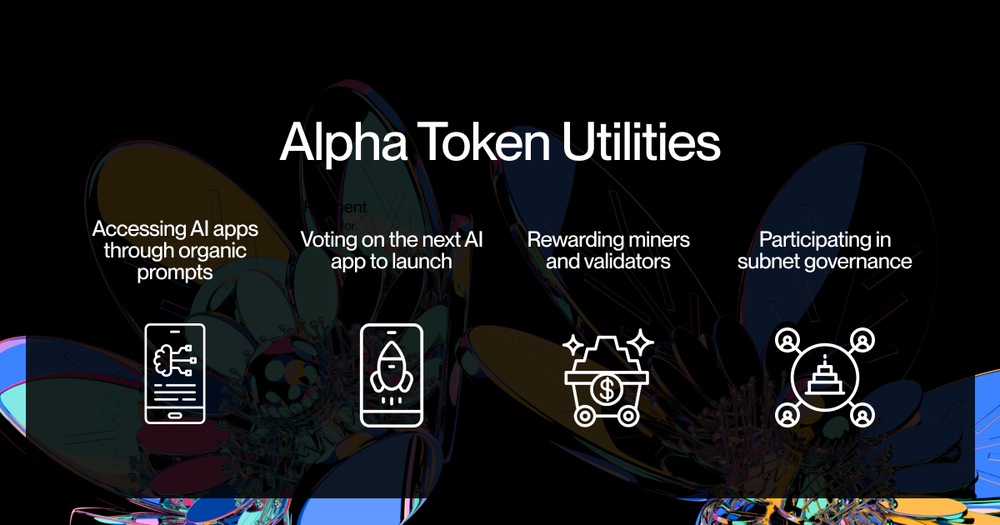
Hermes operates using the SN82 Alpha token, which is obtained by staking TAO. Alpha is used for accessing AI applications, voting on which blockchain projects the subnet should prioritize, rewarding miners and validators, and participating in governance decisions. By tying rewards to performance, the subnet incentivizes participants to maintain high standards for accuracy and efficiency.
SubQuery says the goal is to make GraphQL AI agents commercially viable for real-world use cases such as trading assistants, governance tools, analytics platforms, and automated support systems. Instead of building custom infrastructure for each application, developers can rely on Hermes-powered agents to handle blockchain data retrieval and interpretation at scale.
"A new wave of agentic AI is transforming industries, but web3 risks missing out. The current approach of using general-purpose LLMs (Large Language Models) for GraphQL agents creates prohibitive cost and latency, stifling innovation. To unlock this new era for our industry, we must solve these fundamental adoption barriers. Hermes changes that by introducing GraphQL Agents capable of automatically retrieving, analyzing, and responding to blockchain data in real time."
The company has identified 50,000 Subgraph and SubQuery indexers built by Web3 developers; each of them could be upgraded into GraphQL agents with Hermes, enabling them to consume and respond to blockchain data intelligently.
SubQuery also plans to introduce cloud mining features in the future, which would allow participants to contribute computing resources without running dedicated hardware. This could lower barriers to entry and expand the network of AI agents supporting blockchain data access.
AskSubQuery: Natural Language For Blockchain Data
AskSubQuery is SubQuery’s new interface layer that allows developers and users to query blockchain data using natural language instead of technical GraphQL commands. Put more plainly, it's the user-facing experience layer of SubQuery's AI stack.
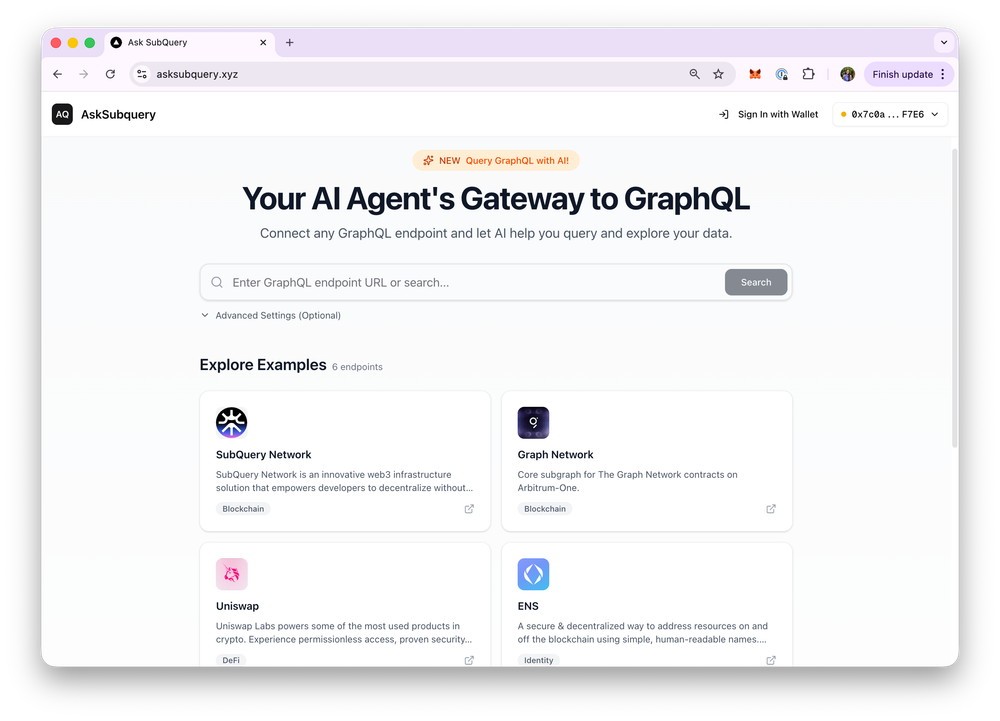
The product exposes a GraphQL query agent through the Model Context Protocol, making it easy for AI applications to integrate onchain data access.
With AskSubQuery, users can ask simple questions such as which wallets interacted with a specific contract, how many NFTs were minted today, or what transactions occurred on a given network. The system translates those prompts into structured GraphQL queries and returns accurate results in real time.
The service works with both SubQuery indexers and The Graph subgraphs, allowing it to support a wide range of blockchain networks and data sources. This makes AskSubQuery a universal conversational layer for Web3 data rather than a tool limited to a single ecosystem.
For developers, AskSubQuery removes the need to build custom data pipelines or manage complex schemas. AI agents can plug into the service and immediately gain access to blockchain data through standardized prompts. This reduces development time, lowers infrastructure costs, and simplifies the process of adding intelligent features to Web3 applications.
How Hermes And AskSubQuery Work Together
Hermes and AskSubQuery were designed to function as a connected system rather than as standalone products. Each serves a different role in SubQuery’s broader AI and blockchain data strategy.
Hermes operates as the intelligence layer. It trains and evaluates specialized AI agents that understand blockchain data structures and can generate accurate GraphQL queries. These agents compete within the Bittensor subnet, improving over time through performance-based rewards.
AskSubQuery acts as the access layer. It allows developers, AI agents, and users to interact with blockchain data using natural language prompts instead of technical queries.
When a user submits a request through AskSubQuery, the system can leverage the optimized AI agents trained within Hermes to generate faster and more accurate responses. Hermes improves the underlying intelligence, while AskSubQuery delivers that intelligence through a simple interface.
This architecture allows blockchain data to become conversational, interactive, and usable by non-technical users. Instead of requiring deep knowledge of schemas or query languages, applications can rely on AI agents that translate human questions into structured blockchain queries.
Together, the two products enable a new category of AI-native Web3 applications.
"This combination opens the door to AI-native Web3 applications—intelligent explorers, trading assistants, automated support agents, governance tools, on-chain analytics engines, and more."
SubQuery’s approach turns blockchain data from a developer-only resource into something that can be accessed and understood by a much wider audience.
Why Bittensor Was Chosen And What This Enables For Web3
SubQuery chose Bittensor as the foundation for Hermes because it provides a built-in incentive system for training and improving specialized AI models in a decentralized way.
Traditional AI development relies on centralized infrastructure and general-purpose models that are expensive to run, slow to respond, and not optimized for blockchain data. This makes them poorly suited for real-time Web3 applications that require fast, accurate, and cost-efficient access to onchain information.
Bittensor offers a different approach. It allows independent AI agents, known as miners, to compete based on performance. Their responses are evaluated on accuracy, speed, and usefulness. The best-performing agents are rewarded, while weaker ones earn less. This creates continuous pressure for improvement without relying on a single company to manage or update the models.
 Antonio Verrico
For Hermes, this means GraphQL-focused AI agents can evolve in an open and competitive environment. Over time, the network naturally selects the fastest and most accurate models for querying blockchain data. As more developers and projects use the subnet, the quality of the AI agents improves further.
This structure also keeps costs lower. Instead of paying premium fees to large AI providers, Web3 applications can access specialized agents that are trained specifically for blockchain data and optimized through decentralized incentives.
Why SubQuery Is Positioned to Build This and What It Means for Web3
Since 2021, SubQuery has focused on helping developers access and organize onchain data across hundreds of networks. Its indexing tools and decentralized data services already power thousands of decentralized applications, making blockchain information easier to query, analyze, and integrate into real products.
This foundation is critical for building AI systems that rely on accurate, structured, and up-to-date blockchain data. Without reliable indexing and standardized data access, AI agents cannot operate effectively in Web3 environments. SubQuery’s existing infrastructure and years of expertise solve that problem.
Why are we doing this?
— SubQuery (@SubQueryNetwork) January 15, 2026
Since 2021, SubQuery has been shaping how developers access blockchain data. Hermes is the next step in our mission to unlock intelligence in blockchain data - connecting AI agents directly to Web3’s data layer via GraphQL, and removing the cost and…
By launching Hermes and AskSubQuery, SubQuery is extending its data layer into an intelligence layer. Instead of only delivering raw blockchain data, it now enables AI agents to interpret, query, and respond to that data in ways that are useful for both developers and users.
As AI becomes more central to how users interact with digital systems, this combination of data infrastructure and intelligent agents could shape the next generation of Web3 applications.
Disclaimer:
This article is for informational purposes only and does not constitute financial, investment, or trading advice. The information provided should not be interpreted as an endorsement of any digital asset, security, or investment strategy. Readers should conduct their own research and consult with a licensed financial professional before making any investment decisions. The publisher and its contributors are not responsible for any losses that may arise from reliance on the information presented.