
Table of Contents
Bittensor was designed to do one thing: reward the best intelligence in the world. The network routes compute, capital, and TAO emissions toward whichever models perform best, in real time, on real tasks, with no favoritism for institution, geography, or credentials. On paper, it is the most meritocratic AI incentive structure ever built.
In practice, every one of the best ML researchers should be participating in the Bittensor network, but that isn't the case.
It's not because the problems aren't interesting; Bittensor's 120-plus subnets span structural break detection in financial time series, causal discovery in high-dimensional data, predictive genomics for cancer diagnostics. These sit at the frontier of machine learning research. It's definitely not because the rewards aren't meaningful; subnets distribute millions of dollars in TAO emissions annually.
The barrier has been something more mundane and more stubborn: mining a subnet competitively requires a researcher to simultaneously manage GPU infrastructure, navigate on-chain registration, understand staking mechanics, monitor validator scoring dynamics, parse subnet-specific documentation across GitHub repositories, and track emissions schedules, all before building a single model. For a data scientist whose expertise is the model itself, that overhead isn't an inconvenience. It's a second career. One that has nothing to do with producing better intelligence.
CrunchDAO's Subnet Mining Hub is built on a simple premise: that friction is the problem, not talent. And CrunchDAO has already proven, with verified results from two of the world's most demanding research institutions, what happens when that friction disappears.
What CrunchDAO Has Already Proven
CrunchDAO operates as a decentralized machine learning(ML) coordination layer, connecting over 11,000 ML engineers and 1,200-plus PhDs across 100 countries through structured prediction challenges called Crunches. Institutions bring hard ML problems to the protocol. Contributors worldwide compete to solve them. The best models, evaluated purely on predictive performance, win.
The results are documented and verified. ADIA Lab, the research arm of the Abu Dhabi Investment Authority, partnered with CrunchDAO to advance causal AI research, building algorithms to identify robust drivers in high-dimensional data that standard machine learning misses. The CrunchDAO network delivered a 17% improvement over ADIA's internal benchmark in cross-sectional asset pricing predictions.
The Broad Institute of MIT and Harvard brought CrunchDAO a computer vision challenge in predictive genomics: building models to infer expensive molecular data from cheaper tissue images, with direct application to early diagnosis of colorectal cancer. CrunchDAO's community outperformed the Broad Institute's internal computer vision benchmark by 14%.
These are not minor benchmarks. ADIA manages one of the world's largest sovereign wealth fund portfolios and operates a sophisticated internal quantitative research function. The Broad Institute is among the most respected genomics research organizations on earth. When CrunchDAO's decentralized network outperforms its internal teams on its own problems, it validates the protocol's core thesis: that a diverse, global collective of independent researchers, evaluated purely on performance, consistently produces better intelligence than any centralized team working in isolation.
This is the track record that the Subnet Mining Hub now brings to Bittensor.
The Problem on Bittensor Is Focus, Not Talent
Bittensor's subnets are competitive marketplaces for intelligence. Miners submit model outputs. Validators score them. The highest-quality intelligence earns the most emissions. In theory, this is the most meritocratic AI incentive structure ever designed. In practice, the path to participating as a miner has required a combination of skills that very few people have simultaneously: deep ML expertise and fluency in blockchain infrastructure.
As Jean Herelle, CrunchDAO's founder, described it when the Hub launched: "The majority of Crunch's community are data scientists and ML engineers from enterprise and academic backgrounds who want to contribute to decentralized AI without becoming blockchain experts. (Source: Chainwire, January 19, 2026)
"Our role is to unify the compatible opportunities and abstract away some of the decentralization complexity so they can focus purely on what they do best: building better models."
— Jean Herelle, Founder, CrunchDAO · Chainwire, Jan. 19, 2026
This framing is precise. CrunchDAO is not trying to turn data scientists into crypto miners. It is trying to ensure that the intelligence flowing into Bittensor's subnets is as good as it can possibly be, and that the researchers capable of producing that intelligence are not spending their time on tasks that have nothing to do with the quality of the models.
The Subnet Mining Hub is the infrastructure that makes that possible.
How the Hub Actually Works and Why It Produces Better Intelligence
The Hub solves the friction problem in two stages, and the order matters. First, it tells researchers where to compete. Then it handles everything required to actually compete there.
The first stage is the Crunch Fit Index, a composite score, updated daily, that ranks all 120-plus active Bittensor subnets on a 0-to-100 scale by how well they fit ML talent. This matters because Bittensor's subnets are not interchangeable. Some ask miners to build and submit predictive models, exactly what a data scientist does. Others ask for raw compute, or specialized hardware infrastructure, or tasks that have no relationship to modeling skill. Without a way to distinguish between them, a researcher entering the Bittensor ecosystem faces the same overhead problem in a different form: hours of reading subnet documentation, GitHub repositories, and validator logic just to figure out where their skills are relevant.
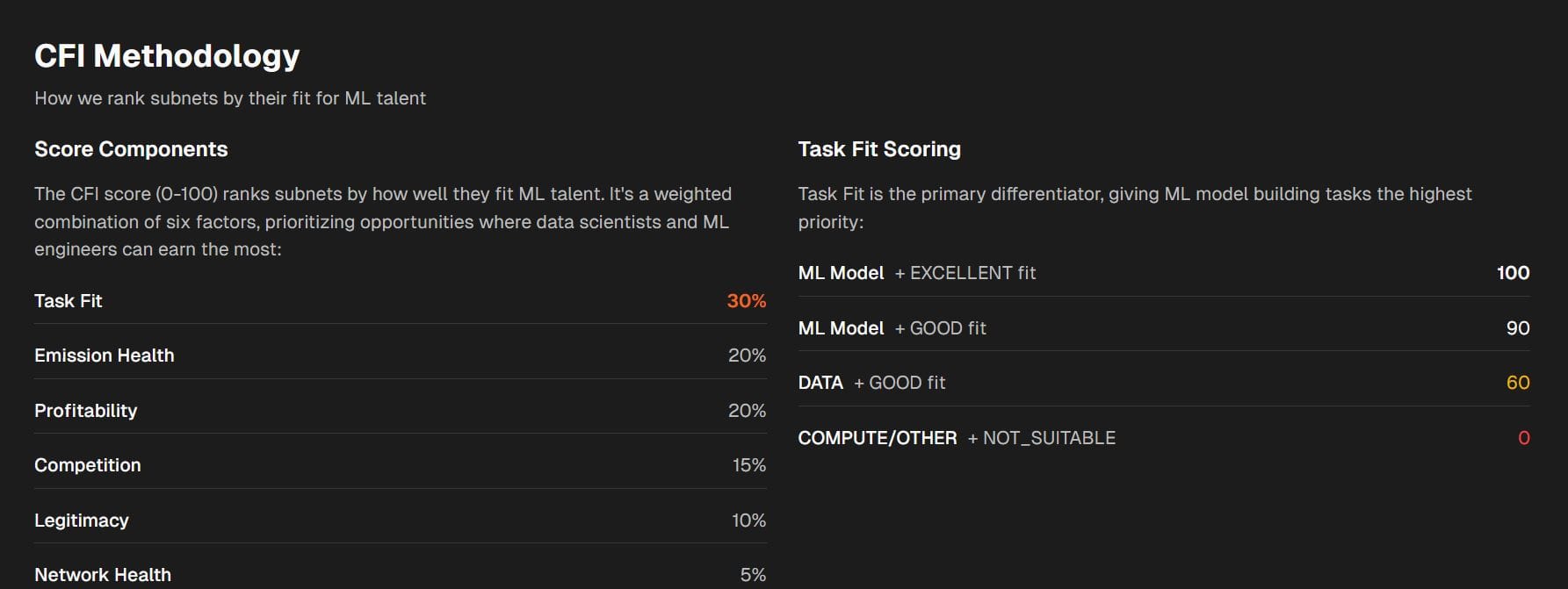
The CFI cuts through that. Its heaviest weight, 30% of the total score, goes to Task Fit, which scores subnets based purely on what kind of work they're asking miners to do. ML model-building tasks score at the top. Compute-only tasks score zero and are effectively filtered out of the rankings regardless of their daily emission levels. The remaining weight is distributed across emission health (20%), profitability (20%), competition density (15%), legitimacy (10%), and network health (5%), all sourced from the TaoStats API and manual research into each subnet's documentation, recalculated every day. The result is a ranked list that answers one specific question: given that you are a data scientist, where can your skills actually win?
Once a researcher knows which subnets are worth competing on, the second stage kicks in: the Coordinator Node handles everything else. On Bittensor, participating as a miner isn't just about submitting a good model; you need to register a mining slot on-chain, stake TAO, time your submissions correctly relative to each subnet's scoring cadence, and maintain an active presence that validators can score against. Miss any of these steps, and your model will never be evaluated, regardless of its quality.
The Coordinator Node absorbs all of that. It purchases mining slots, manages staking, monitors validator schedules, and times submissions, acting as what CrunchDAO calls a "super-miner," a single entity on Bittensor's chain that represents the combined output of dozens or hundreds of contributors.
What the Coordinator actually submits isn't any individual researcher's model. It's an ensemble, an aggregated prediction built from all the qualifying submissions to that subnet's Crunch challenge. This is the same architecture that produced the ADIA and Broad Institute results: independent models, built by researchers approaching the same problem from different angles, combined into a single output that is more accurate and more robust than any one of them alone. The researcher who contributed their model never registered a wallet, never staked a token, never parsed a validator's scoring formula. They built a model. The Coordinator turned it into a mining position.
Why Collective Intelligence Wins on Bittensor
The mechanism that makes CrunchDAO's approach effective on Bittensor is the same one that explains the ADIA and Broad Institute results. Ensemble methods, combining independent predictions from diverse contributors, consistently outperform individual experts when the contributors are genuinely independent and bring different approaches to the same problem.
CrunchDAO's own documentation describes it directly: "A network of independent approaches outperforms centralized teams stuck in single modes of thinking." This is not a philosophical claim. It is a documented empirical result, reproduced across multiple high-stakes challenges with verified institutional benchmarks.
On Bittensor, this matters because validator scoring rewards prediction quality against ground truth. A Coordinator Node submitting an ensemble built from hundreds of independent CrunchDAO model submissions will, on average, produce more accurate and more robust predictions than any individual miner, not because any single contributor is necessarily better, but because the diversity of their approaches, aggregated correctly, reduces the variance that any individual model carries. The collective intelligence advantage is structural, and it compounds as the contributor pool grows.
Great episode of Hash Rate with @markjeffrey, Bittensor Fund partner and one of the sharpest minds in the TAO ecosystem.@herelle_jean breaks down how Crunch is simplifying $TAO mining for data scientists at scale.https://t.co/jDvQmQ1MhG https://t.co/hxY1qeSnN3
— Crunch (Quant/acc) (@crunchDAO) February 19, 2026
Latest Hash Rate Podcast with Mark Jeffrey on CrunchDAO
What It Means for Bittensor's Hardest Problems
Bittensor's highest-value subnets are working on problems with real-world consequences. Financial forecasting subnets are running the same classes of challenges that ADIA brought to CrunchDAO: structural break detection, causal discovery, and regime identification in market data. These are not benchmarks designed to demonstrate that decentralized AI is theoretically possible. They are the actual problems that determine portfolio performance at institutional scale.
Genomics and biomedical subnets are working on prediction tasks where the downstream application is diagnostics and drug discovery. Code generation subnets are pushing toward software engineering automation. The common thread is that all of these problems require deep domain expertise, the kind that comes from years of research in a specific field, not from being crypto-native. When the Subnet Mining Hub routes specialist researchers toward subnets that match their expertise, the quality of what those subnets produce goes up. The rewards for contributors go up with it.
None of this is guaranteed to work cleanly. The Coordinator Node model assumes that validator scoring on each target subnet rewards ensemble-style submissions in the same way it rewards individual miners, and that assumption has not been tested at scale across every subnet CrunchDAO may enter. Bittensor's validator mechanisms vary significantly between subnets, and some are designed specifically to penalize coordinated or aggregated submissions in ways that would undercut the ensemble advantage. CrunchDAO will need to evaluate each subnet's scoring dynamics carefully before committing community attention to it, which is precisely what the CFI is designed to surface, but the index is only as reliable as the research behind each subnet's manual classification. Daily recalculation helps. It doesn't eliminate the risk that a subnet's dynamics shift faster than the data does.
There is also the question of replication. The Coordinator Node architecture is not proprietary in the sense of being technically impossible to copy. If the model proves effective, if CrunchDAO's Coordinator Nodes consistently outperform individual miners on high-CFI subnets, other coordinators will build similar structures. The competitive moat is not the infrastructure itself. It is the 11,000+ researchers, 35,000+ deployed models, and the institutional track record that makes CrunchDAO's collective intelligence worth routing through a Coordinator Node in the first place. That community took years to build. It does not replicate overnight.
Why It Matters
Crunch Lab, the core contributor behind CrunchDAO, has raised $10 million in total funding, with a $5 million round co-led by Galaxy Ventures and Road Capital, and participation from VanEck and Multicoin. The institutional validation is real. But the more important number is the one that has nothing to do with fundraising: 35,000 models deployed across challenges for ADIA and the Broad Institute, outperforming internal benchmarks at two of the most demanding research organizations in the world.
That is the capability CrunchDAO is now routing into Bittensor. The subnets that attract it will produce better intelligence. The researchers who contribute it will earn rewards calibrated to the actual quality of their work, without spending a day learning to be blockchain engineers. And Bittensor's promise, that the best AI in the world should win, gets meaningfully closer to being true.
CrunchDAO allows Data scientists to just focus on the models while handling all the other stuff. The Cambrian explosion of decentralized AI has started on Bittensor. Welcome!
Disclaimer: This article is for informational purposes only and does not constitute financial, investment, or trading advice. The information provided should not be interpreted as an endorsement of any digital asset, security, or investment strategy. Readers should conduct their own research and consult with a licensed financial professional before making any investment decisions. The publisher and its contributors are not responsible for any losses that may arise from reliance on the information presented.