

Table of Contents
The rapid ascension of artificial intelligence as the primary driver of global productivity has forced a radical reimagining of how computational resources and intellectual property are organized, valued, and distributed.
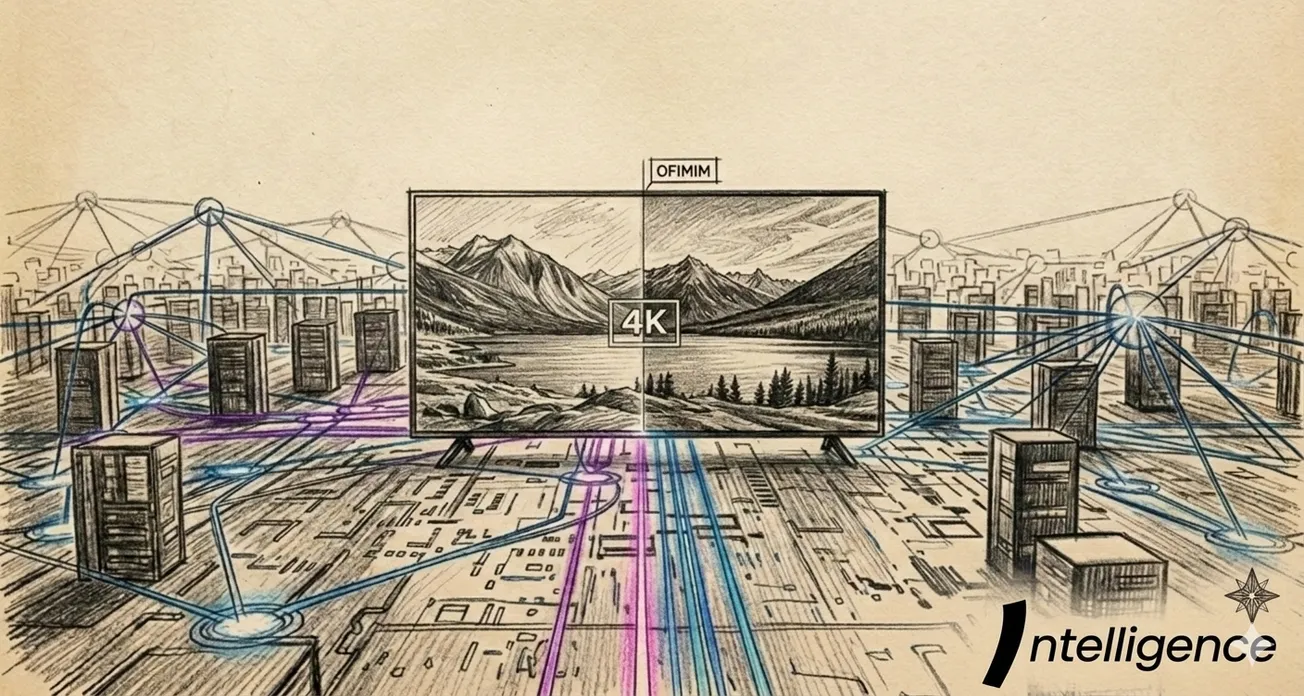
At the forefront of this shift is the Bittensor protocol, a decentralized, peer-to-peer system that commoditizes machine intelligence through a sophisticated interplay of blockchain technology and incentive-driven competition.1 For the institutional investor, Bittensor represents more than a technological innovation; it is a novel economic architecture that leverages the principles of market economics, biological self-organization, and industrial scaling to create a global marketplace for intelligence.3
By abstracting the complexities of neural network training and inference into a set of programmable incentives, Bittensor transforms the traditionally opaque and centralized AI development cycle into a transparent, balancing mechanism for supply and demand.3
The following analysis explores the Bittensor ecosystem through a series of structural analogies, mapping its components to established paradigms in traditional business, infrastructure, and natural systems. Through these lenses, any investor can discern the underlying value drivers, competitive moats, and scaling laws that define the TAO token not merely as a currency, but as the base-layer commodity of the nascent decentralized AI economy.6
The Organizational Archetype: The Global Franchise and the Operating Manual
A foundational framework for understanding the relationship between the Bittensor protocol and its various subnets is the "Franchise Model."7
In a traditional commercial franchise, a central entity (the franchisor) provides a rigorous set of Standard Operating Procedures (SOPs) or an "Operating Manual" to independent operators (franchisees). These operators invest their own capital and labor to execute the manual in exchange for a share of the resulting revenue. Within the Bittensor ecosystem, the "Subnet Owner" acts as the franchisor, while the "Miners" and "Validators" serve as the independent operators.1
The Incentive Mechanism as a Programmable SOP
The "Operating Manual" in the Bittensor context is the Incentive Mechanism, a codebase that defines the specific task to be performed and the criteria by which it will be judged.7 Unlike traditional corporate manuals, which are enforced through hierarchical oversight, the Bittensor mechanism is enforced through game-theoretic consensus.3 This mechanism coordinates the behavior of thousands of geographically dispersed participants without requiring central command.7
The investment implication of this model is the radical reduction of management overhead. In a traditional AI firm, thousands of managers are required to coordinate researchers and engineers; in Bittensor, the "Incentive Mechanism" performs this coordination automatically.3
The protocol functions as a "gravitational force for excellence," where profit-driven researchers are naturally drawn to the subnets where their models can earn the highest rewards, effectively bridging the gap between academia and industry.
The Lifecycle of the Intelligent Unit
The Bittensor protocol enforces a high degree of competitive discipline through the "deregistration" process, a mechanism analogous to a franchise closing underperforming locations.2 Currently, the network is limited to a set number of active subnets (growing toward 1,024).13 When a new subnet registers, it must pay a fee in TAO, and the lowest-performing subnet, as determined by the market's allocation of emissions, is removed.13 This "Hunger Games" style of competition ensures that the network's collective resources are always allocated to the most productive and in-demand AI services.16
The Capital Market Archetype: Bittensor as a High-Throughput Incubator
In early 2025, Grayscale Research characterized Bittensor as the "Y-Combinator of Decentralized AI development."7 In this framework, the subnets are treated as early-stage AI startups, and the TAO token acts as the sovereign funding mechanism for the entire cohort.7
The Startup Accelerator Dynamics
Y-Combinator provides startups with a small amount of capital and a massive network of mentors and peers in exchange for equity. Bittensor provides subnets with a recurring stream of capital (daily TAO emissions) and a massive pool of decentralized labor (miners).7 The "Dynamic TAO" (dTAO) upgrade transformed this incubator into a liquid capital market, where subnets are directly investible for the first time.7
Survival of the Most Efficient
The deregistration of subnets serves as the incubator's "demo day" or "exit event" in reverse.2 If a subnet cannot attract enough TAO holders to stake into it, meaning the market does not value its output, it loses its "emissions budget" and is eventually removed from the chain.2 This ensures that the protocol does not "waste" TAO on projects that have no real-world utility.3
The Root Network (SN0) even allows validators to "recycle" emissions if they believe none of the current subnets are worth funding, saving that "monetary energy" for future innovation.3
The Corporate Operating Model: Cost Centers, Payroll, and the Burn Dial
To the professional institutional investor, the "Corporate Subnet" archetype provides the most compelling link to traditional business operations.20 A corporate subnet is essentially a corporate department (e.g., R&D, data processing) that has been moved on-chain to leverage the protocol's subsidy and the world's decentralized compute market.20
Alpha as Payroll Economics
This concept redefines how we view the specific tokens for each subnet. Instead of seeing them as "stock," it is more accurate to view them as a corporate payroll budget.20
- The Wage Market: The company (subnet owner) consumes the output of the miners as an input to their business. The emissions flowing to miners are the "wages" paid for their work.
- The Protocol Subsidy: Because the protocol injects a portion of daily TAO emissions into the subnet's liquidity pool, the protocol effectively discounts the company's cost of acquiring supply.20 The protocol pays a portion of the "wages," allowing the company to scale supply more cheaply than hiring a traditional in-house team.
- The "Burn Dial": Operators use a "burn" mechanism (0–100%) that acts like shift scheduling.20 If the company needs less work done, they "burn" more of the emissions, effectively reducing the wage budget without having to dump the token's price or lay off staff in the traditional sense.20
The Scaling Archetype: Reed’s Law and the "Network of Networks"
The ultimate investment bull case for TAO rests on the difference between Metcalfe's Law and Reed's Law.4 Metcalfe’s Law, which explains the growth of Bitcoin, states that a network's value is proportional to the square of its users (n^2). Reed’s Law, however, argues that networks that allow for "group formation" grow exponentially faster because the number of possible sub-groups is (2 ^n)
Exponential Interconnectivity
Bittensor is a "network of networks."27 Each subnet is its own micro-economy coordinating miners, validators, and customers. As these subnets begin to "network with each other," the total utility of the system scales exponentially.27 This is the "network effect snowball" in motion.
In a centralized AI environment, the "group formation" is limited by the corporate hierarchy. In Bittensor, any team can form a group (a subnet) to solve a niche problem, and that group can immediately tap into the liquidity and security of the entire network. As the number of subnets grows toward 1,024, the "interconnectivity" value could theoretically push TAO toward a trillion-dollar market cap, mirroring the trajectory of base-layer infrastructure in previous technological revolutions.
The Commodity Archetype: Proof of Intelligence and the Rare Earth Analogy
From a fundamental resource perspective, Bittensor redefines "mining." In traditional sectors like oil or rare earth minerals, value is extracted through physical labor and energy to refine raw "ore" into a useful "product".17 Bittensor applies this industrial logic to data and models.1
Mining the Ore of Data
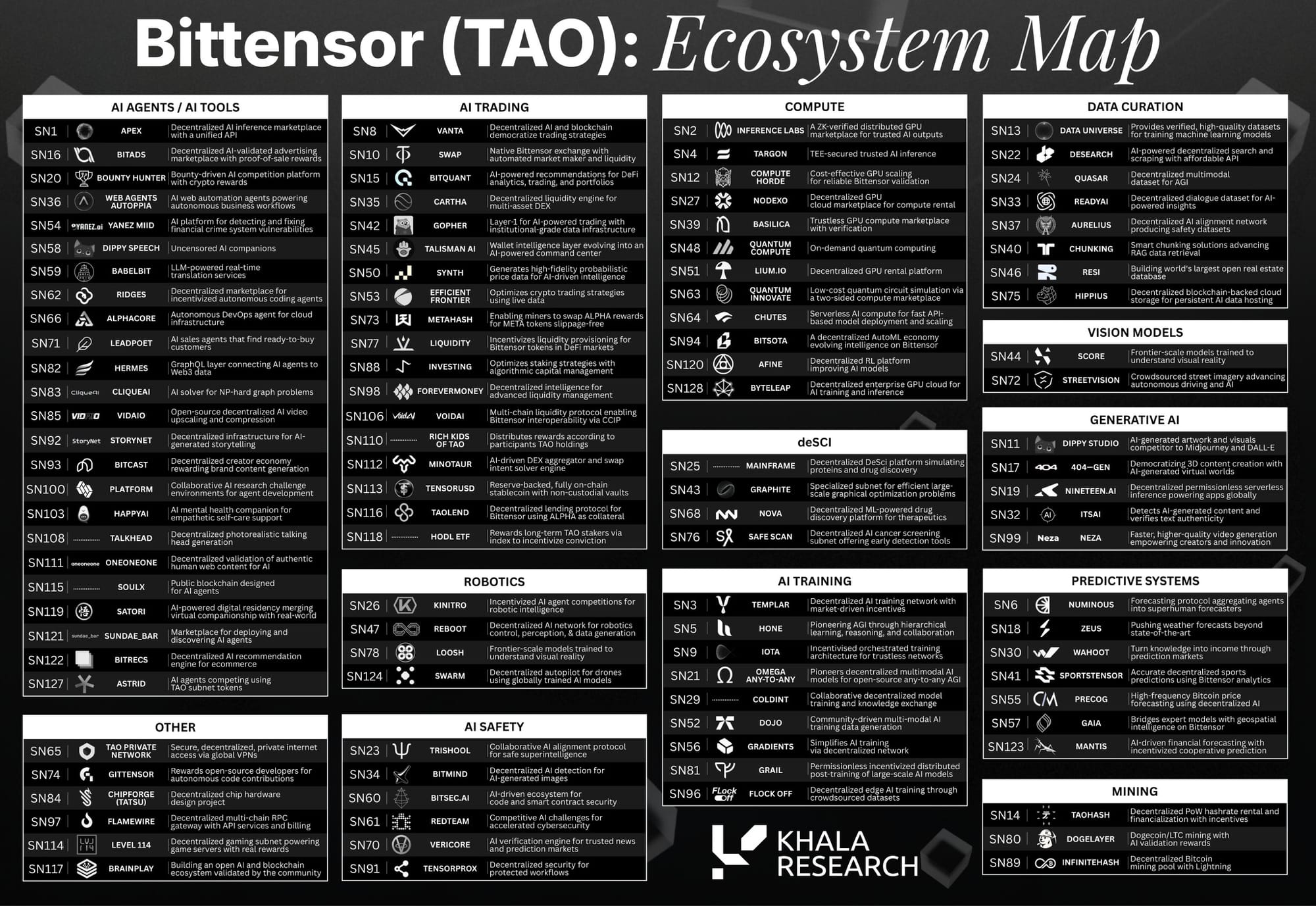
Subnets like "Data Universe" (SN13) act as the "exploration and extraction" phase of the AI industry.29 They scrape and structure billions of data points, the "raw ore" of the digital age.29
Other subnets then "refine" this data into "intelligence" through training and inference. Unlike Bitcoin mining, which is "wasteful" in that the hashes produced have no utility outside of network security, Bittensor "Mining" is productive.
The computational power is directed toward solving real-world problems like protein folding, drug discovery, or price prediction. This "Proof of Intelligence" drops energy consumption by over 95% compared to Bitcoin while producing a digital commodity (intelligence) that has immediate market value.
The CapEx to OpEx Pivot
For an investor looking at the "mining" companies within the Bittensor ecosystem, there is a fundamental shift from Capital Expenditure (CapEx) to Operating Expenditure (OpEx).
In traditional Bitcoin mining, the barrier to entry is massive, with an expensive hardware investment (ASICs). In Bittensor, because participants can lease high-end GPUs (NVIDIA H200/B200) on an hourly basis, the "mining" becomes an asset-light business. This allows teams to pivot between subnets in response to shifting incentives, much as a hedge fund reallocates capital across asset classes.
The Treasury Archetype: Bittensor as a "Digital Berkshire Hathaway"
As the network matures, a new corporate archetype has emerged: the Digital Asset Treasury Company.30 These are traditional publicly traded companies that have pivoted their entire strategy to focus on acquiring and staking TAO.30
The Berkshire of AI Crypto
Investors often use a "Berkshire Hathaway" analogy to describe entities like TAO Synergies Inc. (TWAV) or xTAO. These companies aim to be "crypto treasury" plays where every holder of their stock is effectively a shareholder in a diversified portfolio of Bittensor-based assets. By staking TAO for revenue generation and capital appreciation, these companies provide a "traditional security wrapper" for TAO.5
The Central Bank of Intelligence
Finally, one can view the Bittensor protocol itself as a Decentralized Central Bank for AI.18 It issues the "currency" (TAO), sets the "interest rate" (the emission rate), and uses its "monetary policy" (incentive mechanisms) to stimulate growth in specific sectors of the AI economy.17
Because TAO has no central owner-issuer and is "inflation-proof" due to its hard cap, it is viewed as a "neutral platform" for AI development, immune to the corporate capture seen in centralized models.
Technical and Economic Foundation: A Final Overview
While the focus is on analogies, the economic logic rests on the "Subtensor" blockchain, a public Layer 1 built with the Substrate framework.
- The Yuma Consensus: This aggregates rankings from validators to determine the distribution of daily TAO "emissions" (approx. 7,200 TAO/day, halving to 3,600 post-December 2025).2
 Bart Hillerich
The Dynamic TAO Pricing: Under the dTAO upgrade, the price of a subnet's Alpha token is determined by the ratio of TAO to Alpha in its liquidity pool.1

This allows TAO holders to "vote" on a subnet's value by staking into it, which in turn increases the subnet's share of global TAO emissions.7
Investment Perspective and Conclusion
The convergence of AI and blockchain within the Bittensor protocol creates a unique set of risks and opportunities for the institutional investor. By viewing Bittensor as a franchise, an incubator, and an operations cost center, we can synthesize a complete understanding of its potential.
The "bull case" is that Bittensor succeeds where centralized AI fails by creating a "permissionless, global base layer for intelligence." As demand for AI grows toward a multi-trillion dollar market, TAO's capped supply and "network of networks" effect (Reed's Law) position it as a primary beneficiary of the "AI Super-cycle."17
Ultimately, Bittensor represents the "Industrialization of Information."3 It stands out as a recursive, self-improving machine that could define the next phase of global human productivity.
Works cited
- Inside Bittensor: How Decentralised Machine Learning Is Redefining AI Collaboration, accessed February 1, 2026, https://www.systango.com/blog/inside-bittensor-how-decentralised-machine-learning-is-redefining-ai-collaboration
- Bittensor (TAO) : A comprehensive presentation of a protocol combining AI and blockchain | OAK Research, accessed February 1, 2026, https://oakresearch.io/en/reports/protocols/bittensor-tao-presentation-protocol-combining-ai-blockchain
- The Bittensor standard, accessed February 1, 2026, https://bittensor.com/content/the-bittensor-standard
- Bittensor Subnets Are Quietly Entering Their “Reed's Law Moment ..., accessed February 1, 2026, https://www.reddit.com/r/bittensor_/comments/1qi7c9x/bittensor_subnets_are_quietly_entering_their/
- Bittensor Gains After Regulated Trust Launch - MEXC Blog, accessed February 1, 2026, https://blog.mexc.com/news/bittensor-gains-after-regulated-trust-launch/
- Bittensor on the Eve of the First Halving | Grayscale, accessed February 1, 2026, https://research.grayscale.com/reports/bittensor-on-the-eve-of-the-first-halving-research
- Understanding Incentive Mechanisms | Bittensor, accessed February 1, 2026, https://docs.learnbittensor.org/learn/anatomy-of-incentive-mechanism
- From Top to Bottom: A Subnet Emissions Analysis | by Mentat Minds | Medium, accessed February 1, 2026, https://medium.com/@mentatminds/from-top-to-bottom-what-tao-emissions-reveal-about-subnets-dynamics-446ff606de1e
- The Rise of Data Center REITs: What Investors and Operators Should Know, accessed February 1, 2026, https://www.datacenters.com/news/the-rise-of-data-center-reits-what-investors-and-operators-should-know
- Bittensor subnets: The best opportunities for investing in TAO | OAK Research, accessed February 1, 2026, https://oakresearch.io/en/analyses/innovations/bittensor-subnets-best-opportunities-investing-tao
- TaoWeave (TWAV) | Trefis, accessed February 1, 2026, https://www.trefis.com/data/companies/TWAV
- Why Bittensor price is falling by 7.77% today | ET Markets - The Economic Times, accessed February 1, 2026, https://economictimes.indiatimes.com/markets/cryptocurrency/bittensor-price/cryptodetail/symbol-tao.cms
- Taτsu price today, TATSU to USD live price, marketcap and chart | CoinMarketCap, accessed February 1, 2026, https://coinmarketcap.com/currencies/tatsu/
- Subnet 13 Data Universe | Macrocosmos Developer Guide, accessed February 1, 2026, https://docs.macrocosmos.ai/subnets/subnet-13-data-universe
- Swap, Convert Binance Goat (币安山羊) to would (WOULD) | Coinbase, accessed February 1, 2026, https://www.coinbase.com/converter/%E5%B8%81%E5%AE%89%E5%B1%B1%E7%BE%8A/would
- Crypto Analyst Explains Why Bittensor (TAO) Could | CaptainAltcoin on Gate Square, accessed February 1, 2026, https://www.gate.com/news/detail/14987239
- Bittensor - Staking, Scarcity and Scale: TAO's Path to a Reference Asset for Decentralised AI, accessed February 1, 2026, https://www.jellyc.io/insights/bittsensorbluebottledigitalinfrastructurefund
- www.sec.gov, accessed February 1, 2026, https://www.sec.gov/Archives/edgar/data/1571934/000110465925110353/tm2530709d1_s3.htm
- Data Centers Part 2: Public Market's Two Models | by Parth Chhaparwal - Medium, accessed February 1, 2026, https://medium.com/@pdchhaparwal/data-centers-part-2-public-markets-two-models-22c7b9be5e1a
- How to Profit from the Best Data Center REITs in 2026 - Intellectia AI, accessed February 1, 2026, https://intellectia.ai/blog/best-data-center-reits
- Running a High-Performance Bittensor Validator or Miner? Here's ..., accessed February 1, 2026, https://ionstream.ai/running-a-high-performance-bittensor-validator-or-miner-heres-the-infrastructure-checklist/
- Anyone still bullish on Bittensor? If yes, then why? : r/bittensor_ - Reddit, accessed February 1, 2026, https://www.reddit.com/r/bittensor_/comments/1pw4hjw/anyone_still_bullish_on_bittensor_if_yes_then_why/
- Bittensor Corporate Subnets: A Second Subnet Archetype — and Why Alpha Is Payroll, Not Ownership | by Igor A | Jan, 2026 | Medium, accessed February 1, 2026, https://medium.com/@igoraxz/corporate-subnets-a-second-subnet-archetype-and-why-alpha-is-payroll-not-ownership-5b4de77f306d
- Incentivizing Intelligence: The Bittensor Approach - GitHub Pages, accessed February 1, 2026, https://ai-secure.github.io/DMLW2022/assets/papers/6.pdf
- Crypto Analyst Explains Why Bittensor (TAO) Could Become a Trillion-Dollar Asset | CaptainAltcoin on Binance Square, accessed February 1, 2026, https://www.binance.com/en/square/post/31174139341994
- Allora Network: A Comprehensive Analysis of a Self-Improving Decentralized AI Protocol, accessed February 1, 2026, https://medium.com/@gwrx2005/allora-network-a-comprehensive-analysis-of-a-self-improving-decentralized-ai-protocol-5047e9fc7c00
- Why is Bittensor more lucrative than Mining? Understand the revolution of AI Mining in one article. | ZKProofster on Gate Square, accessed February 1, 2026, https://www.gate.com/post/status/16184171
- Page 2, accessed February 1, 2026, https://www.branduk.net/page/2/
- Is GPU Mining Still Profitable? - EZ Blockchain, accessed February 1, 2026, https://ezblockchain.net/article/is-gpu-mining-still-profitable/
- The Miner's Dilemma: Choosing Between Bitcoin and AI for Computing Power | ForkLog, accessed February 1, 2026, https://forklog.com/en/bitcoin-or-ai-which-way-will-miners-turn/
Disclaimer:
This article is for informational purposes only and does not constitute financial, investment, or trading advice. The information provided should not be interpreted as an endorsement of any digital asset, security, or investment strategy. Readers should conduct their own research and consult with a licensed financial professional before making any investment decisions. The publisher and its contributors are not responsible for any losses that may arise from reliance on the information presented.