Table of Contents
UR, the decentralized privacy network, has launched on Bittensor Subnet 25 mainnet and is transitioning its existing network of more than 100,000 providers into Bittensor miners. Its validator is active, setting weights and verifying traffic, and participation is now permissionless for miners and validators.
Alongside the launch, UR introduced a Network Capacity Reserve to pay for connectivity before customer traffic generates enough demand to sustain it. The reserve retains part of the subnet’s miner emissions and is intended to fund specific capacity commitments, with payments tied to verified delivery.
How UR Connects Operators and Miners
UR separates customer-facing services from the infrastructure supplying their connections. Network operators, including ur.io, develop products and bring customers; providers contribute connections and routing capacity; and SN25 coordinates incentives and verifies the underlying supply and usage.
That structure allows multiple operators to use shared connectivity instead of each assembling its own provider network. Operators buy and permanently lock the SN25 token to continue accessing the network, linking their access requirements to demand for the subnet’s services.
Funding Supply Before Traffic Arrives
UR has set miner burn to 0%, routing miner emissions to active providers and the reserve. Its treasury policy sets the launch provider share at 10% of the native miner allocation, with 90% retained by the reserve. In epochs without provider weight, the entire allocation goes to the reserve. Changing the provider share requires a newly signed treasury policy and approval.
The Network Capacity Reserve addresses a practical sequencing problem: operators want reliable connectivity in place before launching, while providers need incentives to maintain that supply before traffic arrives. UR plans to use retained emissions to commission capacity for new operators, improve underserved coverage, respond to usage spikes, and keep useful connections available between demand peaks.
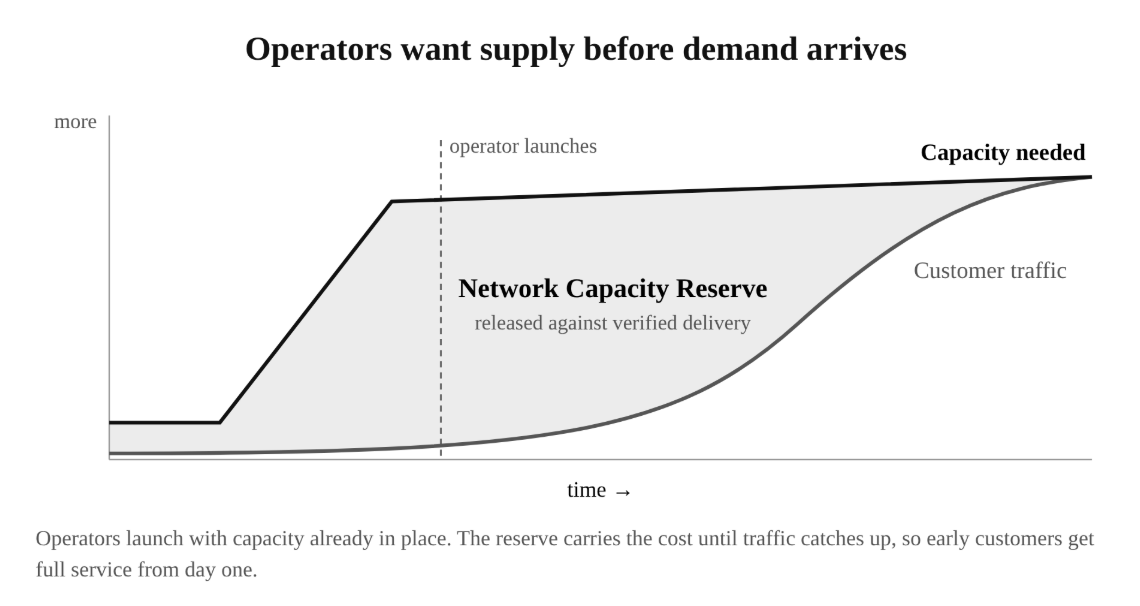
Payments would depend on defined service commitments; one proposed program would pay providers for working routes and sustained service ahead of an operator’s expansion, while another would offer time-limited incentives to keep connections online, conditional on successful random verification.
Some programs require additional measurement. UR’s current fleet mechanism measures routable network-prefix breadth, the range of network address blocks reachable through providers, while geographic rewards would need location verification. Payments specifically tied to throughput or delivered traffic would also require stronger verification than the current routing checks.
Reserve Custody and Public Reporting
The reserve is held in a dedicated multisig, separate from owner emissions, and UR says it will not fund team or operating costs. Its published address is associated with SN25 UIDs 170 and 250. It is a two-of-three multisig, meaning two of its three signers must authorize a transaction.
For each incentive program, UR has committed to publishing objectives, eligibility, measurement criteria, and duration. It plans to account for existing baseline rewards, verify delivery, publish reward calculations, approve payments through the multisig, and disclose every outgoing transfer. Unused funds would remain available for future operator and network needs.
UR is also launching a dashboard showing reserve balances and published allocations, with commitments and payments to be reported as programs become active.