


Table of Contents
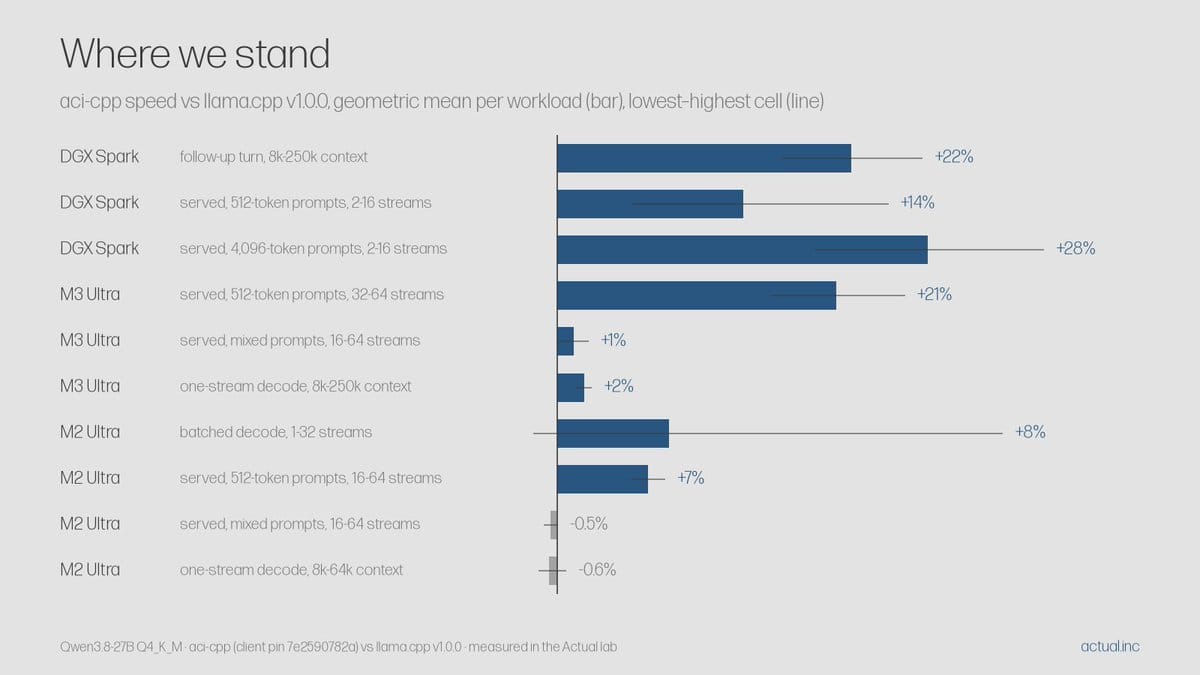
Actual has updated aci-cpp, the local AI inference engine inside its client, reporting performance ahead of llama.cpp v1.0.0 on eight of 10 tested workloads, with gains of up to 28% and results within 1% on the remaining two. The improvements cover follow-up responses in long conversations, concurrent requests, and prompt processing on NVIDIA and Apple hardware.
The client now ships aci-cpp build 7e2590782a, a fork of llama.cpp used on Macs, NVIDIA DGX Spark systems, and consumer NVIDIA cards. Actual shared the benchmark results after merging 60 performance changes since opening its platform to users.
The headline comparison comes from Actual's own lab tests using Qwen3.8-27B at Q4\_K\_M quantization, alternating builds on the same machine. Quantization stores model weights at reduced precision to lower their memory requirements. Individual charts specify the conditions for each workload, and the eight-of-10 result summarizes performance across the tested platforms and workloads rather than a single universal speed increase.
Faster Responses With Long Conversations in Memory
A follow-up request presents a different workload from starting a conversation. Much of the preceding exchange is already cached, but the engine still has to process new input and produce a response while retaining access to that history. For an agent repeatedly calling tools or a user working through a long chat, the delay before the next response is a recurring part of the experience.
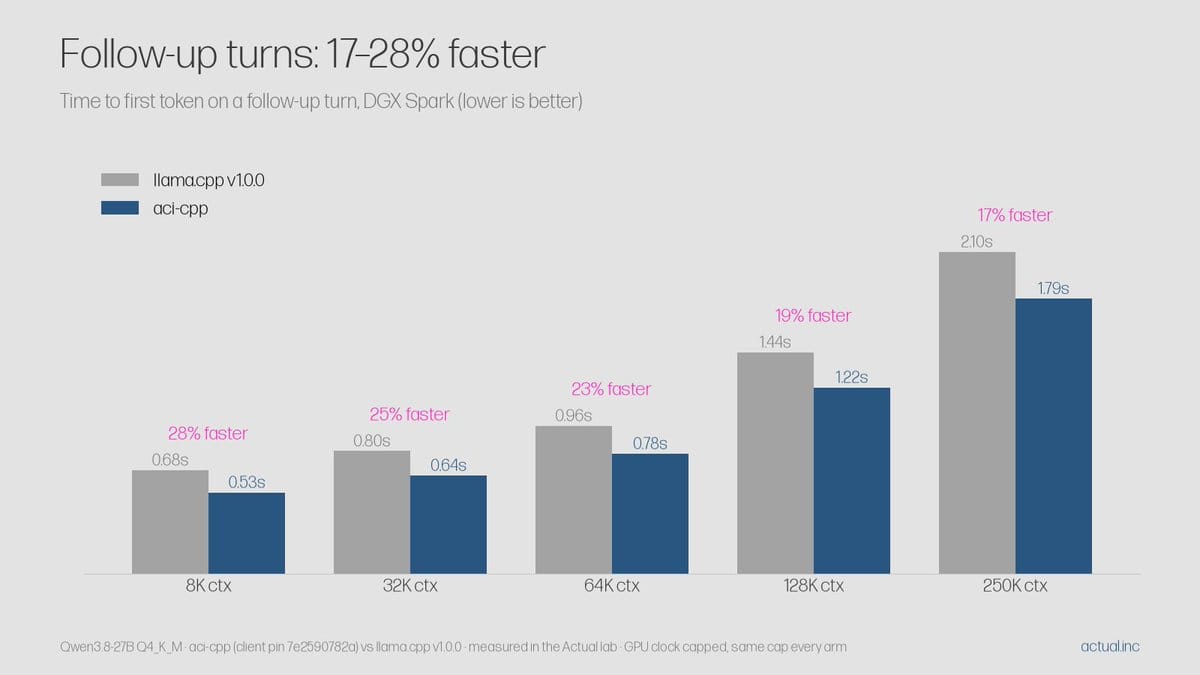
On DGX Spark, Actual reports follow-up responses 17% to 28% faster than llama.cpp v1.0.0 across context lengths from 8,000 to 250,000 tokens. At 64,000 tokens, time to first token fell to 0.78 seconds from 0.97 seconds. At 250,000 tokens, it fell to 1.79 seconds from 2.10 seconds.
The improvement over Actual's previous client build was larger at the longest context, where that build took 5.2 seconds to return the first token at 250,000 tokens. This comparison measures progress within Actual's engine, separately from its lead over upstream llama.cpp.
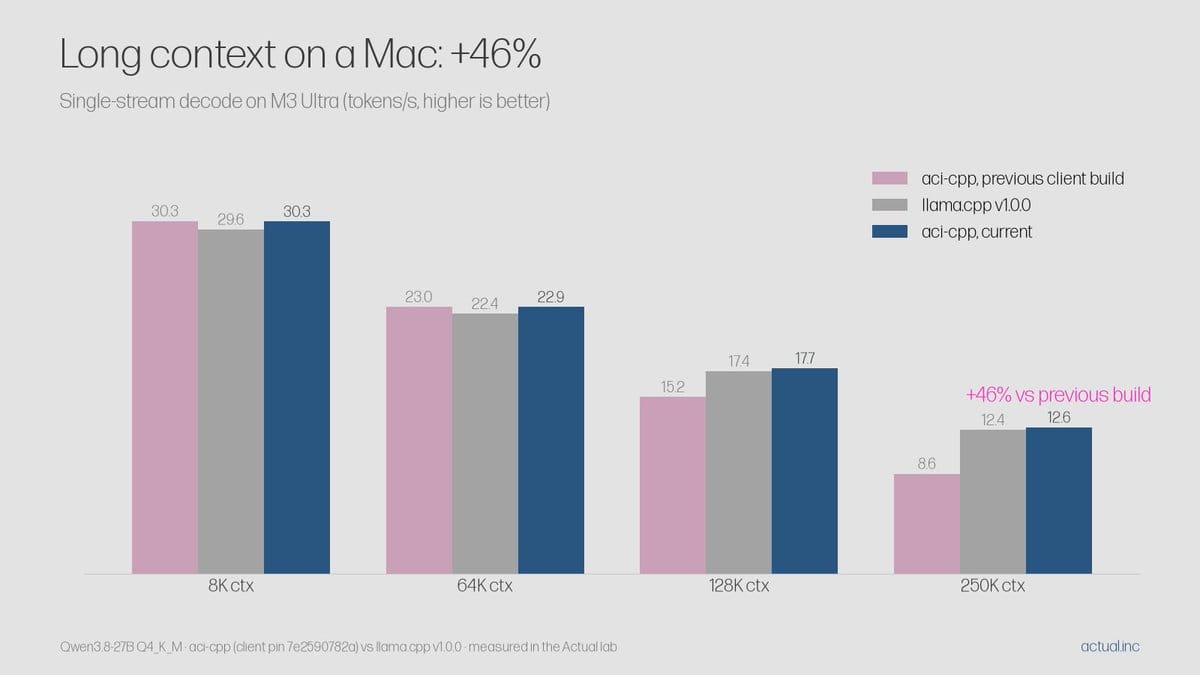
On an M3 Ultra, aci-cpp generated 12.6 tokens per second with 250,000 tokens in context, 46% faster than Actual's previous client build. It also ran slightly ahead of llama.cpp v1.0.0 at every measured context depth, from 8,000 to 250,000 tokens.
Those Mac results measure decode speed, the rate at which output tokens are generated, rather than the initial wait for a response. Both affect responsiveness, but they describe different stages of inference.
More Concurrent Streams From One Machine
Actual also tested how much output a machine could generate while serving multiple streams at once. This measures aggregate throughput, a useful metric when several users or agents share one computer, rather than the speed of a single conversation.
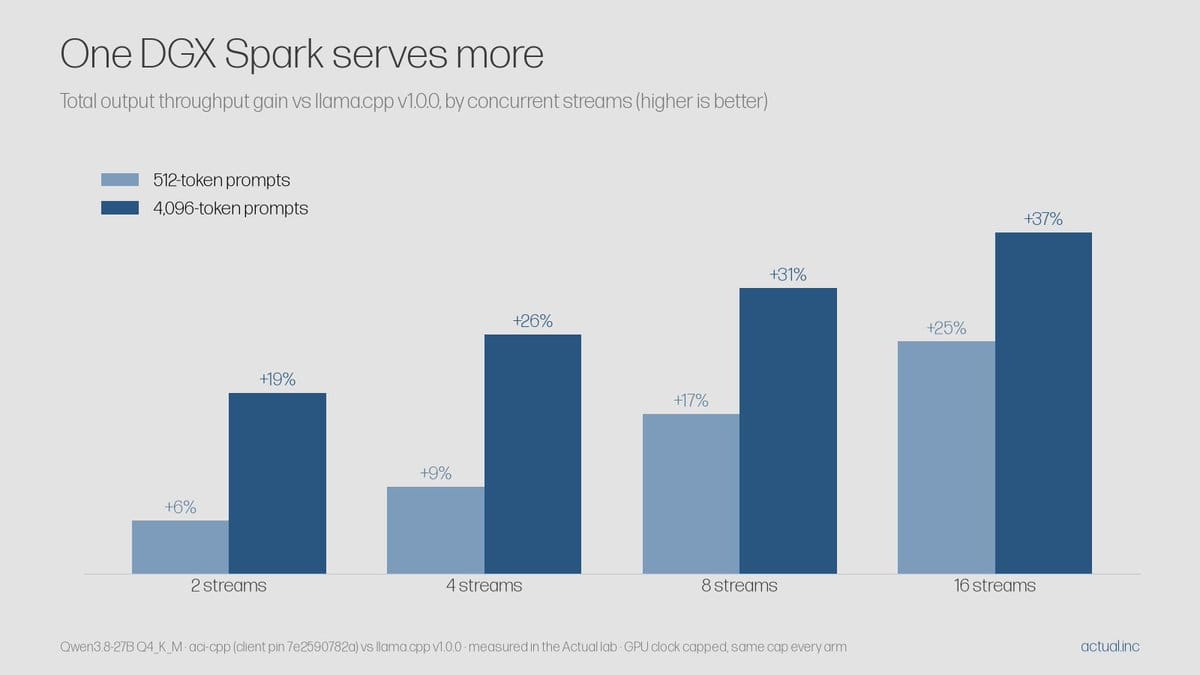
Across two to 16 concurrent streams on DGX Spark, aci-cpp delivered 6% to 25% more total throughput than llama.cpp v1.0.0 with 512-token prompts. With 4,096-token prompts, the reported advantage ranged from 19% to 37%.
The Mac serving tests showed gains as well. On M3 Ultra, throughput with 512-token prompts was 16% to 26% higher than v1.0.0. On M2 Ultra, batched decoding was up to 34% faster at 32 streams, while served throughput with 512-token prompts was 6% to 8% higher.
A separate comparison used upstream llama.cpp's latest development build, which includes its own multi-token prediction, or MTP. With speculative decoding disabled in both engines, aci-cpp led in every tested configuration. With MTP enabled in both, Actual reports a 4% to 38% advantage across the comparison grid. Those results use a different upstream baseline from the v1.0.0 release behind the headline figures.
Speculative decoding attempts to accelerate generation by drafting candidate tokens and checking them with the main model. Actual's changes include a faster MTP drafter and matrix operations designed to verify several draft tokens for roughly the cost of one. The development-build comparison tests that path against upstream's implementation, alongside the runs with speculation switched off.
Changes to Prompt Processing, Attention, and Scheduling
The update combines hardware-specific computation changes with adjustments to how the engine manages cached context and shares work between requests. Actual's principal engineer, Justin Bennington, details the changes in a technical write-up.
For NVIDIA hardware, new 8-bit integer tensor-core matrix multiplications read GGUF model weights in place. GGUF is the model-file format used by llama.cpp. On DGX Spark with 2,048-token prompts, Actual measured prompt processing 27% faster at Q4\_K\_M and about 31% faster at Q8\_0, both against its previous build. RTX Blackwell cards received the same family of kernels.
Prompt processing, also called prefill, handles the input before output generation begins. Actual also added fused, chunked gated DeltaNet kernels for Qwen3.8's linear-attention layers on CUDA and Metal, covering both prefill and decoding. These are specialized implementations of model operations for NVIDIA GPUs and Apple's graphics platform.
For long contexts, the engine now uses flash attention that skips masked blocks, per-sequence key-value blocks in shared caches, and an M3 Ultra read path designed for very long key-value spans. The key-value cache retains intermediate attention data from earlier tokens so the engine can reuse it during generation.
Serving changes include scheduling prefill across request slots using a token budget, parallel sampling, and faster prompt-cache saves. Together, these address how the engine allocates processing work and handles the state needed to continue conversations, alongside the faster model kernels.
The improvements are shipping in the Actual client through aci-cpp 7e2590782a. Actual is also building a separate flagship engine, e; the benchmarks and optimizations reported here concern its existing llama.cpp-based engine.