Table of Contents
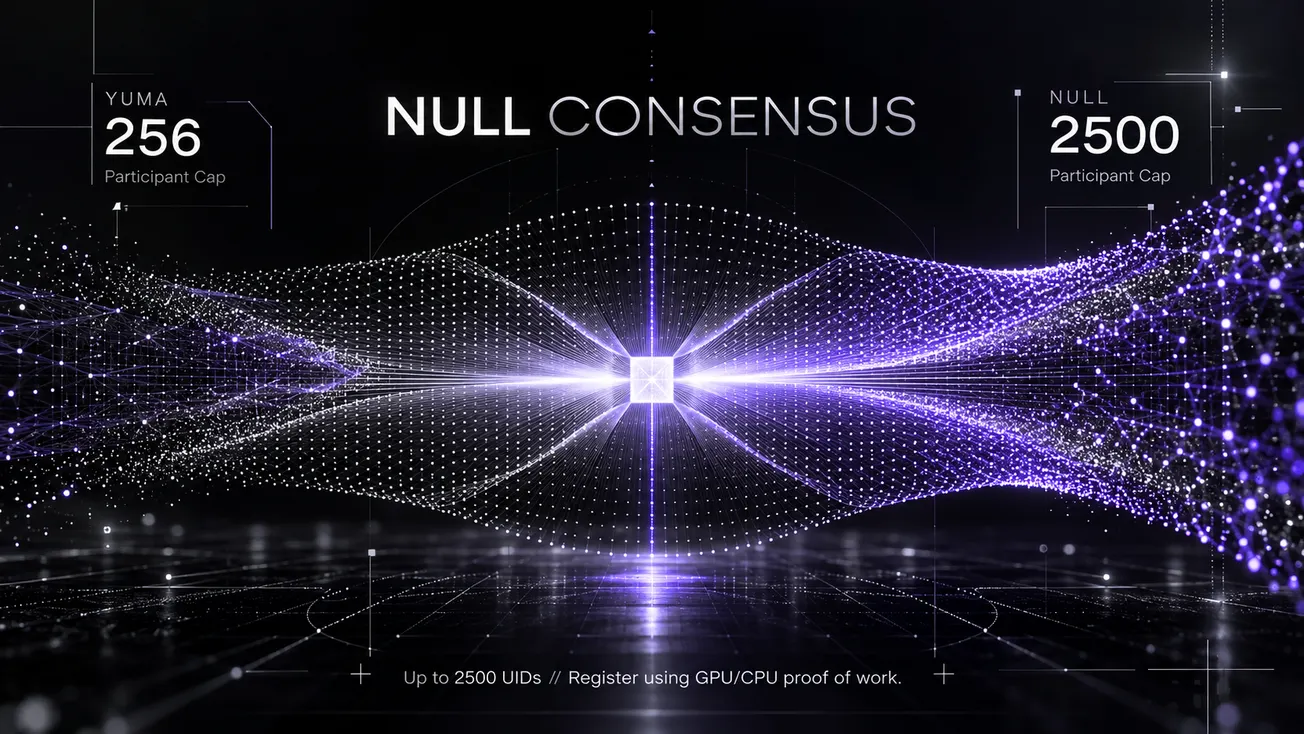
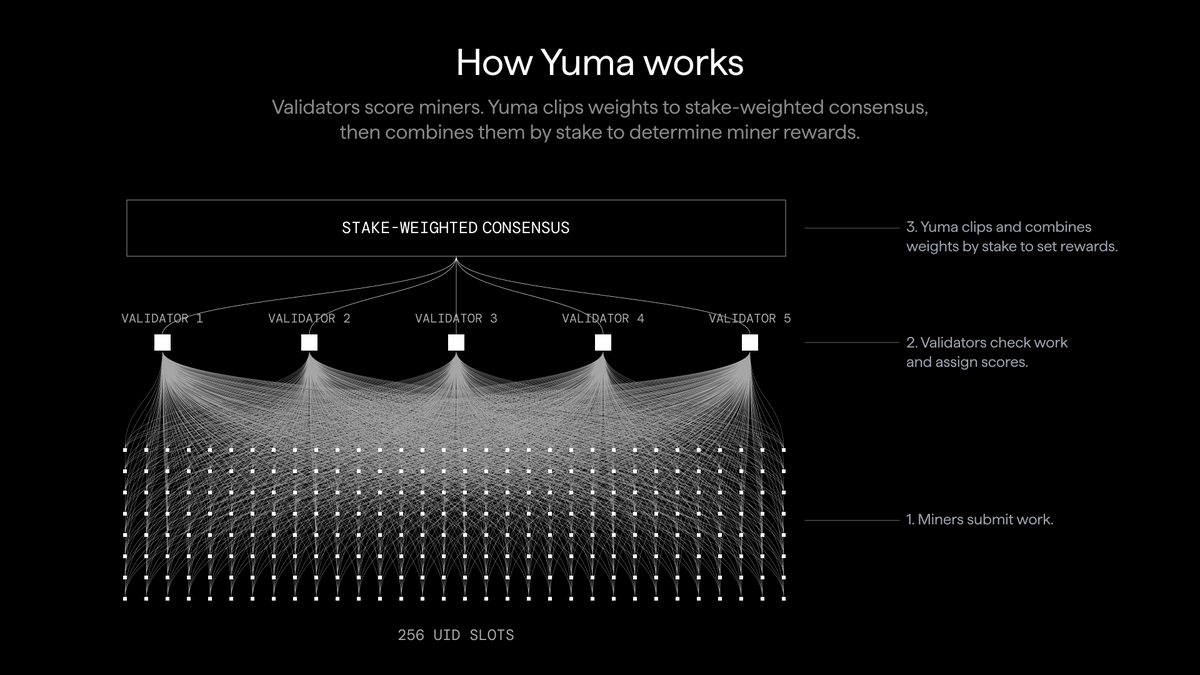
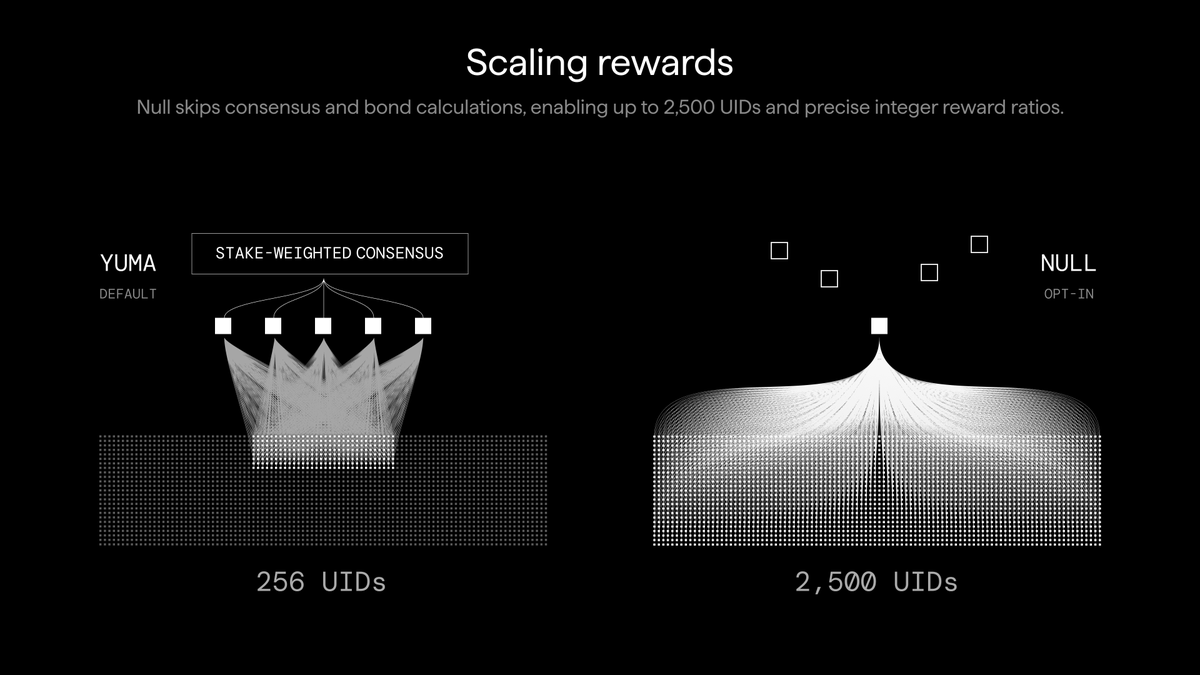
Bittensor has released Null Consensus, an optional alternative to Yuma Consensus that supports up to 2,500 registered participants per subnet. The Opentensor Foundation announced the update today, expanding the available capacity from Yuma’s 256-slot ceiling while changing how miner rewards are determined.
The release also introduces owner-enabled, fee-free proof-of-work registration, allowing participants to join eligible subnets without paying a TAO registration burn. Bittensor co-founder const described the change as a way for agents to begin mining without first acquiring TAO before adding:
“First step adding more freedom and scale to our incentive systems.”
Null Consensus and the registration changes were included in Subtensor runtime v475, published Oct. 7. Owners choose whether to use the new consensus mode; the release does not automatically expand every subnet.
How the 2,500-Slot Limit Works
The larger capacity comes with a shared budget instead of an unconditional 2,500 slots for every configuration. In Bittensor, a UID is a registered participant’s identifier within a subnet. Under the Null Consensus implementation, the maximum UID count is divided by the number of emission mechanisms, which govern reward distribution.
| Emission Mechanisms | Maximum UIDs Under Null |
|---|---|
| One | 2,500 |
| Two | 1,250 |
| Four | 625 |
For a subnet with one mechanism, the ceiling is about 9.8 times Yuma’s 256-UID limit. Owners can raise their subnet’s capacity after switching to Null, giving them more registration slots without requiring all other subnets to adopt the same configuration.
Moving back to Yuma requires reducing the registered population to fit its shared 256-UID ceiling. Null’s pruning operation removes at most 64 UIDs per transaction, so returning a fully populated subnet to Yuma can require multiple transactions. The switch also restores the saved validator limit, capped by the remaining capacity.
Null Consensus Changes Who Sets Rewards
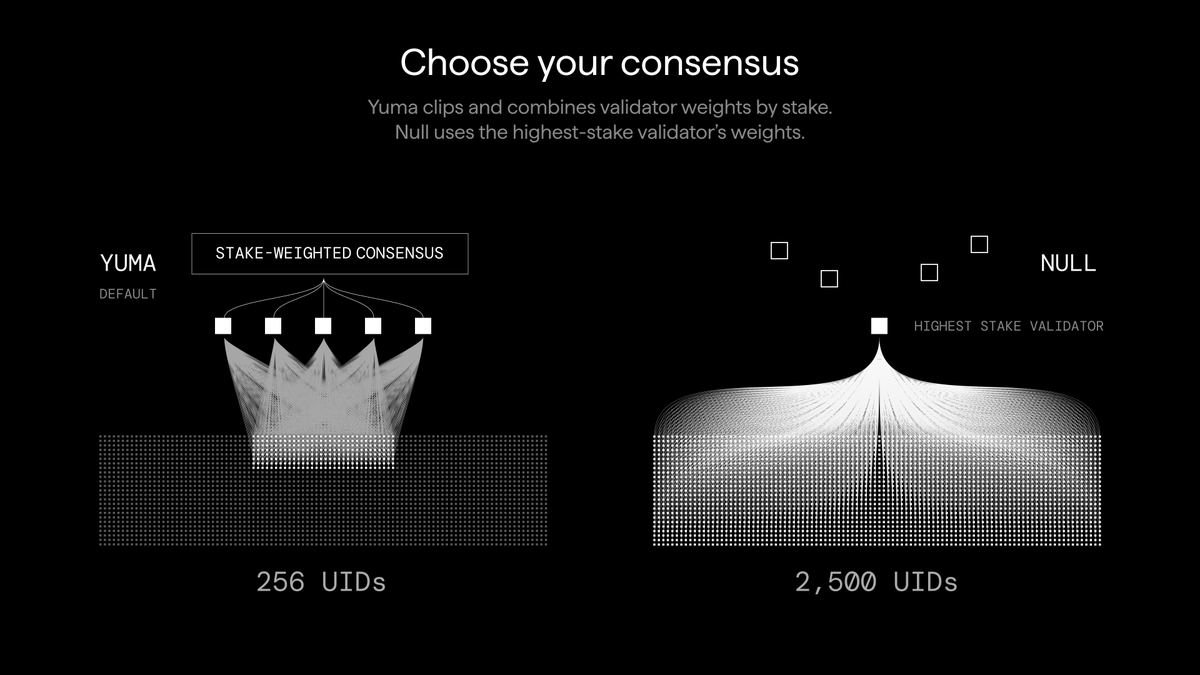
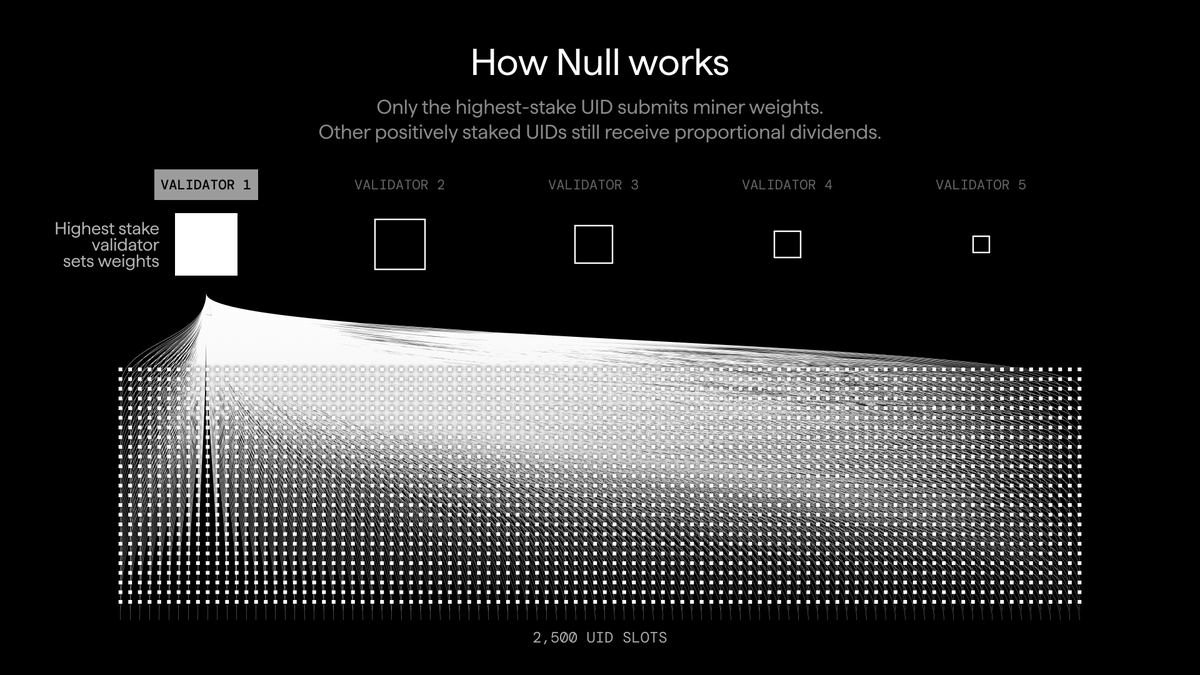
The increase in size accompanies a different reward-allocation model. Null grants exactly one validator permit to the UID with the largest unrounded stake. If stakes are tied, the first UID wins. Only that participant can submit weights or use the commit-and-reveal process for submitting them.
Weights determine how miner rewards are allocated. During each reward epoch, Null loads the selected participant’s weight row and skips consensus and bond calculations, preserving existing bond storage rather than updating it. If the selected participant has no valid weights, miner rewards are distributed across all registered UIDs.
Dividend eligibility remains broader than the single permit: all UIDs with positive stake retain proportional dividends, including inactive participants and those without a validator permit. The authority to set miner reward weights and the right to receive stake-based dividends are therefore separate.
Null concentrates reward-weight authority in the highest-staked UID while allowing a larger registered population. That UID is selected by stake, rather than automatically being the subnet owner.
Proof-of-Work Registration Removes the TAO Entry Payment
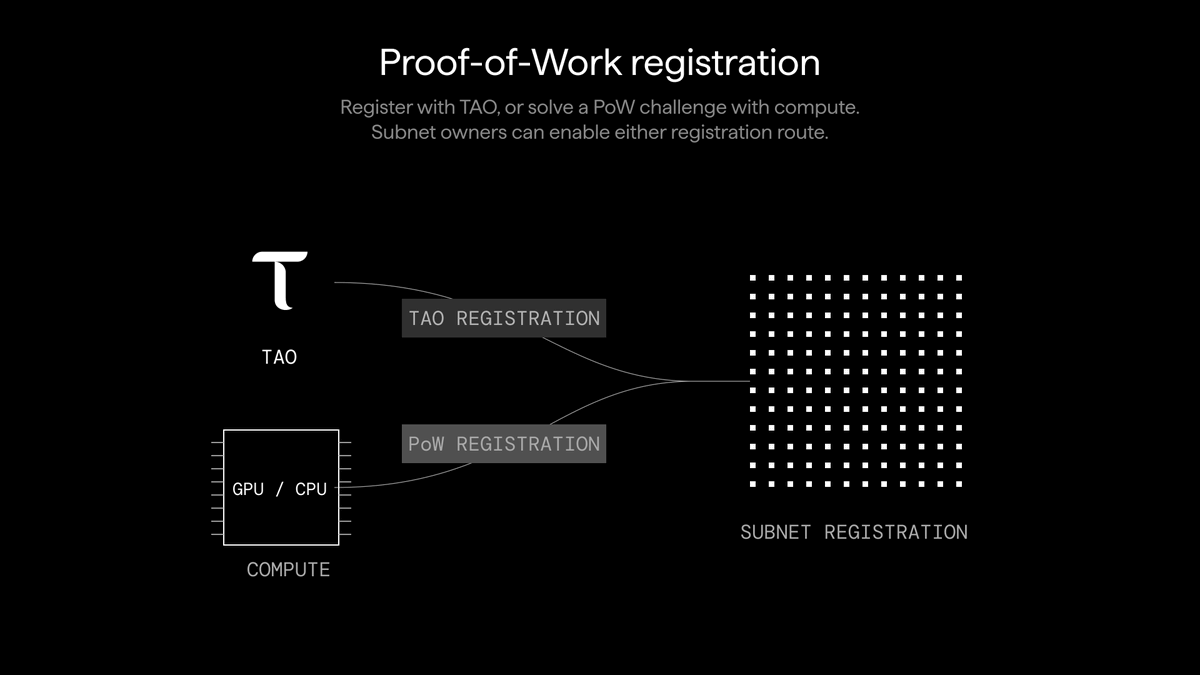
The new pow_register call provides a registration route based on computational work rather than a TAO burn. A direct call with no tip requires no TAO transaction fee, registration burn, or upfront collateral purchase. The root subnet is excluded, and new or missing PoW settings default to off; owners must enable the route where it is not already enabled.
Owners can offer burn-only registration, PoW-only registration, or both. The two routes have independent demand adjustments: PoW registrations increase PoW difficulty, while burn registrations increase the burn price. Enabling computational entry therefore does not make PoW demand directly raise the TAO price of the burn route.
The work is tied to the subnet, a recent block hash, the participant’s hotkey, the signing coldkey, and a nonce. Proofs are accepted only within a short block-age window, and transaction-pool checks validate the work, replay protections, and shared per-block registration limits before admitting fee-free calls.
Participants can use btcli subnets register --pow or the SDK. Both use a Rust-native backend, with support for OpenCL GPUs and CPU verification of every solution. CPU and GPU modes and device selection are available. The route removes the upfront TAO payment, but participants still supply the computation needed to solve the registration challenge.
Implementation Review Flagged Resource Accounting
The merged pull request records tests covering the 2,500-UID boundary, consensus-mode switching, single-validator enforcement, reward-budget conservation, and registration using unfunded keys. It also documents an accepted exception for the automated Skeptic security-review check, which remained non-passing with five unresolved resource-accounting findings.
Those findings concern whether runtime charges adequately reflect operations such as consensus switching, mechanism removal, pruning, epoch processing, and PoW replacement at the expanded subnet size. The pull request states that reference weight accounting and the deployment resource envelope remained unverified. These runtime resource weights are distinct from the reward weights used to allocate miner payouts.
The update gives subnet owners two concrete levers: more participant slots under a single weight-setting validator and an optional computational registration route without a TAO entry payment. Together, they change both who can join an eligible subnet and how its miner rewards are assigned.