
Table of Contents
Following the departure of Covenant AI from Bittensor, everyone is talking about how to best move forward as an ecosystem.
What's important to first note is that world-changing systems always level up through pain. And for blockchains that actually end up changing the world, growing pains that result in user losses seem to be an unfortunate right of passage (take Bitcoin and the Mt. Gox implosion, for example).
So, for a blockchain with as much potential as Bittensor, one could have considered it inevitable that we'd find ourselves at some form of "here" eventually.
 Bart Hillerich
Recognizing where we are today as a growing-pains moment is step one. The sky isn't falling; we just have some issues to work out. Step two is determining how we actually proceed with a stronger Bittensor, and step three is, of course, implementation.
In that regard, what we now face specifically is an opportunity to emerge from the pain with a more robust alignment between the people who build subnets and those who invest and participate in them.
In his "Response to Covenant" X Article, Bittensor co-founder Jacob Steeves ("Const") highlighted a solution, "Locked Stake," which Samuel Dare ironically worked on before departing from the Opentensor Foundation.
Before we dive into that, let's first discuss how the Covenant AI rug pull was able to happen in the first place.
What Needs Fixing
The Covenant AI rug pull was able to happen because, once someone takes ownership of a subnet, they can own a subnet indefinitely with no requirement for them to take any action moving forward. Alpha token investors have zero enforceable claim on the subnet owner's continued participation.
In a more passive case, this results in the abandoned subnets we see today. But in an active one, like with Covenant AI, a founder can work genuinely for a period to attract retail investors, and then rug pull at the opportune time.
Locked Stake is intended to fix this at the protocol level.
How Locked Stake Could Prevent Future Rugs
Currently existing as a draft proposal (BIT-0011), the foundational premise of Locked State is that subnets should be able to be taken over by a group or individual that locks a significant amount of stake for a significant period.
From a specs standpoint, the proposal states:
- "Change subnet owner based on subnet stake lock. Locks are linear with 100% being locked at the start block and 0% on the end block. Any staker can lock their stake. Approximately once per month (7200 * 30 blocks) the lock EMAs are recalculated and, if stake lock EMA is the highest for some account, it becomes the owner of the subnet.
- If stake is locked, then only unlocked portion of it can be unstaked at a given block.
- In order to prevent subnet sniping, the lock EMA is applied, which gives subnet owner enough warning to act.
- Conviction should also increase with higher lock duration (not implemented in reference impl)."
Alright, so what does all that actually mean?
Under Locked Stake, subnet ownership becomes a contest of commitment that anyone can play, allowing the community to commandeer abandoned subnets and carry out a resurrection mission if needed.
Determining who has ownership of the subnet is measured as a function of how many alpha tokens have been staked, and for how long (i.e., the time remaining before tokens can move, time + stake).
Therefore, with Locked Stake in place, subnet owners would have to explicitly and transparently demonstrate their economic commitment to the subnet. Once locked, their stake would be irrevocably committed for the selected duration, with only a small portion available to withdraw each block.
This means that everyone else could invest in subnets while knowing what kind of carrot is dangling in front of the founder/team, incentivizing them to continue working honestly. The impact here would be similar to that of how traditional equity vesting works in standalone crypto companies. But here it'd be better, as it'd be enforced at the protocol level instead of "Just trust us, bro."
Overall, Locked Stake would help ensure that only actors with a genuine, long-term commitment could control a subnet.
How To Actually Determine Who's Subnet Owner
Like in any competition, for Locked Stake to work, we need a way to keep score. "Conviction" serves that purpose, reflecting the amount and duration of the stake.
"We are tackling one of the hardest problems in crypto; how do you measure a team's commitment to what they are building - aside from incentive and ownership - in open systems? - Const
Conviction starts at "100% of the locked ALPHA amount at the moment the lock is created, then decreases linearly down to 0 by the time the lock expires."
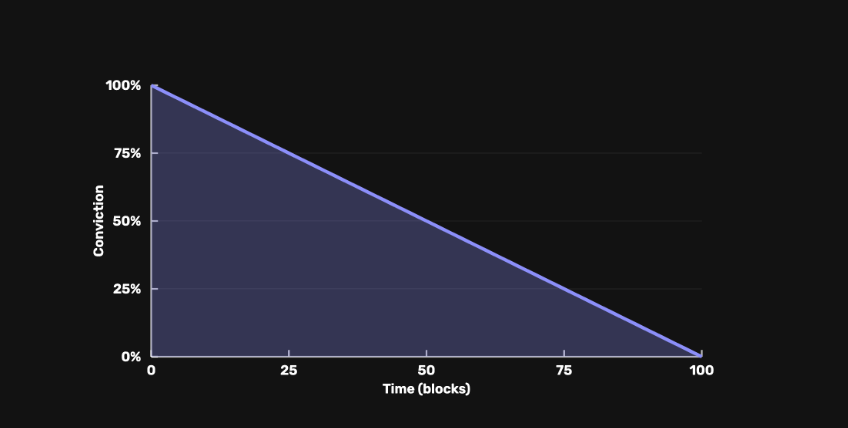
To increase conviction, one could lock additional stake or extend the duration of their currently locked stake, or both. Most importantly, changes can't be made that would lower Conviction (i.e., subnet owners can't make a decision here that would hurt subnet investors).
Conviction scores change constantly to reflect upcoming stake unlocks. An exponential moving average (EMA) is used to prevent sudden ownership changes, and is updated approximately once every 30 days.
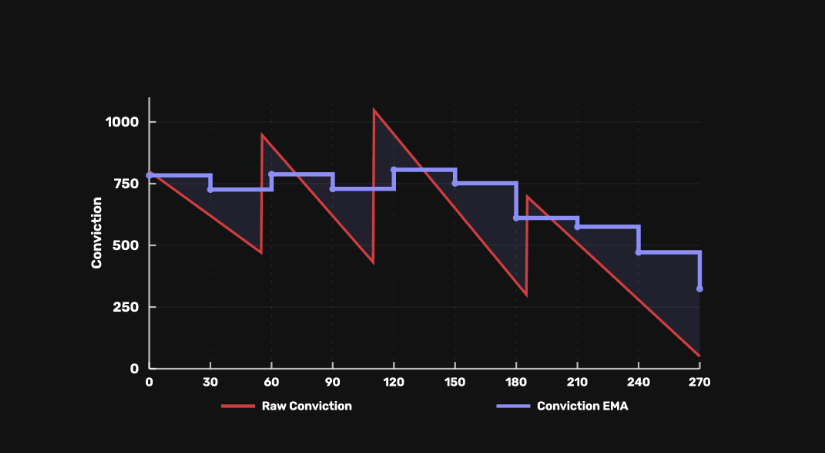
When updates to Conviction scores occur, the current Conviction and historical Conviction are blended, giving us a score that functions as a smoothed version of stakers' Conviction over time.
The 30-day update period and score smoothing give subnet owners a buffer against challengers, affording them adequate time to respond before potentially losing ownership.
Moving Forward
Every serious blockchain gets stress-tested, and the ones that endure emerge stronger than ever, having filled the exposed gap. That's where we find ourselves at Bittensor: a known hole to plug and a stronger protocol waiting for us on the other side.
If Locked Stake is passed by community vote, instead of the cost of subnet ownership being the price of admission, it would now be an ongoing stake commitment, helping foster a high-conviction ecosystem of builders for the network.
While the focus is on preventing bad actors, Locked Stake would notably also give honest subnets a new axis on which they can compete and build trust—one that has nothing to do with marketing, and everything to do with demonstrated commitment over time.
To learn more about Locked Stake, we recommend checking out Learn Bittensor's dedicated page here.
Here's to a brighter, stronger Bittensor.
Disclaimer: This article is for informational purposes only and does not constitute financial, investment, or trading advice. The information provided should not be interpreted as an endorsement of any digital asset, security, or investment strategy. Readers should conduct their own research and consult with a licensed financial professional before making any investment decisions. The publisher and its contributors are not responsible for any losses that may arise from reliance on the information presented.