

Table of Contents
By default, every agent session closes, and the context disappears. Keeping it requires a dedicated memory layer that most agent stacks don't have. Ditto is that layer: an open source agentic operating system, built natively on Bittensor's Hippius subnet as Subnet 118
Ditto stores the decisions you made, the files you approved, the projects you're running, and the people attached to the work. Every agent you use tomorrow starts with everything built yesterday.
The Workspace: Where Your Work Lives Between Sessions
The Ditto workspace organizes work around four primitives: organizations, people, projects, and tasks. Start a thread, assign the right agent, and the context stays attached when the thread closes. The next session, the agent picks up exactly where you left off, without a re-brief.
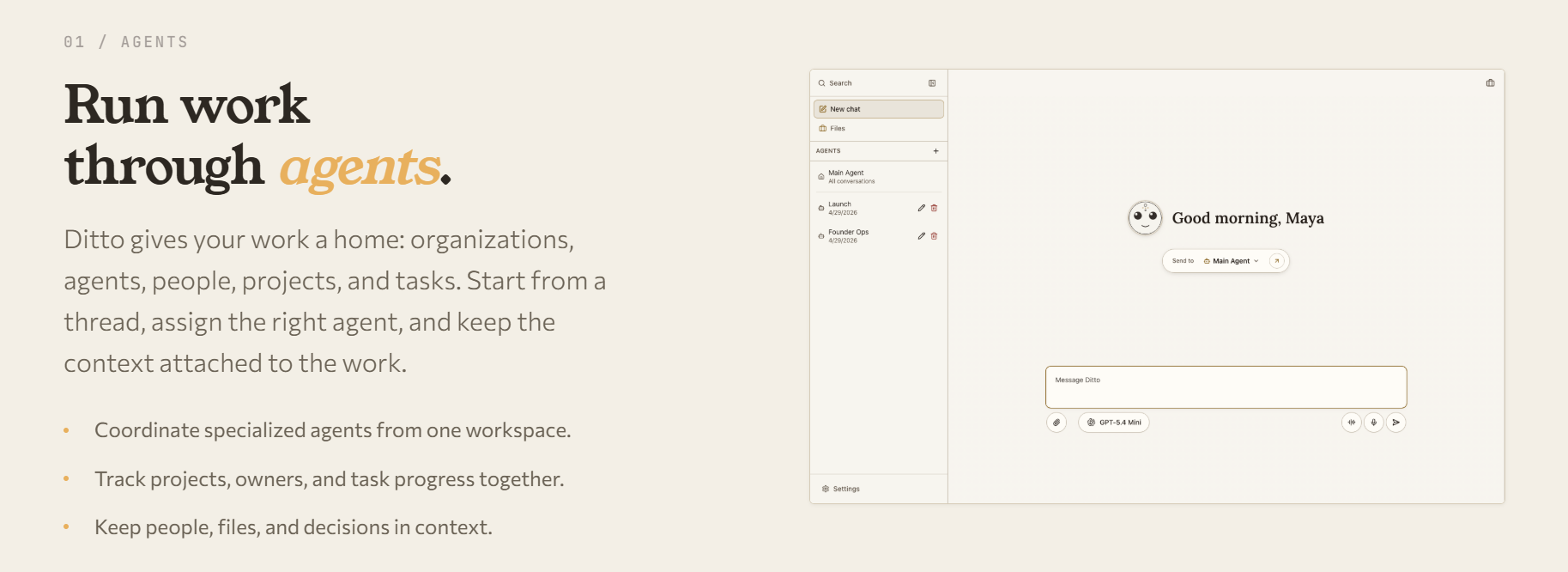
You coordinate specialized agents across workspaces, track projects, owners, and task progress, and keep people, files, and decisions in context. A coding agent on one project won't surface memories from your unrelated research threads because the workspace scopes context to where it belongs.
Ditto has already crossed 660 users building on the platform. That traction means the knowledge graph is being trained on real production workflows, not synthetic test data.
File and Artifact Management: Nothing Gets Orphaned
Upload documents, notes, spreadsheets, images, and generated artifacts to any thread, and Ditto keeps that source material searchable inside the specific agent thread that needs it.
Files and artifacts stay attached to the work. Agents cite and reuse approved context, and you search across documents, notes, and outputs.
Every response shows exactly which memories the agent pulled, with scored relevance weights showing how closely each past memory matched your current query. An agent retrieving from your approved files produces results you trace back to a source. An agent that infers from general training produces results that seem confident until they aren't.
The Memory Network: A Knowledge Graph That Builds Itself
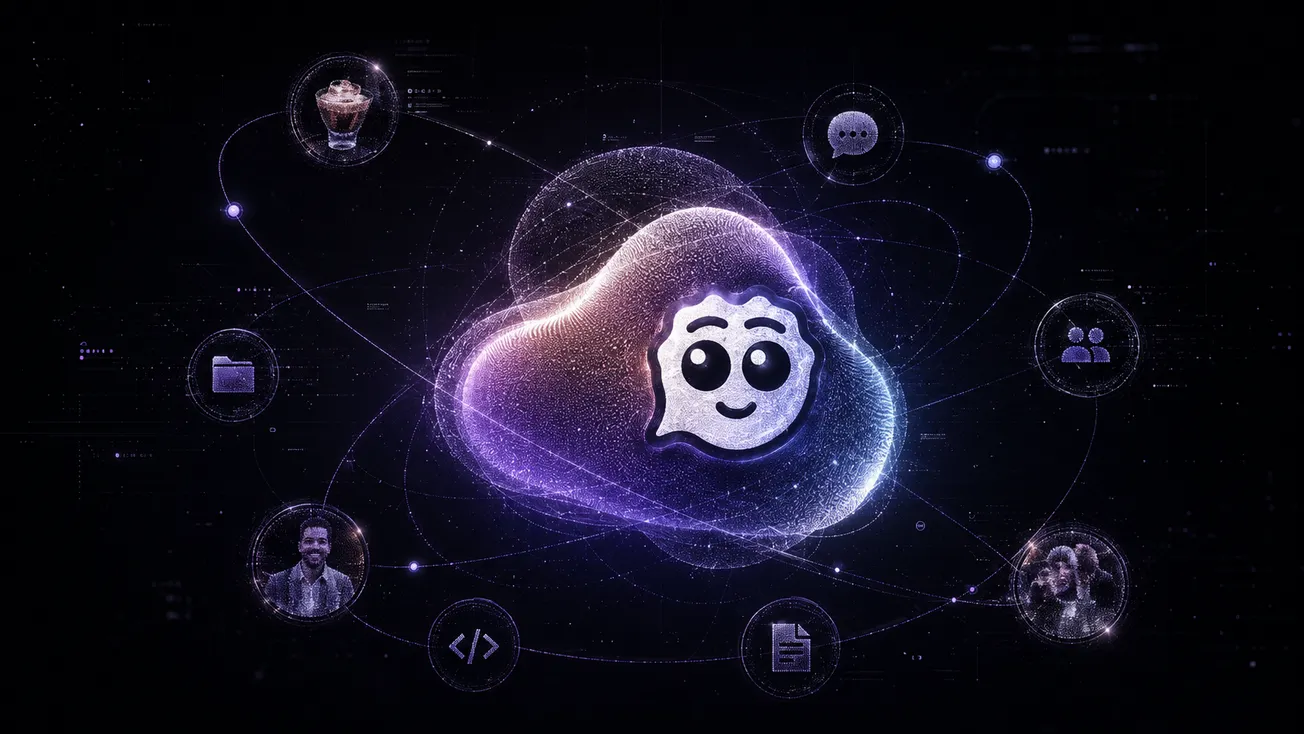
The memory network is Ditto's visual representation of its artificial hippocampus, the system that stores and organizes all your interactions, creating a rich knowledge graph of your preferences, experiences, and context that evolves over time.
Ditto uses vector embeddings to build the graph and a visualization engine to render it. The dynamic graph view shows your memories as nodes in an interactive network, with hierarchical organization mapping parent-child relationships and subject nodes appearing as satellites around related memories. Click any node to see the original prompt, the full response, creation timestamps, and all connected memories.
The Memory Network visualization makes Ditto not just an AI assistant, but a true knowledge companion that grows and evolves with you over time.
The Memory Dashboard, accessed from the top bar with a paid tier, opens a full-screen Neural Memory Network view. Graph and card views let you scan visually or read memory cards, search finds related memories by topic, and subject nodes highlight important themes. From any active conversation, click the Memory Network icon on a message, choose it as a root node, and Ditto generates the surrounding network. On wide screens it appears as a sidebar alongside your live conversation.
The MCP Server: Six Tools, One Brain
That knowledge graph isn't just for you to explore visually. Every node in it is queryable by any agent in your stack through Ditto's remote MCP server at api.heyditto.ai/mcp.
Connect it once, and Claude, Codex, Cursor, or another MCP client searches your Ditto memories and subjects from wherever you're already working. Switch between Claude, GPT, and Gemini mid-workflow, and the memory graph doesn't reset: every model draws from the same persistent context without re-briefing.
Retrieval uses composite scoring across similarity, recency, and frequency signals, not keyword matching alone. The six tools:
- Search memories: semantic retrieval across your full conversation history
- Fetch memories: retrieves complete text of specific memories by ID, used after a search to pull full context
- Search subjects: queries the knowledge graph by semantic similarity, returning up to 100 results
- Search memories in subjects: narrows retrieval to memories linked to specific subject IDs, keeping results scoped to the relevant project
- Get memory network: returns a memory and its web of related memories via shared subjects, up to 50 connections per call
- Save memory: writes external content directly into the knowledge graph, enabling imports from notes, documents, or other tools
Three read-only resources supply account context: memory://profile returns your name, personality summary, and timezone; memory://stats returns total memories, subjects, and top subjects by frequency; memory://capabilities returns available tools and limits. Authentication runs via OAuth for clients that support it, or an API key in a standard Authorization header for manual configurations.
The CLI: Memory for Agents That Don't Speak MCP
The Ditto CLI gives agent skills a local command surface for Ditto memory. OpenClaw and Hermes use this path instead of MCP. Install it with npm, authenticate with ditto login, and the CLI writes your key locally with restricted file permissions. Node.js 20 or newer is required.
The seven commands:
- Ditto search: finds relevant memories semantically
- Ditto fetch: retrieves specific memories by ID
- Ditto save: stores durable preferences, decisions, and facts
- Ditto subjects: searches the knowledge graph for subject matches
- Ditto memories: previews memories scoped to a specific subject
- Ditto network: returns related memories and subject context from any root memory
- Ditto status: verifies auth and confirms endpoint access
The same six memory operations available over MCP are exposed through the CLI. What OpenClaw saves, Claude retrieves. The integration method changes. The memory store doesn't.
Plans Built for the Workflows You're Already Running
How deeply the memory layer serves you depends on which plan you're running. Ditto offers a free tier to get started, with paid plans that unlock smarter models, enhanced tools, and deeper memory capabilities. Free includes fast models, basic memory, and web search. The three paid tiers:
- Flex at $5 per month: web search, AI image creation, secure history, pause or cancel anytime
- Plus at $10 per month: smart models, enhanced tools, higher usage limits, and personality insights drawn from Big Five, MBTI, and DISC analysis of your actual conversation history
- Pro at $20 per month: premium models from OpenAI, Anthropic, Google, and others, HD image creation, advanced memory features, priority support, and Google Workspace integration covering Gmail, Calendar, Docs, and Sheets
Speed demons https://t.co/UvCHf94JgU
— const (@const_reborn) May 13, 2026
The Operating System Bittensor's Agents Have Been Waiting For
Ditto is solving a unique problem: what happens to everything your agents know when the session closes, the thread ends, and the work continues tomorrow.
With Ditto's knowledge graph, memory grows with every thread. The workspace keeps projects, decisions, and people in one place. Every agent in your stack, through MCP or the CLI, draws from the same persistent context rather than rebuilding it on demand.
Ditto has also pledged 100% of the Alpha owned by the subnet owners as a part of the Conviction upgrade, indicating their long-term mindset in the protocol.
Ditto will be locking 40,000 alpha into conviction.
— Ditto (@heydittoai) May 29, 2026
For context, this is 100% of the alpha owned by the team.
Ditto is forever.
This is our conviction.
You're not adding another agent with Ditto. You're giving every agent you already use an operating system that remembers across time. That's what Ditto built.
Disclaimer: This article is for informational purposes only and does not constitute financial, investment, or trading advice. The information provided should not be interpreted as an endorsement of any digital asset, security, or investment strategy. Readers should conduct their own research and consult with a licensed financial professional before making any investment decisions. The publisher and its contributors are not responsible for any losses that may arise from reliance on the information presented.




%3A%20The%20Open%20Source%20Agentic%20Operating%20System)