


Table of Contents
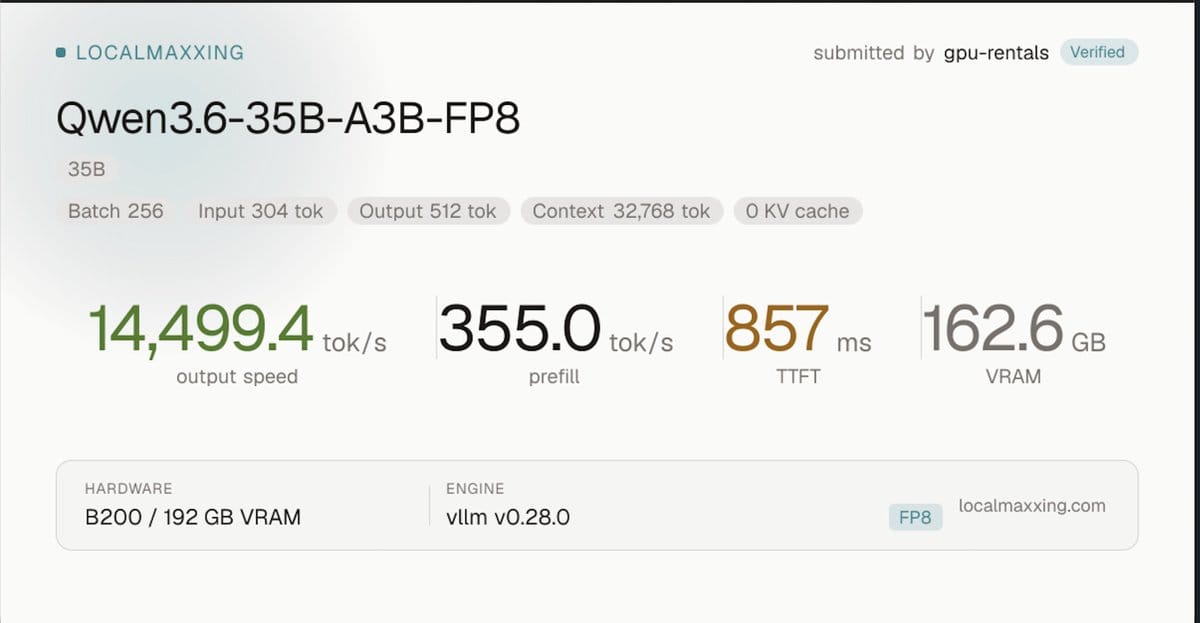
Lium, the Bittensor Subnet 51 GPU marketplace, says it ran Qwen3.6-35B-A3B-FP8 at 14,499 output tokens per second on a single rented NVIDIA B200, placing the run at the top of the model's LocalMaxxing leaderboard as of the team's September 6 update.
The team shared the result via X and published a reproduction repository showing the setup, benchmark commands, model configuration, and cost calculations behind the run. According to the repository, the benchmark used the official Qwen FP8 checkpoint, vLLM 0.28.0, one NVIDIA B200, 256 concurrent streams, and 512 output tokens.
Lium calculated the run at $0.107 per million output tokens, based on a listed B200 rental price of $5.60 per hour and 52.2 million output tokens per hour. The team compared that with $0.90 per million tokens for the cheapest FP8 OpenRouter provider it cited for the same model, and said the result points to a lower-cost path for high-throughput open-model inference.
A Public Benchmark for Rented GPU Infrastructure
The run measures aggregate serving throughput instead of consumer chatbot speed. Lium's repository notes that the 14,499-token-per-second row was produced with 256 concurrent streams, so it represents the total output rate across many simultaneous requests, not what one user would see in a single stream.
LocalMaxxing ranks aggregate runs on the public board, but its Verified badge system is designed around single-stream measurements, with requirements around canonical prompts, engine timings, output length, and concurrency. Lium's B200 aggregate row topped the Qwen3.6-35B-A3B board, while its repository also lists separate single-stream runs for the same model and hardware class.
The aggregate number still matters to infrastructure buyers. Model-serving economics often depend on how efficiently a system can keep expensive GPUs saturated across many users. A single stream may show the experience for one request, but aggregate throughput helps indicate whether a rented node can support API-style inference workloads without sitting idle.
The benchmark used a B200 rented through Lium, not hardware owned by the team, according to the repository's disclosure. The team says the full LocalMaxxing campaign covered 36 submitted runs across five GPU classes and cost $9.71 in GPU time, with the B200 session that produced several aggregate results costing $3.78 for about 40 minutes.
The LocalMaxxing run adds credibility to the argument that decentralized compute can be cheaper, as does Lium publishing a reproducible example showing a rented node serving a current open model at high aggregate throughput.