


Table of Contents
Minos has co-authored a new field report with OpenAI examining how AI coding agents are changing scientific computing, with the project’s HelixForge system featured as the report’s most ambitious and complex case study projects.
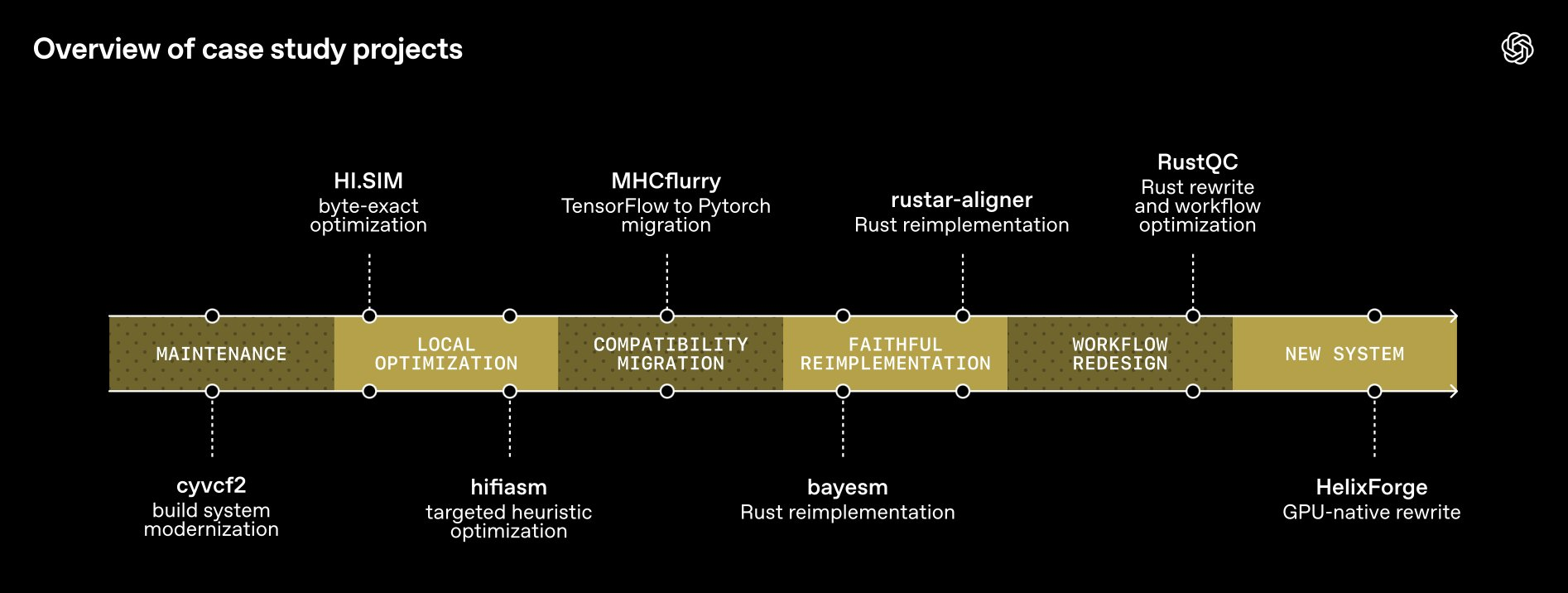
The report, titled Scientific Computing in the Age of Agentic AI, explores eight agent-assisted software projects across genomics and other data-rich scientific fields. The included case studies cover build system modernization, targeted optimization, language migrations, Rust reimplementations, workflow redesigns, and entirely new systems.
Minos's key focus is HelixForge, a GPU-native engine for generating synthetic genomes. According to Minos, the system represents “an entirely new architecture, built from the ground up,” and reflects the project’s broader goal of building infrastructure for AI-driven genomics.
“HelixForge, our GPU-native engine for generating synthetic genomes, is featured as the study’s most ambitious and complex system,” Minos said in its announcement. “Minos is building the infrastructure for the age of AI in genomics.”
Agentic AI in Scientific Software
The OpenAI report frames scientific computing as a core pillar of modern research, but one that has often been held back by fragile, aging software systems.
Many widely used research tools began as code written alongside academic papers, often by small teams with limited time for packaging, testing, optimization, or long-term maintenance. As scientific datasets grow larger and more complex, those constraints can slow research and create reproducibility issues.
AI coding agents, the report argues, are beginning to reduce some of that engineering burden.
“By lowering the costs of engineering work and taking on tedious implementation tasks, they can help researchers prototype ideas more quickly, pursue projects that were previously impractical, and more easily maintain software over the long term,” the report said.
The report also notes a shift in the researcher’s role. Instead of spending as much time on direct implementation, scientists increasingly define goals, set correctness criteria, review outputs, and decide when systems are ready to ship.
“Contributors consistently describe a shift in the researchers’ role from implementation to verification and orchestration,” the report said.
Minos, HelixForge, and AI-Native Genomics Infrastructure
HelixForge sits at the most advanced end of the report’s case study spectrum, categorized as a "new system" placed beyond maintenance, local optimization, compatibility migration, faithful reimplementation, and workflow redesign.
Minos is Bittensor’s genomics-focused subnet, turning genomic variant calling into an open, decentralized competition.
Note: Variant calling is the process of identifying mutations in DNA sequencing data, a foundational task in genomics research, diagnostics, and personalized medicine.
On Minos, miners compete to build optimized variant-calling pipelines, while validators score those submissions against hidden ground truth using industry-standard benchmarking tools. The network generates new synthetic genomes on a recurring basis, giving miners fresh challenges and creating economic incentives to improve accuracy over time.
Instead of relying on self-reported performance, Minos makes accuracy itself the competitive product.
HelixForge pushes that model further by improving the infrastructure used to generate synthetic genomic data, which is central to how the subnet creates reliable, hidden benchmarks for miners.
"On a benchmark involving real human data, HelixForge reduced runtime by about 60x, produced mutation frequencies closer to the requested targets, and resolved several artifact-generating bugs," the report said.
Agents Can Accelerate Work, But Scientific Stewardship Still Matters
While the report is optimistic about AI agents, it is careful not to present them as a replacement for scientific judgment or long-term ownership.
Across the case studies, contributors said agents were effective at handling well-scoped engineering tasks, but could not reliably determine whether their own outputs were scientifically valid. The report notes that agents could appear confident even when their work contained meaningful errors, making validation the new bottleneck. In other words, agents can move quickly, but the scientific bar still has to be set and enforced by people.
That point is especially relevant for systems like HelixForge, which sit close to the core of scientific infrastructure. Minos’ inclusion in OpenAI’s field report places the Bittensor genomics subnet within a broader shift in scientific computing, where small teams can take on more ambitious engineering projects while researchers spend more time defining goals, breaking complex systems into manageable pieces, and judging whether results are valid.
The age of AI in genomics will require new infrastructure, and Minos is positioning Bittensor as one of the places where it gets built.