
Table of Contents
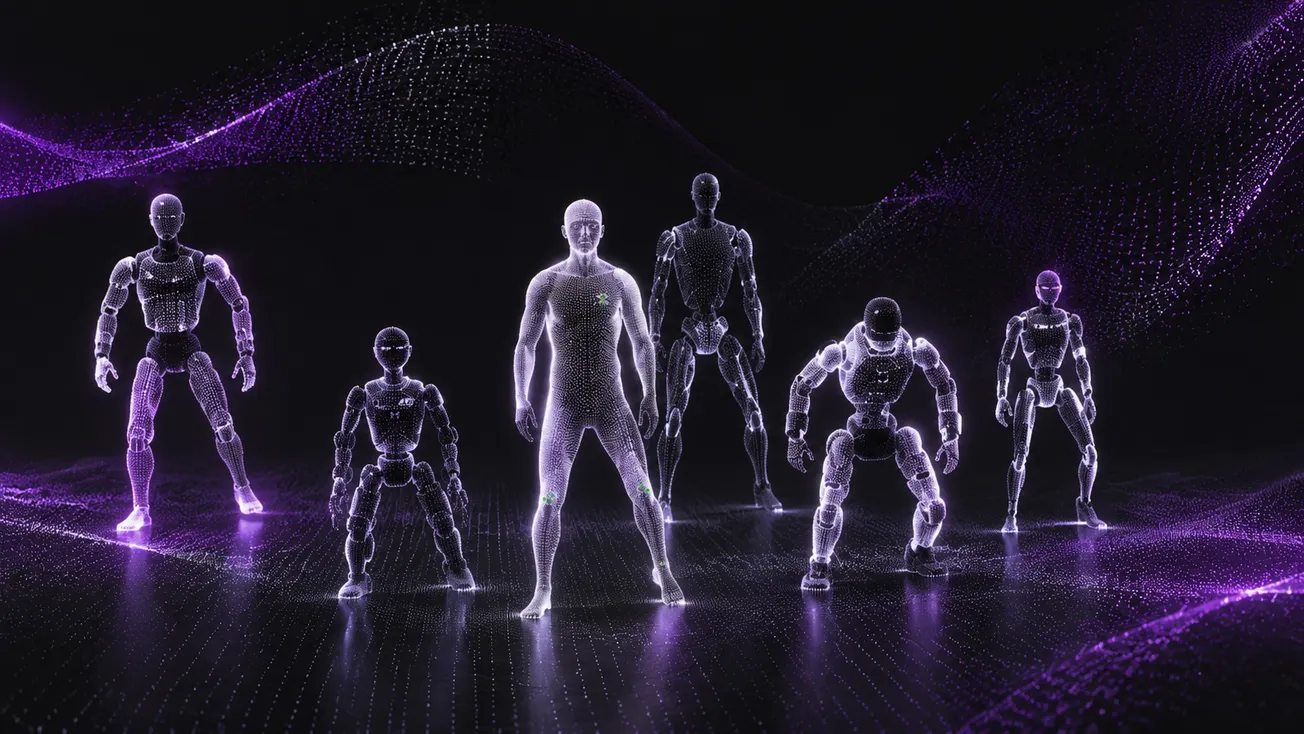
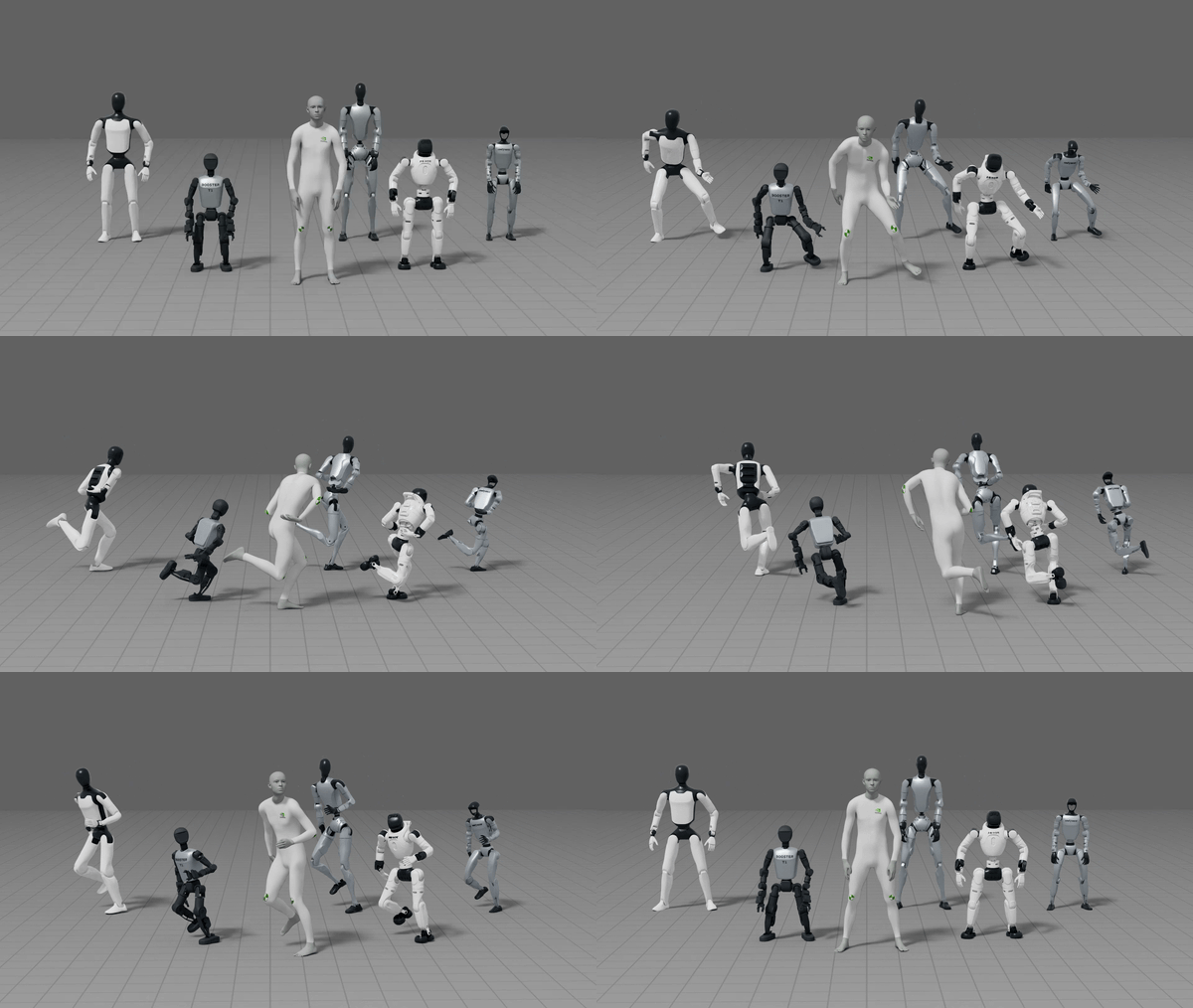
NVIDIA has released SOMA Retargeter, an open-source toolkit that converts human movement into robot-specific joint trajectories for simulation and policy training. Its v0.2 release includes configurations and reference motions for five humanoids: Unitree G1, Unitree H2, Booster T1, AgiBot X2 Ultra, and AgiBot A3T3.
The software addresses a practical obstacle in using human demonstrations to teach robots. A person's movements cannot be transferred joint for joint to a machine with different limb lengths, joints, and ranges of motion. SOMA Retargeter adapts those movements to the target robot and produces references that downstream systems can use to learn control.
NVIDIA Robotics shared the toolkit alongside examples of human-to-robot motion transfer. The release combines an interactive viewer, robot-configuration tools, motion cleanup, and batch processing, so developers can inspect a single walk before processing a larger motion collection.
Turning Human Movement Into Robot Trajectories
The pipeline uses the shared human-motion representation in SOMA-X. Its input is a Biovision Hierarchy, or BVH, animation using the SOMA base skeleton. BVH files describe a skeleton's hierarchy and its poses over time; the retargeter expects SOMA's structure and naming rather than arbitrary motion-capture exports.
For each animation, the software scales movement targets to the robot's proportions, solves for joint poses, and applies configured corrections and joint limits. It exports a CSV file containing the robot's root position, orientation, and actuated joint values for every frame.
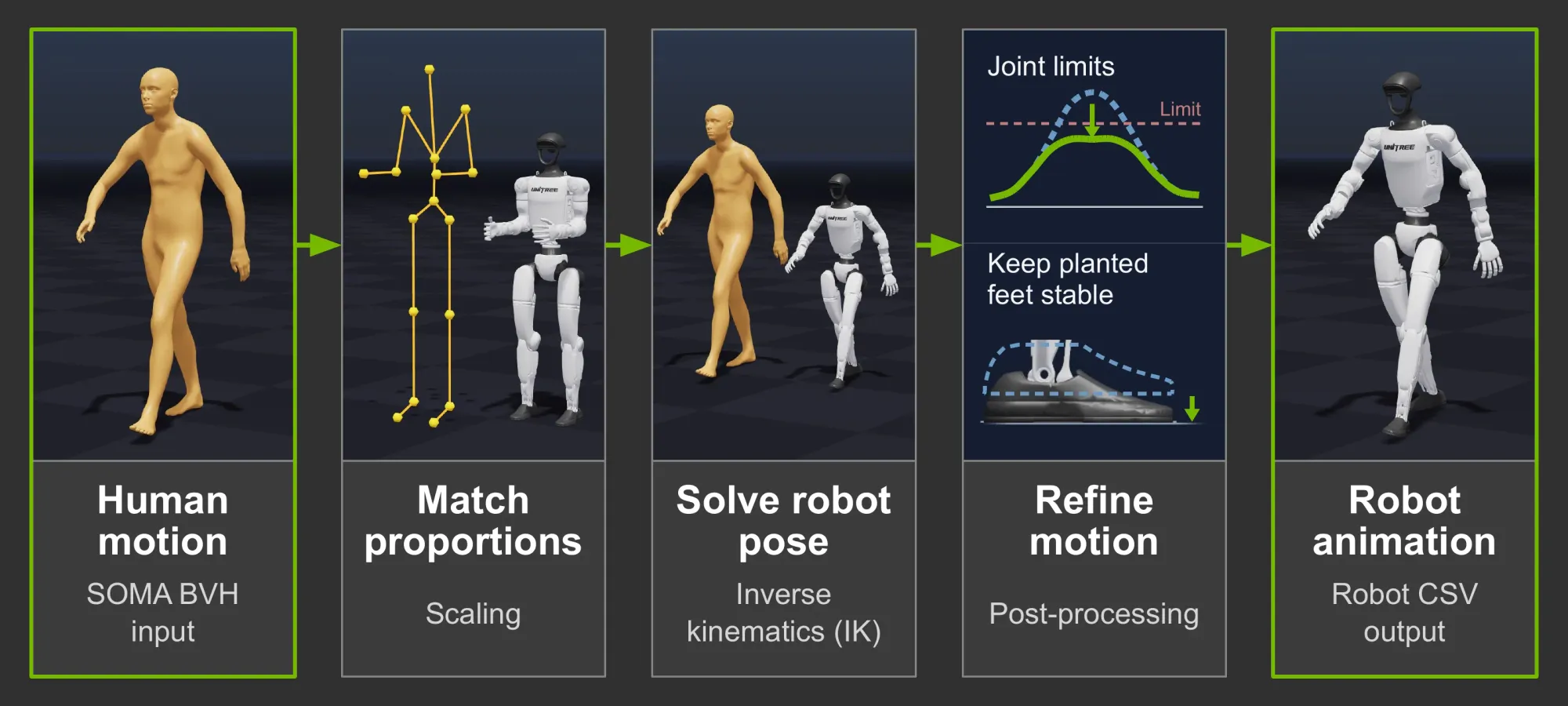
The core calculation is inverse kinematics, which finds joint angles that place selected body parts near desired positions. SOMA Retargeter uses the IK solver from Newton, built with NVIDIA Warp. When a robot cannot satisfy every target simultaneously, weights determine which body parts take priority.
The output is a kinematic reference describing the intended movement. A motion-tracking policy then learns how to execute it using the robot's current state, with simulation evaluating balance, ground contact, actuator limits, and tracking accuracy.
Human motion can enter that workflow through several routes. BONES-SEED supplies recorded motion-capture data. GEM-X reconstructs whole-body 3D movement from a single video, while Kimodo and ARDY generate movement from text and pose constraints. Compatible output on the SOMA skeleton gives these different sources a common path into retargeting.
Configuring Different Robot Bodies
The v0.2 repository bundles 10 example BVH motions and matching CSV results for all five supported robot configurations, plus 15 BVH motions for optimizing IK weights. Developers can compare their output with the supplied references as they adjust settings.
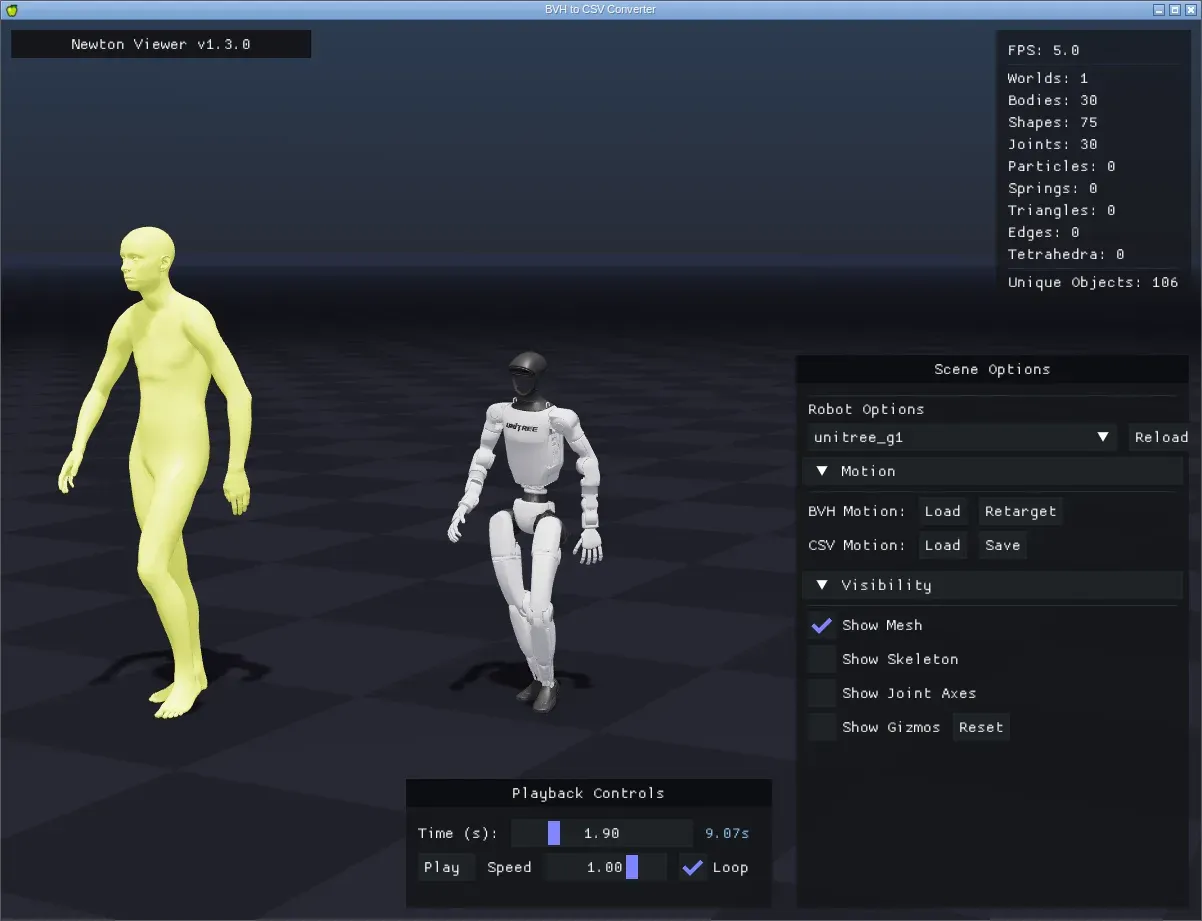
The interactive BVH to CSV Converter opens with Unitree G1 selected by default. Users load a bundled human motion, run retargeting, inspect the human and robot animations together, and save the resulting robot trajectory.
Adding another embodiment involves more than selecting a different robot model. The Robot Configurator lets developers load a robot description, align the human and robot reference poses, adjust scale, and map the source skeleton to robot body parts. Those settings can be saved and reused across clips.
NVIDIA illustrates the effect with a Booster T1 wave. Before reference-pose alignment, the robot holds both arms outward. After alignment, one hand waves beside its head while the other arm rests at its side. The input motion and IK settings remain unchanged, which isolates the effect of the pose setup.
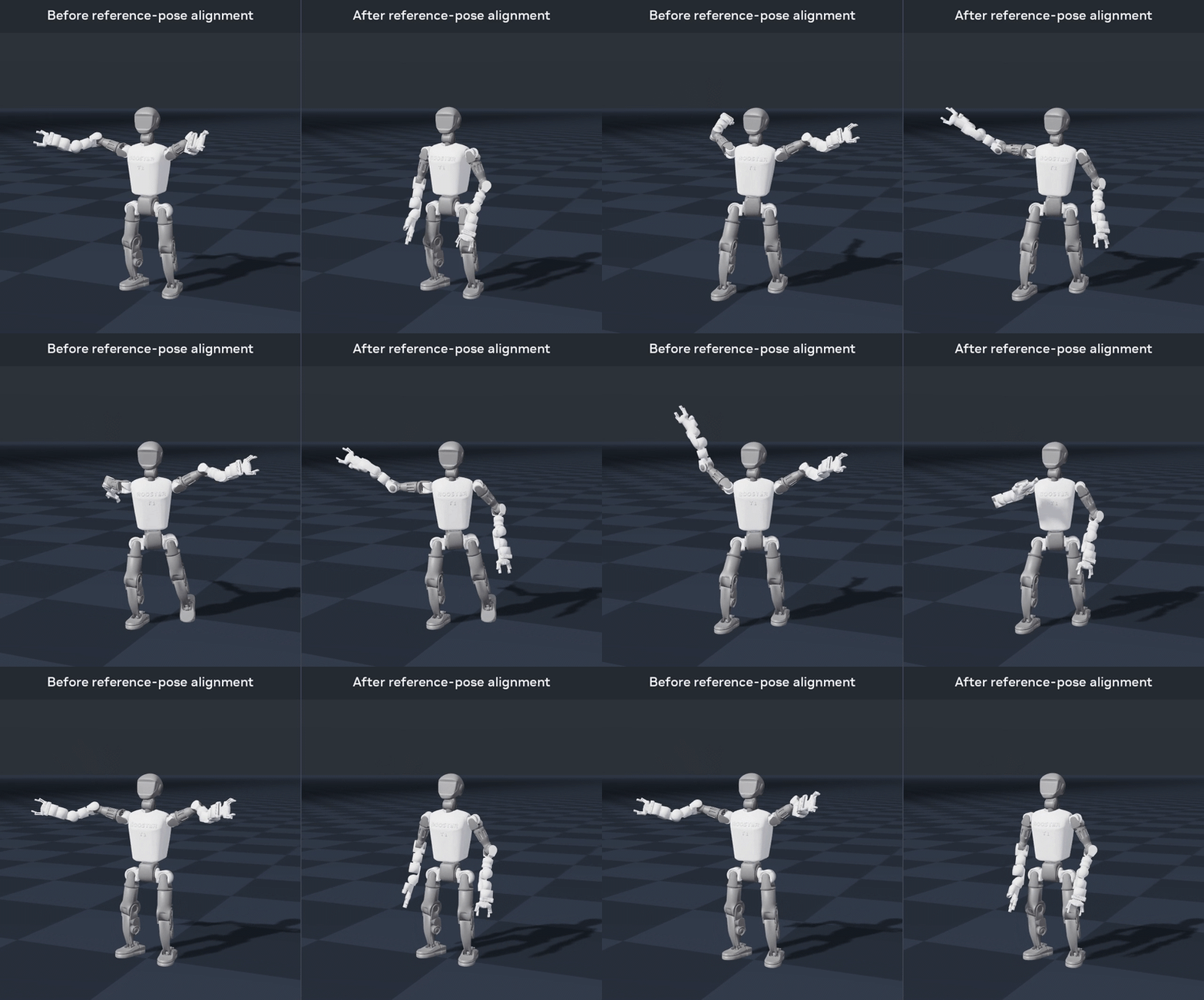
An experimental IK weight optimizer tests adjustments against representative motions and measures how closely and smoothly the robot follows the targets. Foot-plant correction tackles another training-data problem, a reference foot that slides while it should remain in contact with the ground. Developers can refine contact timing and correction settings before sending the motion into training.
Once a configuration works on representative clips, headless batch processing applies it to a larger collection without opening the viewer for each animation.
Connecting Motion References to Learned Control
NVIDIA's technical walkthrough connects the exported trajectories to SONIC and ProtoMotions. The SONIC training workflow includes a SOMA CSV converter for G1, which prepares trajectories in its motion-library format. ProtoMotions provides another framework for physics-based motion tracking.
A separate MicroDuck experiment shows the stages side by side: the original human performance, a retargeted robot reference, and a trained controller following that movement in Isaac Lab and Newton. Human motion from Bones supplied the source material, with a controller trained for each clip in physics simulation.
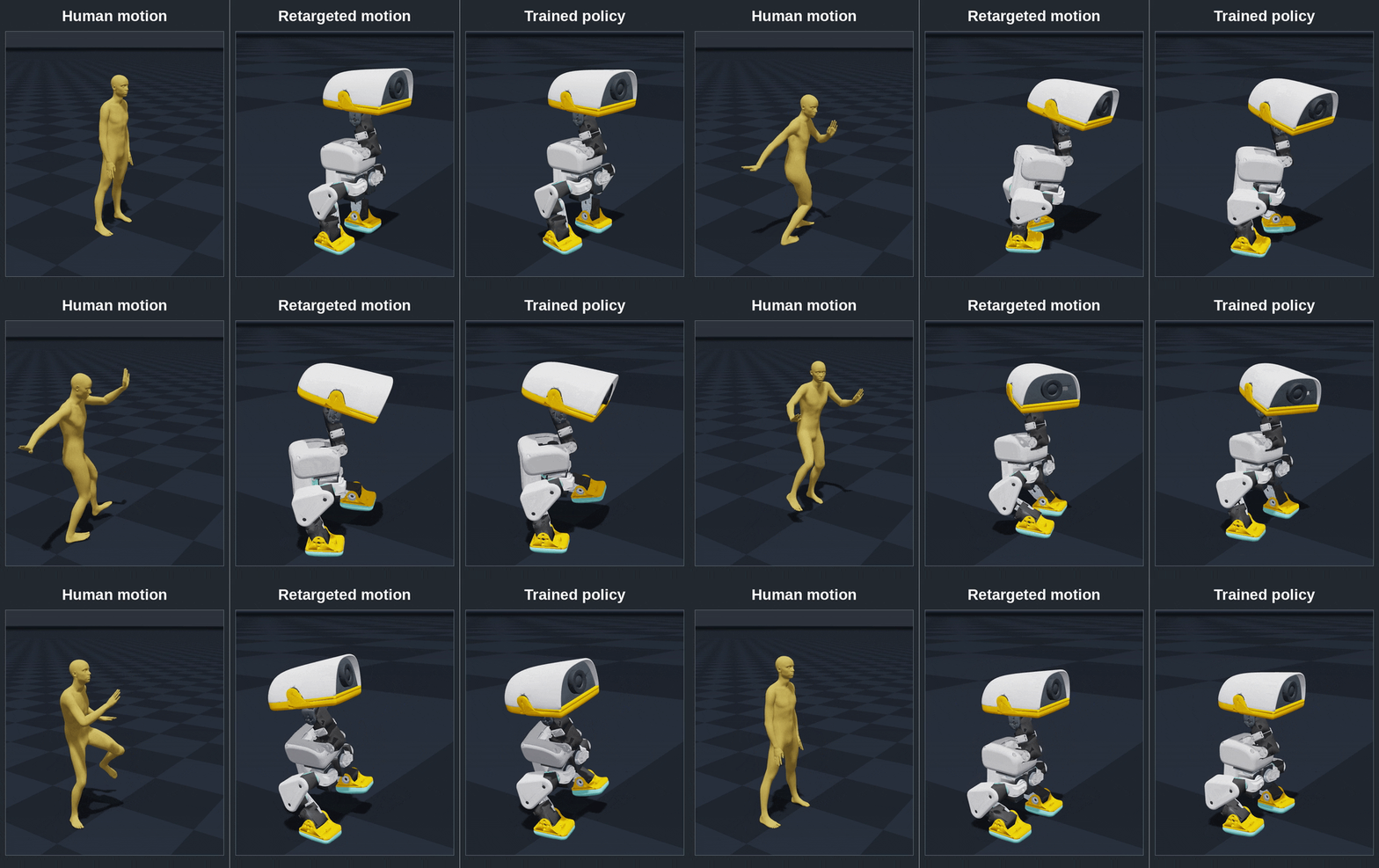
The toolkit also feeds motion-generation research. NVIDIA's MotionBricks G1 model was trained partly on BONES-SEED movements adapted with SOMA Retargeter. It generates continuous whole-body motion between changing target poses in real time. NVIDIA demonstrated that approach on a physical Unitree G1, with the G1-specific MotionBricks model supplying motion targets and SONIC controlling execution.
Code and Motion Data Have Separate Licenses
NVIDIA's source code is available under Apache 2.0. The bundled BVH examples, optimizer inputs, and retargeted CSV files instead fall under the NVIDIA Sample Data Evaluation License. Robot-description and mesh assets retain their respective third-party licenses, including BSD-3-Clause for the bundled Unitree and Booster assets and Mulan PSL v2 for the AGIBot assets.
The repository documentation includes installation, first-retarget, configuration, and batch-processing guides. Developers can begin with the supplied G1 walk, compare the result with its reference CSV, and reuse a tuned configuration to prepare a robot-specific motion library.