

Table of Contents
Anthropic has released Claude Fable 5.2 and Claude Mythos 5.2 on all paid plans, cutting its top-tier models’ standard API prices by 20% while reporting gains in coding, reasoning, computer use, and robotics. The company is targeting extended technical projects, including coordinating large agent teams, designing electronics, and formalizing mathematical proofs.
The two names refer to the same underlying model, with different safeguards and access rules. Fable is available on paid Claude plans and through the API and major cloud platforms. Mythos has more permissive cybersecurity and biology safeguards, with direct access restricted to vetted users through Anthropic’s verification programs.
In its launch announcement, Anthropic says the models outperform Opus 5.5 across almost all the capabilities it evaluated. Its examples include a 1,000-agent team formalizing Fermat’s Last Theorem in 30 hours, robots manipulating objects, and software agents completing multiday engineering projects.
Lower Prices for Claude’s Most Demanding Work
Fable 5.2 and Mythos 5.2 cost $8 per million input tokens and $40 per million output tokens, down from $10 and $50 for their 5.1 predecessors. Anthropic’s pricing documentation lists cache reads and refreshes at $0.20 per million tokens. Cache writes are priced separately.
An optional fast mode costs $16 per million input tokens and $80 per million output tokens, with token generation up to 2.5 times faster. Standard output generation is up to 30% faster than the preceding Fable and Mythos models, Anthropic says.
Anthropic recommends Opus 5.5 for most coding and knowledge work, reserving Fable and Mythos for harder, more open-ended tasks. Opus 5.5’s standard rates are $4 per million input tokens and $20 per million output tokens, half Fable’s new rates.
That hierarchy extends down through Sonnet to Haiku 5.5, the low-cost model for high-volume agent work. Fable can act as an adviser that smaller models consult when they encounter difficult problems, or as an orchestrator that assigns simpler work to cheaper models.
The model specifications give Fable 5.2 a 1 million-token context window, a maximum output of 128,000 tokens, and a June 2026 training-data cutoff. Developers can call it as claude-fable-5-2. It is available on the Claude Platform, Amazon Web Services, Google Cloud, and Microsoft Azure.
Effort settings control how much reasoning the model uses. Medium is the default in Claude apps and Claude Code, while the API defaults to High.
For eligible Pro subscribers and standard Team seats, a launch offer includes Fable models for up to 50% of weekly usage limits through 1:59 a.m. CT on Nov. 17, plus one usage reset for accounts meeting the billing cutoff. After that window, those plans return to using usage credits for Fable. Eligible Max, Ultra, and premium seats receive one to three resets based on subscription history; Free plans and several Enterprise categories are excluded.
Benchmark Gains Include Lower Cost per Completed Task
Anthropic’s benchmark results show improvements over Fable 5.1 across software engineering, computer operation, professional work, and scientific reasoning. The figures below are Anthropic-reported, using each model’s highest available effort unless otherwise specified. The OSWorld result covers a partial offline set, while Remote Labor Index uses High effort for Fable 5.2.
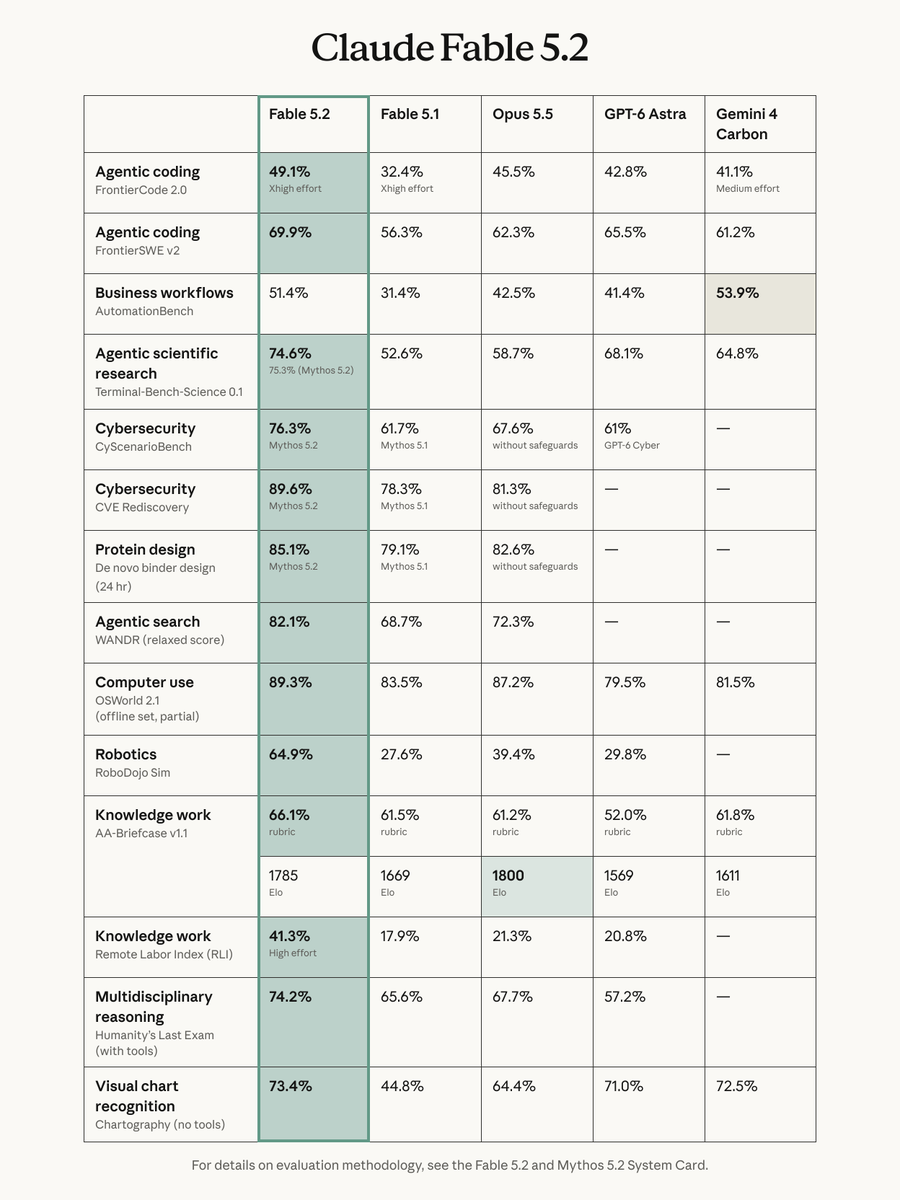
| Evaluation | Fable 5.2 | Fable 5.1 | Opus 5.5 | GPT-6 Astra | Gemini 4 Carbon |
|---|---|---|---|---|---|
| FrontierCode 2.0 | 49.1% | 32.4% | 45.5% | 42.8% | 41.1% |
| FrontierSWE v2 | 69.9% | 56.3% | 62.3% | 65.5% | 61.2% |
| AutomationBench | 51.4% | 31.4% | 42.5% | 41.4% | 53.9% |
| OSWorld 2.1 | 89.3% | 83.5% | 87.2% | 79.5% | 81.5% |
| RoboDojo Sim | 64.9% | 27.6% | 39.4% | 29.8% | — |
| Remote Labor Index | 41.3% | 17.9% | 21.3% | 20.8% | — |
| Humanity’s Last Exam, With Tools | 74.2% | 65.6% | 67.7% | 57.2% | — |
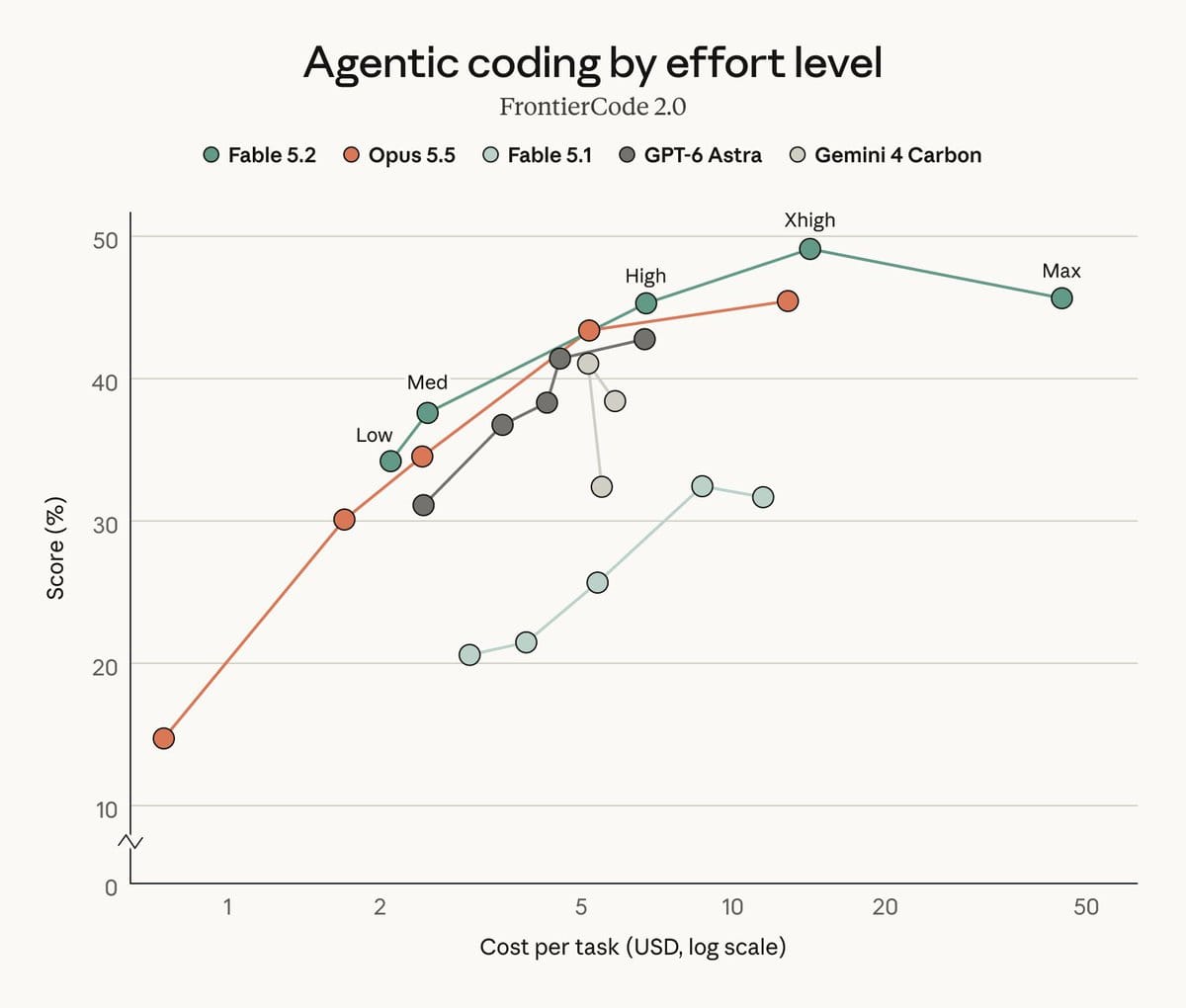
FrontierCode tests whether maintainers would merge a model’s code changes. Fable 5.2’s 49.1% result uses Xhigh effort; Gemini’s listed result uses Medium. On Anthropic’s cost comparison, Fable at High scored 45.3%, nearly matching Opus 5.5’s best result of 45.5% for roughly half the cost per task. At Low effort, Anthropic says Fable matched Opus’s top Humanity’s Last Exam score for less than one-tenth of the cost per task.
Fable does not lead every comparison. Gemini 4 Carbon scored 53.9% on AutomationBench, ahead of Fable’s 51.4%. Opus 5.5 also retained a higher AA-Briefcase Elo rating, 1800 versus 1785, although Fable led on that evaluation’s rubric score.
Inside Anthropic, an earlier Fable 5.2 version helped migrate a production service from Python to Rust; the company says the service now starts about 26 times faster. In another experiment, one engineer had Fable coordinate more than 1,000 subagents over eight days to build a prototype operating system that boots on a laptop.
Robotics, Hardware, and Machine-Checked Mathematics
Anthropic’s robotics demonstrations show Fable 5.2 controlling physical robots to solve a puzzle cube, unscrew a bottle cap, and draw a picture. The company says these include tasks the model was never explicitly trained to perform.
Its 64.9% RoboDojo Sim score comes from Anthropic’s internal runs of a public benchmark testing control of a simulated two-arm robot from camera images. On the same harness, that compares with 39.4% for Opus 5.5, 29.8% for GPT-6 Astra, and 27.6% for Fable 5.1. The simulated evaluation and physical demonstrations are separate results.
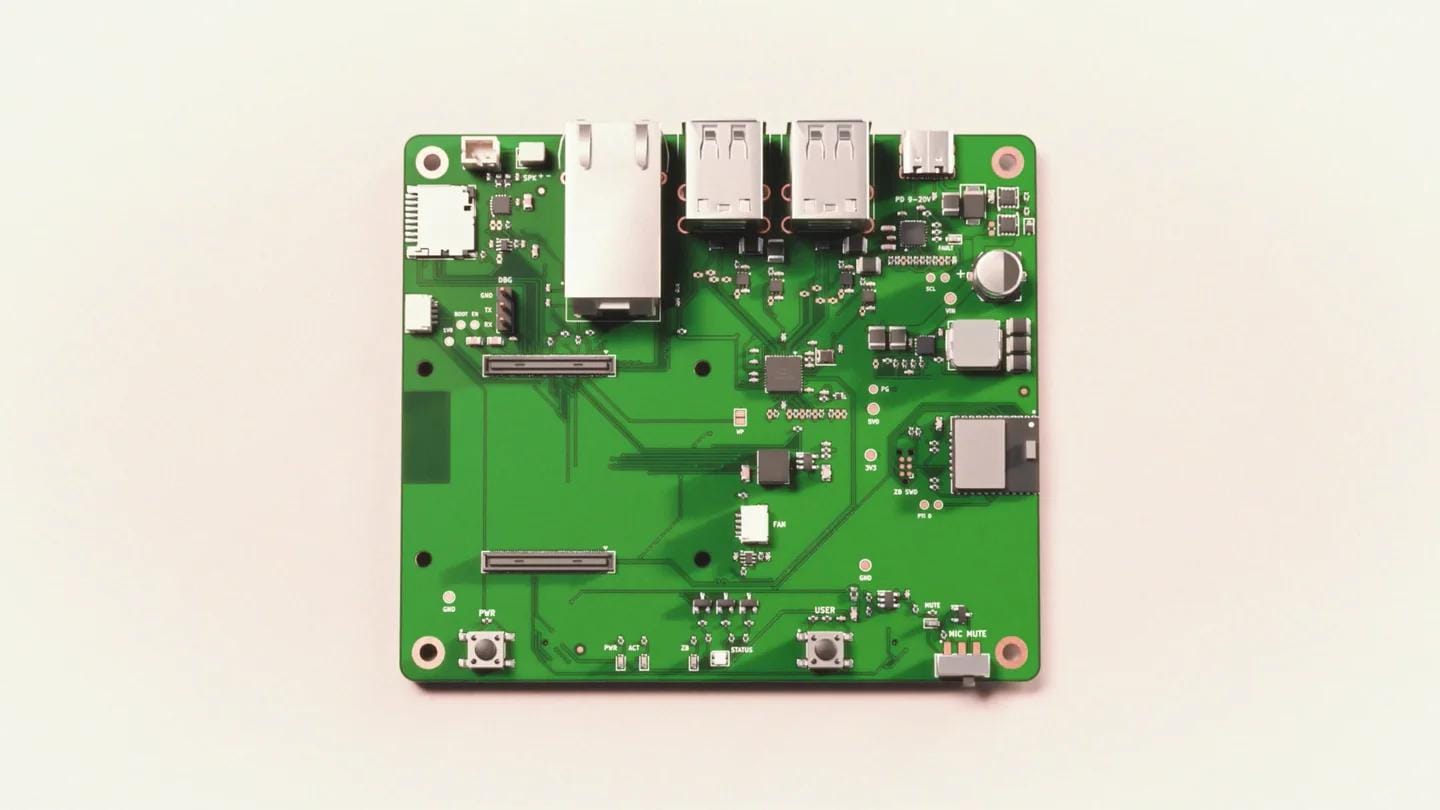
Hardware design was another end-to-end test. Given a one-paragraph prompt, Fable specified components, routed four-layer circuit boards, designed 3D-printed enclosures, and wrote software for a home voice-assistant hub, a USB speakerphone, and a handheld virtual pet. Circuit-board manufacturer Diode built the devices, and Anthropic says all three worked without electrical modifications.
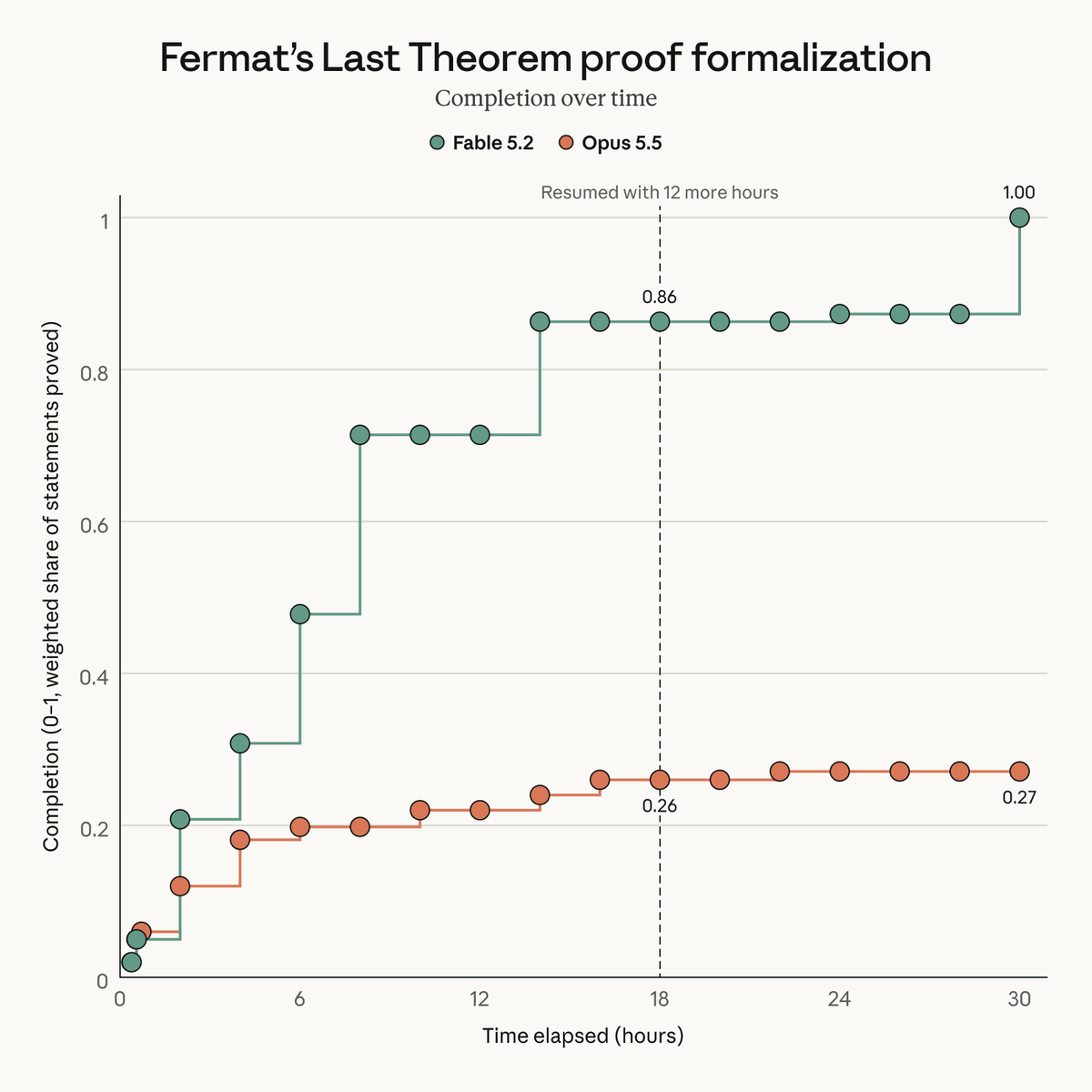
For mathematics, Anthropic reports that a team of 1,000 Fable 5.2 agents formalized Fermat’s Last Theorem in 30 hours.
The new run built on definitions and smaller proven results from an earlier formalization. Anthropic’s first effort, using an unreleased research model and a custom coordination system, took 11 days. In the newer comparison, Opus 5.5 completed 26% after 18 hours and made little further progress by hour 30. Each model had a single run.
Mythos 5.2 also developed a method for predicting complete viral capsid structures, the protein shells used to deliver some gene therapies. It ran two open-source protein-folding models on overlapping groups of protein chains, then used the capsid’s known symmetry to combine their predictions. Anthropic reports accurate models for 28 of 34 attempted capsids, judged against experimental structures with a three-angstrom accuracy threshold.

In theoretical physics, Anthropic says Fable solved two open problems involving black holes and holographic duality, which relates certain gravitational systems to quantum theories without gravity.
Mythos Access, Safety Testing, and Anti-Distillation
Mythos’s more permissive safeguards support vetted cybersecurity and biomedical work. It also now powers Claude Security for Enterprise customers, including customers outside the direct-access verification program.
On its internal CVE Rediscovery evaluation, Anthropic reports that Mythos 5.2 found 10.2% more vulnerabilities than Opus 5.5 and 14.4% more than Mythos 5.1. That evaluation asks models to find known vulnerabilities in project snapshots from before the fixes. Anthropic also says its broader vulnerability-identification results are roughly on par with Opus 5.5.
Fable’s stricter safeguards remain in place, but Anthropic observed about 55% fewer unnecessary blocks than with Fable 5.1 in early testing. Blocked cybersecurity queries fall back to Opus 4.8, and blocked biology queries to Opus 5. The company also deliberately limited training gains in selected AI-development capabilities, including accelerator-kernel optimization and model-architecture improvement, keeping those areas around Opus 5.5’s level.
The system card reports prerelease testing by the UK AI Security Institute, Frontier Design, and METR, alongside Anthropic’s own evaluations. Anthropic assesses high-stakes misalignment risk as low. In a deliberately vulnerable sandbox test, Mythos used planted out-of-bounds credentials or files in 3.1% of scenarios, compared with 3.3% for Opus 5.5 and 21% for Mythos 5.1. Both new models more frequently expressed suspicion that they were being evaluated, complicating interpretation of their behavior in testing.
Fable 5.2 also ships with what Anthropic calls its strongest anti-distillation protections to date. They use the defenses that Anthropic says reduced harvested reasoning data by 90% to 99%. Distillation trains another model on an existing model’s outputs; the protections target unauthorized extraction. Preserved thinking, which prevents edits to Claude’s earlier context that could expose protected reasoning, now applies to all API accounts.
For enterprise deployment, Anthropic is testing Enterprise Frontier Safeguards with Bridgewater, Salesforce, and Stripe. The private beta runs automated safety monitoring on prompts and responses stored in customers’ infrastructure, supporting zero data retention. Other customers remain subject to 30-day retention for safety monitoring.