

Table of Contents
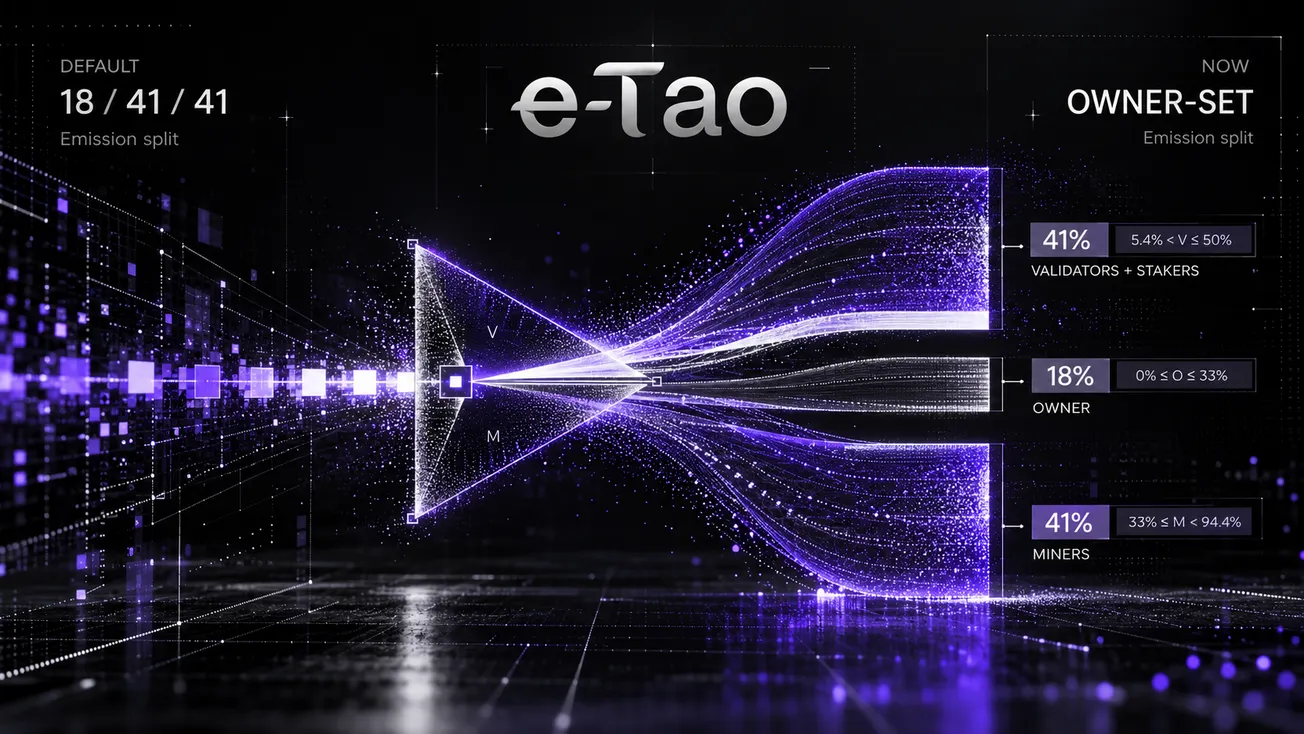
Bittensor's Etao upgrade is live on mainnet, giving subnet owners control over how their networks divide alpha-token emissions among owners, validators, and miners. The Opentensor Foundation has announced the new controls, which replace a standard allocation with subnet-specific settings governed by protocol limits.
Subnet teams can direct more rewards toward the work their networks need: compute and other services supplied by miners, evaluation performed by validators, or operations funded through the owner allocation.
How Owners Can Rebalance Rewards
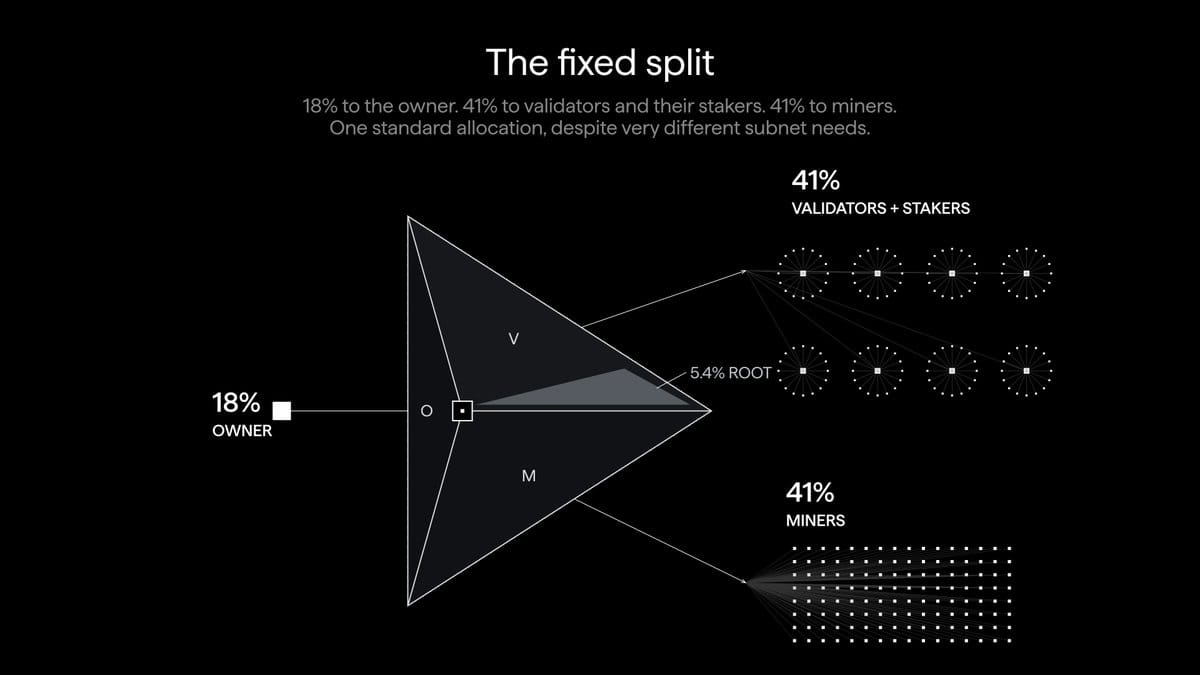
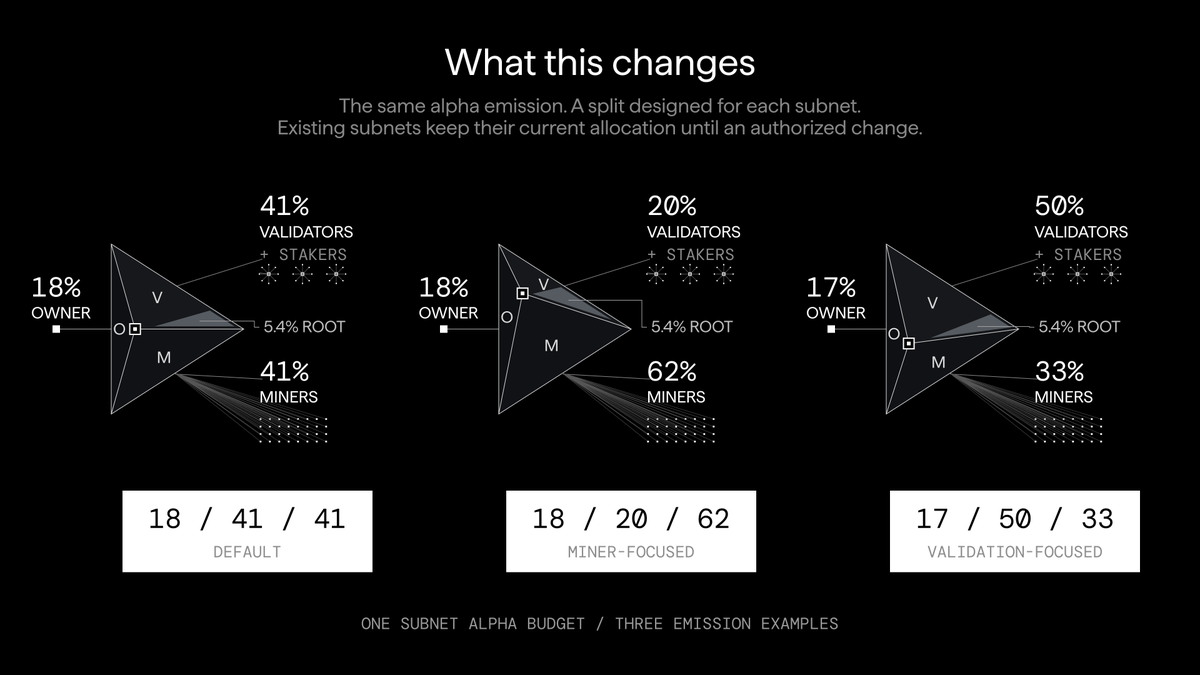
The standard allocation directed 18% of emissions to the owner, 41% to validators and their stakers, and 41% to miners. Validators' allocation includes rewards for root TAO stakers as well as alpha validators.
Etao represents each subnet's allocation as five slots: burn, recycle, owner, validator, and miner. The shares must add up to 100%, and the burn and recycle slots must remain zero in this version. The owner-set allocations must satisfy these limits:
| Allocation | Protocol Limit |
|---|---|
| Owner | 0%–33%; lease-created subnets must retain at least 18% |
| Validator | No more than 50%, and strictly above root's live baseline share when changed |
| Miner | At least 33% |
An eligible subnet could retain an 18% owner allocation, lower validators to 20%, and raise miners to 62%, provided the validator share exceeds its current root-protection threshold. That redirects 21 percentage points from the validator allocation without increasing the subnet's total emissions.
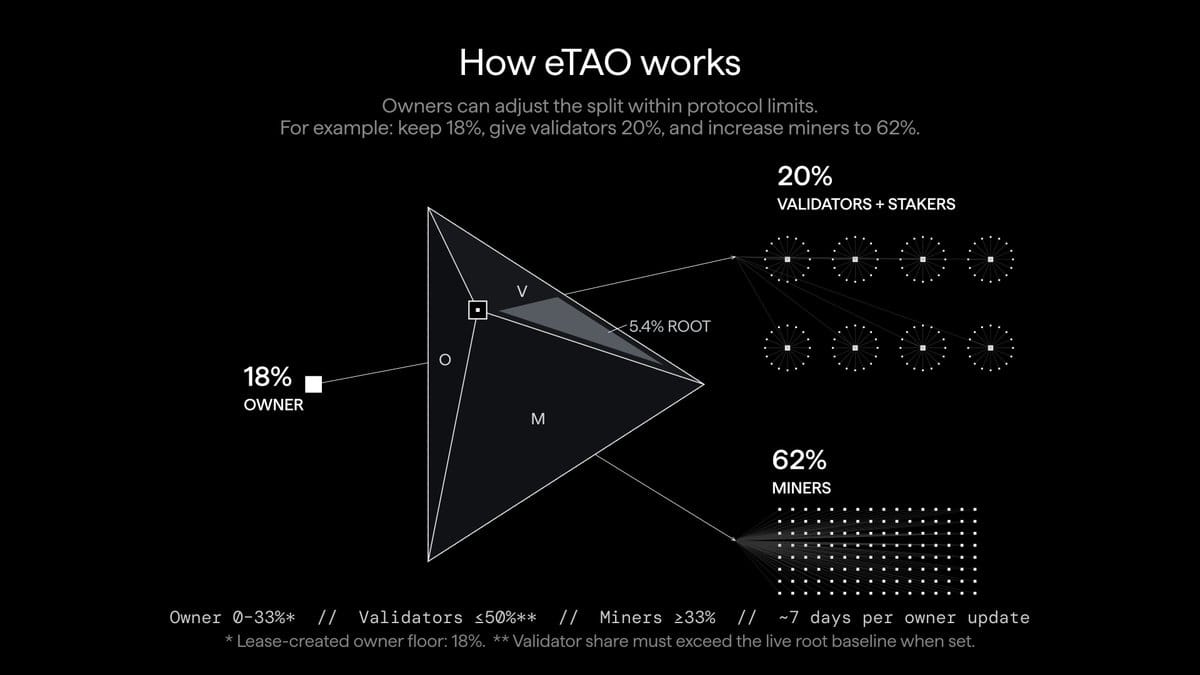
Owners can make one change every 50,400 blocks, approximately seven days. The first change is exempt from that waiting period. The restriction follows the subnet, so transferring ownership to another coldkey does not reset the clock. Root-authorized changes bypass the rate limit but still face the allocation rules and administrative freeze window.
Existing subnets retain their current allocation until an owner changes it. The migration seeds allocations from each subnet's legacy owner-cut state, while newly registered subnets start with the default 18/41/41 split. A miner-heavy compute network can favor service providers, while a subnet that requires more expensive evaluation can increase its validator allocation toward the 50% cap.
Root's Baseline Is Recomputed Every Block
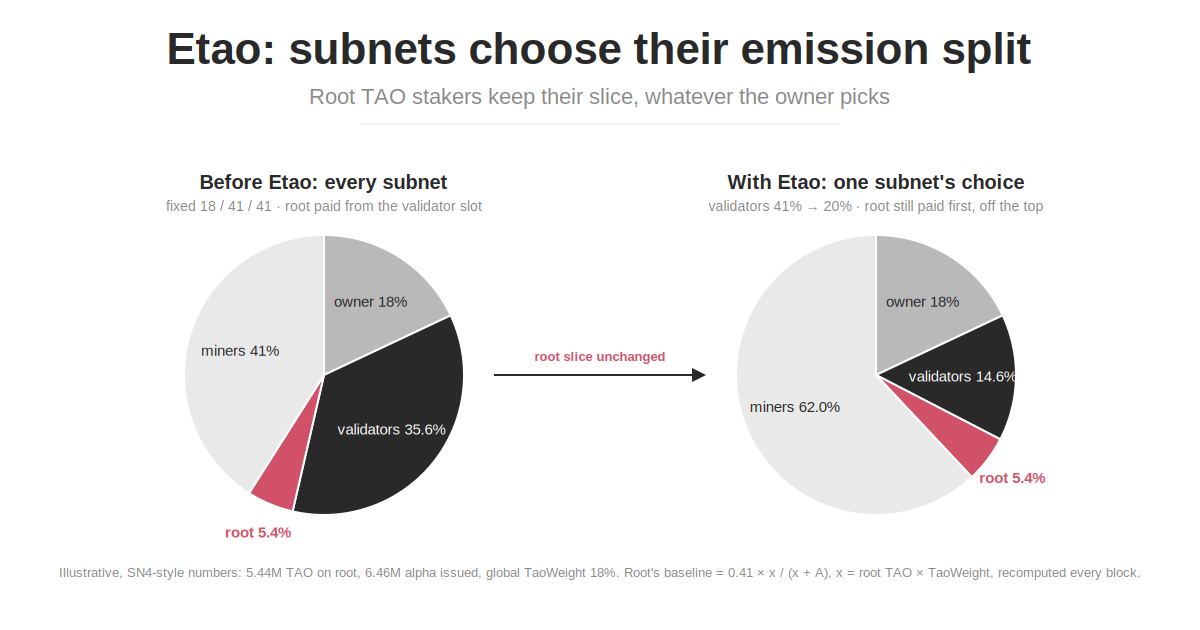
Root TAO stakers receive alpha from each subnet's validator allocation. Under v481, the chain calculates their baseline share every block using the default 41% validator allocation, live root stake, the subnet's alpha issuance, and the global TaoWeight.
The calculation is r = 0.41 × x / (x + A), where x is root TAO multiplied by TaoWeight, and A is the subnet's alpha issuance. Root is paid first from the validator slot, and alpha validators share what remains.
Using Bittensor's illustrative figures of 5.44 million TAO on root, 6.46 million alpha issued, and a TaoWeight of 0.18, root's baseline is approximately 5.4% of the subnet's emissions. Reducing the validator allocation from 41% to 20% leaves that root share unchanged; alpha validators' combined share falls from roughly 35.6% to 14.6%.
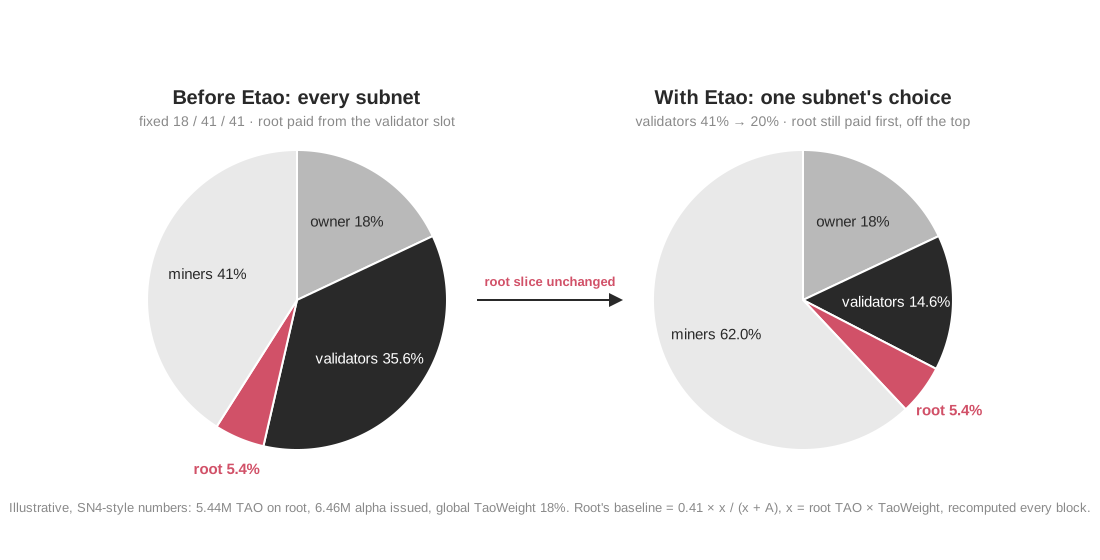
Opentensor's root-protection explanation describes the earlier v480 mechanism, which adjusted a subnet-specific effective TAO weight when an owner changed the split. The v480 implementation commit uses that design. Bittensor's current guide specifies that v481 replaced it with the per-block calculation and removed stored SubnetTaoWeight entries.
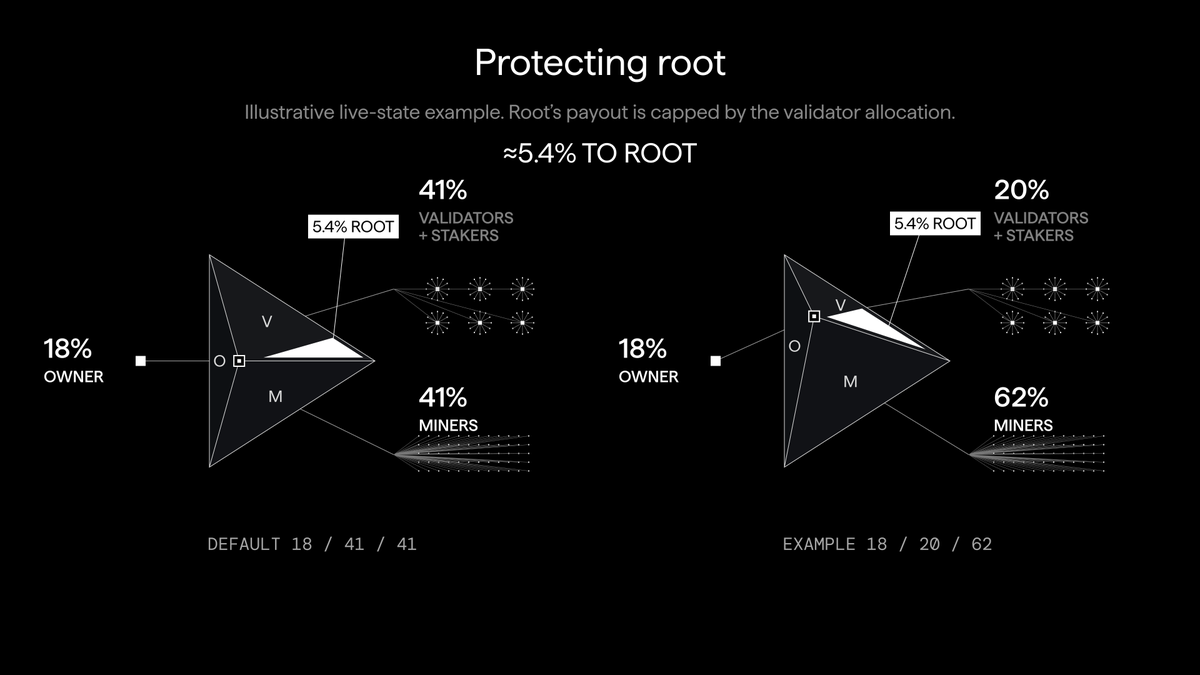
A proposed validator allocation at or below the live baseline is rejected. After an accepted change, however, stake and issuance can move the baseline above the chosen allocation. In that case, root receives the entire validator slot, and alpha validators receive nothing until the allocation is raised. Root's payout is capped at the slot's size, a condition exposed by the runtime API and CLI.
There is also a migration effect for subnets whose legacy owner cut was disabled. Their validator allocation was seeded at 50%. Moving from v480's 50%-based root calculation to v481's global 41%-based baseline reduces root alpha from those subnets by about 18% relative to v480, with the difference going to alpha validators.
Inspecting and Changing a Subnet's Split
The Etao operator guide documents btcli subnets emission, with show, set, set-value, increase, and decrease commands. Owners can inspect the live validator floor, root's baseline, and the next permitted update, then use --dry-run to preview a change without signing it.
The underlying call is AdminUtils.sudo_set_subnet_emission_weights(netuid, uids, values). It accepts updates to selected slots, but the resulting full allocation must satisfy every rule. The old sudo_set_subnet_owner_cut and sudo_set_owner_cut_enabled calls now return Deprecated; owners instead change the owner slot, including setting it to zero where permitted.
Etao Impact
Etao's impact was visible almost immediately. Within the first 90 minutes, early subnet changes showed two different uses of the new controls: some teams redirected more emissions toward miners, while others moved to the maximum owner allocation.
Almanac (SN41) lowered its owner share from 18% to 10% and raised miners to 50%, with validators at 40%. Vanta (SN8) removed owner emissions entirely and moved to a 50/50 validator-miner split. CookingTAO (SN122) kept the 18% owner share but raised miners to 64%, leaving validators at 18%. On the other side, several subnets reportedly moved owners to the 33% cap shortly after activation.
We’re seeing why Etao matters in real time.
The upgrade does not change TAO and alpha injections, swaps, pricing mechanics, or how much emission a subnet receives. It changes who captures the emissions after they arrive. Compute-heavy subnets can pay miners more aggressively, validator-heavy networks can defend evaluation incentives, and owners can claim a larger operating share where the rules allow it.
For alpha holders, that trade-off is key to understand.
Lower validator allocations can reduce the pool available to alpha validators and delegators after root's protected baseline is paid, even if the subnet's total emissions are unchanged. Some holders may accept lower near-term staking yield if redirected rewards improve the subnet's underlying work; others may prefer networks that preserve validator incentives.
Etao therefore turns emission policy into a live, observable strategy choice. Subnet owners now have more freedom to decide which participants their networks reward, and the market can judge those decisions through miner participation, validator returns, owner behavior, and long-term subnet performance.
Etao was also discussed in Targon's Talking Targon episode with Jacob Steeves.