


Table of Contents
Key Takeaways
- Centralized AI labs such as OpenAI, Anthropic, and Google DeepMind build models inside corporate systems and sell access through products and APIs.
- Bittensor coordinates AI work through open subnet markets, where miners, validators, subnet owners, and stakers compete around TAO and alpha tokens.
- Centralized labs still lead on frontier model quality, product polish, enterprise support, and reliability.
- Bittensor's advantage is openness, permissionless participation, market-based funding, and direct exposure to specialized AI economies.
- Centralized labs lead today, yet the core decentralized thesis holds that open, market-driven AI compounds faster and, over a long enough time horizon, outpaces closed systems.
AI is being built through two very different models.
The first model is centralized. Companies such as OpenAI, Anthropic, Google DeepMind, Meta, and xAI raise or allocate enormous amounts of capital, train models inside controlled infrastructure, and sell access through consumer products or APIs. This is the model most people know because it powers ChatGPT, Claude, Gemini, and similar products.
The second model is decentralized. Bittensor is the most visible example in crypto. It uses TAO, subnets, miners, validators, and market incentives to coordinate AI work across many independent participants.
This guide compares the two models without pretending they are equal in every category today. Centralized AI is ahead on raw model quality and product maturity, while Bittensor is earlier, messier, and riskier. The deeper thesis behind Bittensor is that open, competitive, and economically distributed AI production compounds faster over time, so the gap that looks decisive today narrows as the network matures.
How Centralized AI Works
Centralized AI labs concentrate capital, compute, talent, data, and distribution inside one organization. The company trains the model, hosts the infrastructure, controls access, sets the price, and decides what users can or cannot do with the system.
A centralized lab can coordinate massive GPU clusters, hire elite research teams, run closed training pipelines, ship polished products, and provide enterprise support. That level of coordination is why GPT-4-class models, Claude, and Gemini perform as well as they do.
The tradeoff is control, because users get access rather than ownership, and developers pay for APIs while accepting the provider's terms. If the provider changes pricing, removes a model, alters a content policy, or limits a use case, the customer has little recourse.
Frontier AI requires large and recurring spending on compute, talent, data, and infrastructure, which creates intense economic pressure. The centralized model is capital-hungry by design, and the business case depends on converting model quality into durable revenue at very large scale.
How Bittensor Works
Bittensor takes a different route, since it does not train one model inside one company but instead creates markets for AI work.
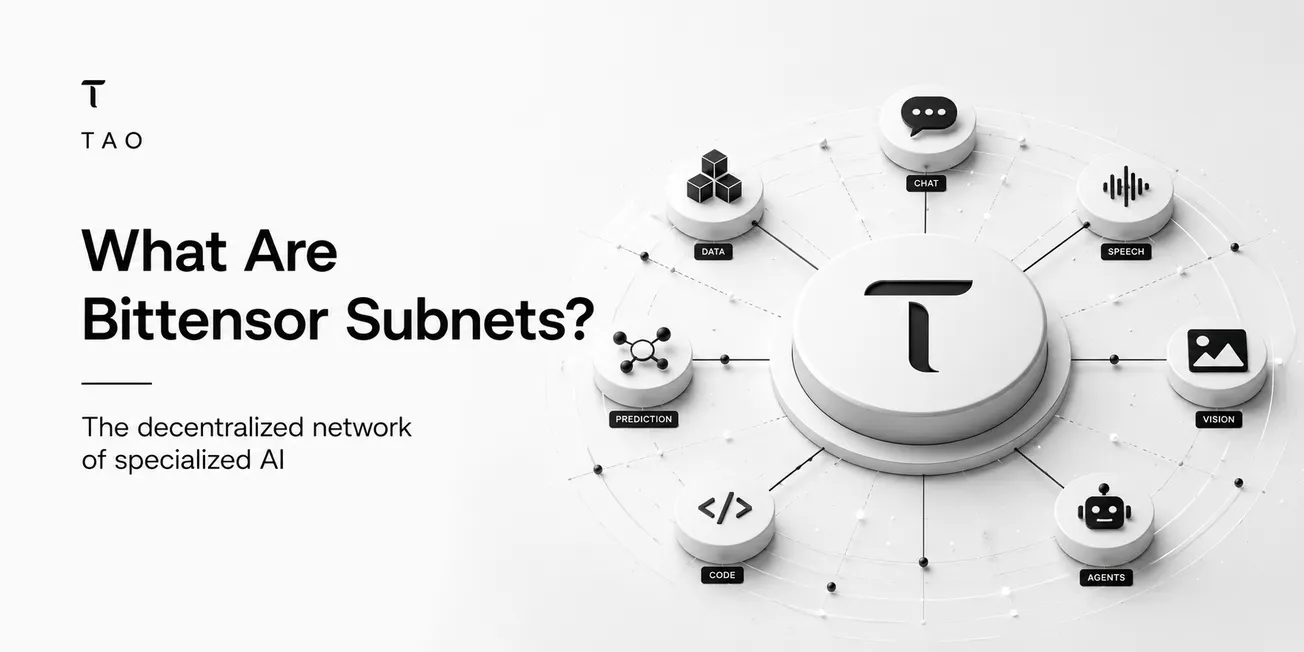
The network is organized into subnets. Each subnet is focused on a specific task, such as inference, compute, prediction, training, data work, coding, or other AI services. Miners produce the work, validators evaluate it, and subnet owners design and maintain the incentive mechanism that scores it, while TAO and alpha tokens coordinate payments and capital allocation across the network.
 Antonio Verrico
Under Dynamic TAO, each subnet has its own alpha token. TAO holders can stake into a subnet, receive that alpha token, and help determine how much emission the subnet receives. Subnets that attract capital can grow their emission share. Subnets that lose confidence can shrink.
This creates a different relationship between money and AI. In centralized AI, money usually buys access to a product. In Bittensor, capital can directly support an AI market and participate in its upside or downside.
Summary: The Core Differences
| Category | Centralized AI | Bittensor |
|---|---|---|
| Who builds | Company employees and contractors | Independent miners, validators, subnet owners, and developers |
| Access | API or product access under provider terms | Permissionless network participation |
| Model control | Usually closed weights and closed training processes | Varies by subnet, with more open-source and community-hosted infrastructure |
| Funding | Corporate budgets, venture capital, strategic investors, revenue | Protocol emissions, staking markets, alpha-token markets, and emerging external revenue |
| Governance | Corporate boards and executive teams | Protocol rules, validators, foundation actors, subnet teams, and token markets |
| User relationship | Customer of a provider | Participant in a network, if the user chooses to stake, mine, validate, or build |
Where Centralized AI Has the Advantage
Centralized labs have the clearest advantage in frontier model quality. The best models from OpenAI, Anthropic, and Google are stronger than decentralized alternatives on many reasoning, coding, multimodal, and long-context tasks. That matters for businesses that need the highest-quality output available today.
They also have better products, since ChatGPT, Claude, and Gemini are easy to use and their APIs are well documented. Enterprise customers can get contracts, support, security reviews, SLAs, and procurement workflows, while Bittensor's ecosystem keeps improving but still requires far more technical and financial sophistication.
Centralized labs also benefit from concentrated infrastructure. Training frontier models usually requires large GPU clusters with high-bandwidth interconnects. Coordinating that work across a decentralized network is difficult. Bittensor can make progress in distributed training and specialized AI services, but the centralized labs still have the strongest infrastructure for frontier-scale training.
If the application requires the best available general-purpose model, centralized AI is the default choice today.
Where Bittensor Has the Advantage
Bittensor's advantages show up in openness and incentives.
The network is permissionless. A miner can compete without being hired by a lab. A validator can evaluate work and earn rewards. A subnet owner can launch an AI market without raising a venture round first. A TAO holder can allocate capital directly into the subnets they believe in.
That funding model is unusual. A subnet can receive meaningful emissions if the market believes it is useful. The team does not need to sell equity before proving the idea. It can launch the market, attract participants, and let performance drive capital.
Bittensor also reduces dependence on any one AI provider. If a developer cares about open-source models, censorship resistance, or avoiding vendor lock-in, a decentralized market can be attractive even if it does not beat frontier labs on every benchmark.
The strongest case for Bittensor has little to do with replacing centralized AI overnight, and everything to do with the reality that many useful AI services do not require the single best frontier model in the world. A prediction market, compute market, inference router, data subnet, or specialized model service can be commercially useful if it solves a specific problem well.
The Economics Compared
Centralized AI is funded through private capital, corporate balance sheets, cloud partnerships, subscriptions, API revenue, and enterprise contracts. The spending is large because frontier models need expensive training runs and constant infrastructure investment.
Bittensor is funded through emissions and markets. The protocol emits TAO, subnets issue alpha tokens, and participants earn rewards for work and evaluation. This can fund AI development without traditional equity financing, but it also creates sell pressure. Miners, validators, and subnet owners often have real costs, and some will sell rewards to cover them.
Neither model has fully solved profitability. Centralized labs are growing revenue but also spending heavily. Bittensor can fund many experiments, but many subnets still need to prove they can generate demand beyond emissions.
Centralized AI is more mature but extremely expensive, while Bittensor is more open but still early and dependent on subnet-level execution.
What It Means for Developers
Developers should choose infrastructure based on the job.
Centralized APIs are the best choice when the application needs frontier reasoning, strong reliability, enterprise support, mature tooling, or simple integration. They are also easier for teams that do not want to manage crypto wallets, decentralized infrastructure, or subnet-specific risk.
Bittensor may be useful when the application values open-source models, lower dependence on one provider, permissionless access, or specialized services that fit a subnet's strengths. Some developers may use Bittensor-powered services without touching TAO directly, especially through routing platforms or products built on top of subnets.
The practical answer is often both. Use centralized APIs where model quality and reliability matter most. Use decentralized infrastructure where openness, cost, specialization, or independence matter more.
What It Means for Investors
The investment profiles are very different.
Centralized AI exposure usually comes through private equity, public companies with AI stakes, cloud providers, semiconductor companies, or large technology platforms. The thesis is that frontier AI will generate enough revenue to justify the spending and valuations.
Bittensor exposure comes through TAO and subnet alpha tokens. TAO is the base asset of the network. Alpha tokens create more targeted exposure to individual subnets. That can produce more upside if a subnet becomes valuable, but it also adds risk. Alpha tokens can fall against TAO, liquidity can be thin, and emissions can create persistent sell pressure.
A useful mental model treats TAO as the broad decentralized AI network bet, while alpha tokens sit closer to early-stage bets on specific AI markets, so the two should not be treated as interchangeable.
Risks on Both Sides
Centralized AI has concentration risk. A few companies can influence model access, pricing, data policy, product direction, and content rules for a large share of the AI economy. Developers building on one provider can become dependent on decisions they do not control.
It also has governance risk. Corporate priorities can change quickly, especially when the companies are balancing safety concerns, investor expectations, regulation, and competition.
Bittensor has different risks. The quality gap with frontier labs is real and many subnets are unproven with thin and volatile alpha-token markets. Governance and coordination inside the ecosystem can still be messy because a decentralized protocol can still have powerful insiders, large validators, influential foundations, and major holders.
The technical challenge is also serious. Decentralized AI has to prove that distributed incentives can produce services people want to use rather than tokens people only want to trade.
Why Decentralized AI Wins on a Long Enough Timeline
The near-term scoreboard favors centralized AI labs. OpenAI, Anthropic, Google DeepMind, and other major players have more compute, capital, proprietary data, distribution, research talent, and product polish than decentralized networks do today. If the question is who has the best general-purpose chatbot or most reliable enterprise API right now, the answer is still centralized AI.
The decentralized thesis is about a longer time horizon. Centralized labs are optimized for coordination at scale today; decentralized networks are optimized for compounding participation over time. The longer the game runs, the more important open experimentation, capital routing, and specialization become.
Bittensor's core advantage is that it turns AI development into an open market instead of a closed corporate roadmap. Anyone can mine, validate, launch a subnet, stake into a subnet, build on top of one, or compete to improve an existing market. That means the network's contributor base is not limited by one company's hiring plan, research priorities, or budget cycle.
This matters because AI is not one market. Frontier chatbots are one category, but inference routing, model hosting, data labeling, prediction, synthetic data, code generation, compute, agent tooling, search, evaluation, and domain-specific models are all different problems with different customers. Centralized labs tend to bundle these into large platforms. Bittensor can split them into specialized subnet markets, where each subnet competes around a narrower task and rewards the participants who perform that task best.
That makes decentralization less of an ideology and more of a market structure. A subnet does not need to beat GPT-4 or Claude at everything to be useful. It only needs to solve a specific problem well enough that users, builders, validators, and stakers believe the market deserves more capital. If it does, attention and emissions can flow toward it. If it does not, capital can leave.
The process will, of course, be messy. Many subnets will fail, some incentives will be gamed, and some markets will attract token speculation before real demand. But in an open market, weak subnets are exposed and repriced, while stronger subnets attract miners, validators, liquidity, developers, and users. Over time, the network improves by reallocating resources toward markets that prove themselves.
The funding model reinforces that loop. Centralized AI depends on corporate balance sheets, venture funding, cloud partnerships, subscriptions, and enterprise contracts. Bittensor uses emissions, staking, and alpha-token markets to fund AI work in public. A promising subnet can bootstrap an economy before it looks like a traditional company, giving builders a funding path that does not require permission from a venture firm, cloud provider, or grant committee.
Importantly, we've seen open networks follow this pattern before. Open-source operating systems, browsers, databases, programming languages, crypto networks, and internet infrastructure often started behind closed alternatives, then compounded until the ecosystem became harder to outcompete than any single product. Decentralized AI is trying to run the same playbook in a more complex category.
Frequently Asked Questions
Is Bittensor a Competitor to OpenAI?
Not in the usual company-versus-company sense, because OpenAI is a centralized AI company while Bittensor is a decentralized protocol for AI markets. They overlap in some infrastructure categories, but they are built around different models.
Can Bittensor Match GPT-4 or Claude Today?
Not across the board today, since centralized frontier models still lead on many general-purpose benchmarks and product use cases. The near-term opportunity is specialized AI infrastructure, and the longer-term thesis is that open markets close that quality gap as the network compounds.
Why Would Someone Use Bittensor?
Reasons include open participation, reduced vendor lock-in, access to decentralized AI services, exposure to subnet economies, and the ability to build or contribute without joining a centralized lab.
How Does Bittensor Make Money?
Bittensor is a protocol, not a company. Participants earn TAO and alpha-token rewards through emissions, staking, mining, validation, and subnet ownership. Some subnets may also generate external revenue through products or services.
What Are the Biggest Risks of Bittensor?
The biggest risks are uneven subnet quality, alpha-token volatility, emission sell pressure, governance concentration, and the possibility that many subnets fail to find real commercial demand.
Will Centralized AI Companies Adopt Decentralized Ideas?
Some may adopt open-source or distributed elements, but full decentralization conflicts with business models built around proprietary access. A more likely outcome is selective borrowing rather than complete adoption.







%3A%20A%20Complete%20Guide)