
Table of Contents
Key takeaways
- A subnet is a specialized marketplace on Bittensor where people compete to produce one specific kind of AI.
- Every subnet has three roles, with miners doing the work, validators scoring it, and an owner running the whole thing.
- Each subnet has its own token, so you can back a single subnet instead of the whole network.
- Subnets compete for a limited number of slots, and weak ones can be replaced by stronger newcomers.
- As of mid-2026, there are around 128 active subnets, with the cap set to expand to 256.
Subnets in Plain Terms
If Bittensor is the network for building AI, subnets are the individual workshops where that AI actually gets made.
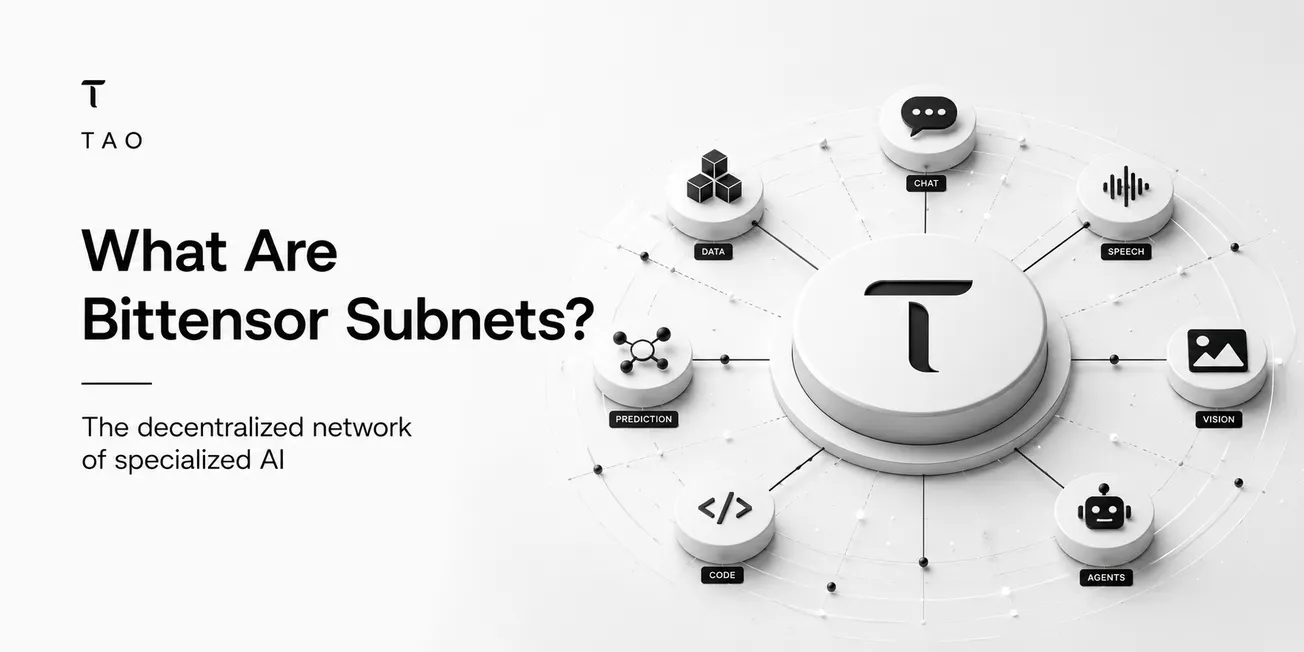
A subnet is a small, focused market for one type of AI work. Instead of Bittensor trying to be good at everything at once, the network splits into many subnets that each specialize, so one might focus on AI text generation while another handles data storage or price prediction. Bittensor describes itself as an open network where these subnets produce digital commodities like compute, inference, storage, and prediction, and contributors earn rewards for supplying them. The simplest way to picture it is a marketplace of marketplaces. Bittensor is the shopping center, and each subnet is a specialized store inside it, competing to offer the best version of its particular product.
The Three Roles Inside a Subnet
Every subnet runs on the same three roles. Miners do the actual AI work, such as answering a query or generating an output. Validators check and score how good that work is, which keeps miners honest and rewards quality. The subnet owner is the team that built the subnet, set its rules, and keeps it running.
Rewards are paid out to all three groups so that everyone has a reason to keep contributing. The people who produce good work, the people who accurately judge it, and the team that maintains the market all earn a share, which is what keeps a healthy subnet improving over time.
Subnet Alpha Tokens
One of the biggest changes to Bittensor is that each subnet now issues its own token, typically referred to as an alpha token. This means you do not have to buy into the entire network to get exposure, because you can back a single subnet you believe in. Interest in this has grown to the point that a major exchange announced plans in July 2026 to list subnet tokens such as Chutes, Targon, and Ridges AI directly.
These subnet tokens are all priced against TAO, the network's main currency, so TAO stays at the center even as each subnet runs its own smaller economy. That design lets the market fund the subnets people find most promising, rather than a central group deciding for everyone. Where results emerge from, value for the subnet token typically follows in a freestanding economic way.
Subnets Compete to Survive
Subnets do not get a permanent spot on the network; there is a threat of being deregistered. Bittensor caps the number of active subnets, currently at 128 slots with an expansion to 256 planned. When the slots are full, registering a new subnet can force out the weakest existing one, measured by the market value of its token.
That creates real competition, because a subnet has to keep performing or risk being replaced by a stronger newcomer. It is a bit like a league with promotion and relegation, where a spot has to be earned and then defended rather than owned forever.
What Subnets Actually Do
The range of tasks is wide, and it keeps growing as builders launch new ideas. Some common categories give a good sense of the variety:
- AI inference: Running trained models to answer questions or generate text and images.
- Model training: Improving and fine-tuning AI models as a competitive service.
- Data and storage: Supplying, cleaning, or storing the data that AI depends on.
- Prediction: Forecasting outcomes such as prices or events.
- Compute: Providing the raw processing power that other AI work runs on.
As of mid-2026, there are around 128 active subnets, each doing something different, and the planned expansion to 256 slots will widen the range even further. You can think of each individual subnet as different start-up companies that are operating within the Bittensor ecosystem, all in an effort to produce a product or solution that the market determines to be valuable.
Bittensor subnets are the specialized markets where the network's AI actually gets built. It is the subnet ecosystem that forms the basis for what the thesis of decentralized compute actually stands for within Bittensor.