

Table of Contents
Google has opened Gemini 4 Carbon to paying developers, enterprises, and consumers, extending access beyond the cybersecurity defenders who first received the model through its Fairwind Program. Carbon is now available through the Gemini API and is rolling out to Google AI Ultra subscribers across the Gemini app, AI Mode in Search, and Antigravity.
The expansion follows Carbon’s October 28 introduction, when access was limited to selected security teams. Google is also previewing /swarm in Antigravity, allowing a single prompt to launch a coordinated team of agents that plan, implement, and verify work in parallel.
Carbon is built for complex work requiring sustained reasoning and extended verification, including difficult debugging, scientific research, and dense document analysis. Google still recommends Gemini 4 Argon for most software engineering and knowledge work; Carbon uses more tokens to explore harder problems and check its results more extensively.
Where Carbon Is Available and What It Costs
Developers can use Carbon through the Gemini API’s paid tier in Google AI Studio and Android Studio. Google AI Ultra subscribers also receive access in AI Studio and Antigravity. For enterprises, the rollout includes Gemini for business through its API or model selector, as well as Antigravity and CodeMender.
Consumer access in the Gemini app and AI Mode in Search requires Google AI Ultra, rather than payment through the developer API.
Introductory API pricing matches Argon at $2 per million input tokens and $10 per million output tokens. Cached input tokens receive a 95% discount, reducing the cost of reusing previously processed material such as instructions or codebase context.
| API Token Type | Introductory Price per Million Tokens | Price After the Introductory Period |
|---|---|---|
| Input | $2 | $4 |
| Output | $10 | $20 |
The introductory period expires November 30, 2026.
Scientists and researchers can apply for six months of free access to Argon and Carbon through Antigravity’s highest usage tier. Onboarding is rolling and subject to eligibility, capacity, and selection. Cybersecurity defenders can continue applying separately through the Fairwind Program for Carbon for cyber.
Partner Results and a New Multimodal Benchmark
Carbon is also reaching developers and users through third-party products. Cursor has added the model and reports a 60.4% score at high effort on CursorBench, making it the top model in that evaluation.
Perplexity has made Carbon available in Computer for Pro and Max subscribers, and in Search for Max subscribers. On its WANDR research-agent benchmark, Perplexity reports a score of 0.857 at $5.86 per task. Its published comparison puts Claude Fable 5.2 at 0.851 and $14.51 per task, with Carbon delivering comparable performance at roughly 40% of the cost.
Google reports that Carbon ranks first on CursorBench 4.0, WANDR, and Zapier’s AutomationBench, at less than half the cost per task of the next-best external model in those comparisons. These task-level costs capture the spending required to complete evaluated workflows, rather than simply the price of a fixed number of tokens.
Google and Artificial Analysis also introduced Multimodal Knowledge Agent, or MKA, to evaluate agents working with visually complex professional files, including blueprints, engineering drawings, and scientific charts. Google reports that Carbon ranks second at less than one-sixth the average cost per task of the leading model.
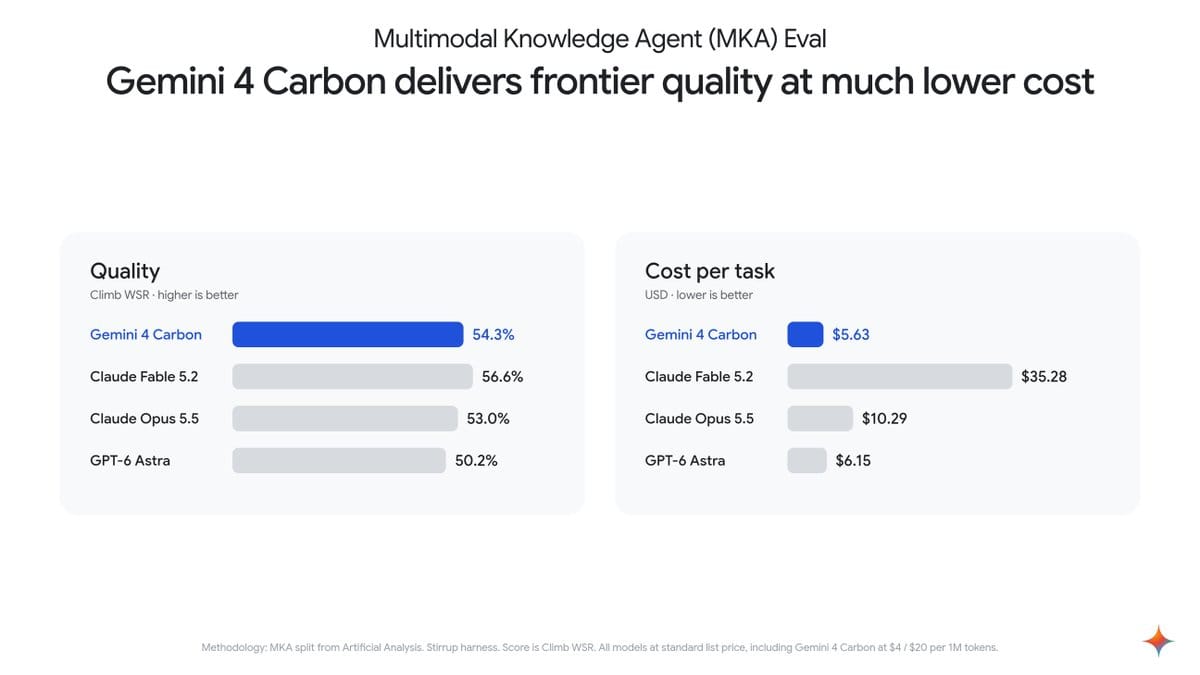
Artificial Analysis runs 200 MKA tasks across 10 industry verticals. Agents receive a workspace of source files and must produce deliverables such as reports, spreadsheets, presentations, or annotated drawings. The evaluation uses its Stirrup harness, with code execution, internet access, and a limit of 250 turns per task.
Its headline measure is the weighted share of harder rubric criteria satisfied, averaged across tasks. Carbon at high effort scores 54%, behind Claude Fable 5.2 at 57%. The benchmark measures how well an agent completes demanding requirements in file-based professional assignments, including work where important evidence is visual rather than plain text.
How /swarm Coordinates Coding Agents
The Antigravity multi-agent preview adds a new execution system through /swarm alongside Carbon. A coordinator creates specialized workers in isolated Git worktrees (separate working copies that let agents edit in parallel without colliding) and assigns adversarial verifiers to run tests and challenge proposed changes.
Agents communicate directly through a shared, append-only message board. They can wait at zero token cost while idle and reactivate when another agent needs input, rather than routing every exchange through a single coordinator’s context.
Developers can assign different models to individual roles. Carbon can handle architecture, coordination, security auditing, or demanding verification, while faster, lighter models carry out routine implementation and parallel file edits. This lets a team reserve the more intensive reasoning model for decisions that require it.
Antigravity’s interface includes a live board feed, a member roster with tool activity and individual agent histories, and a graph timeline for replaying how the team reached its result. Developers can inspect or steer individual agents during execution. The CLI also provides a full-screen board through /swarm board or the Alt+S shortcut.
Google tested the system internally for five weeks on work including multi-package migrations, investigations spanning multiple software subsystems, and architectural redesigns. Although idle waits consume no tokens, parallel agent execution uses quota much faster than a standard chat.
Carbon is rolling out to Google AI Ultra subscribers in the Antigravity App, CLI, and IDE extensions. The /swarm preview is rolling out in the App and CLI.


