


Table of Contents
Hippius, the distributed cloud platform operating on Bittensor Subnet 75, has launched Hippius CDN, adding edge delivery for files stored in its S3-compatible buckets. The service is available to every account, with usage-based billing and a monthly spending cap for each delivery zone.
Developers can use it to publish websites, distribute images and video, or serve application assets and downloads without connecting their buckets to a separate CDN provider. At launch, the network has cache locations in France and Australia.
The addition extends a cloud offering that has expanded this month with AMD SEV-SNP Confidential Compute and an encrypted screen recorder in Hippius Drive. The CDN adds a public delivery layer to the platform's storage infrastructure and gives customers controls over caching and delivery costs.
From S3 Storage to Edge Delivery
A content delivery network keeps cached copies of files closer to their audience, reducing the need to retrieve each request from the original storage location. With Hippius, the original files stay in the customer's bucket and remain managed through the existing storage tools.
Customers create a zone, a delivery configuration covering either an entire bucket or one folder within it. Both public and private Hippius S3 buckets can be origins. Hippius plans to add support for other HTTP and HTTPS web servers.
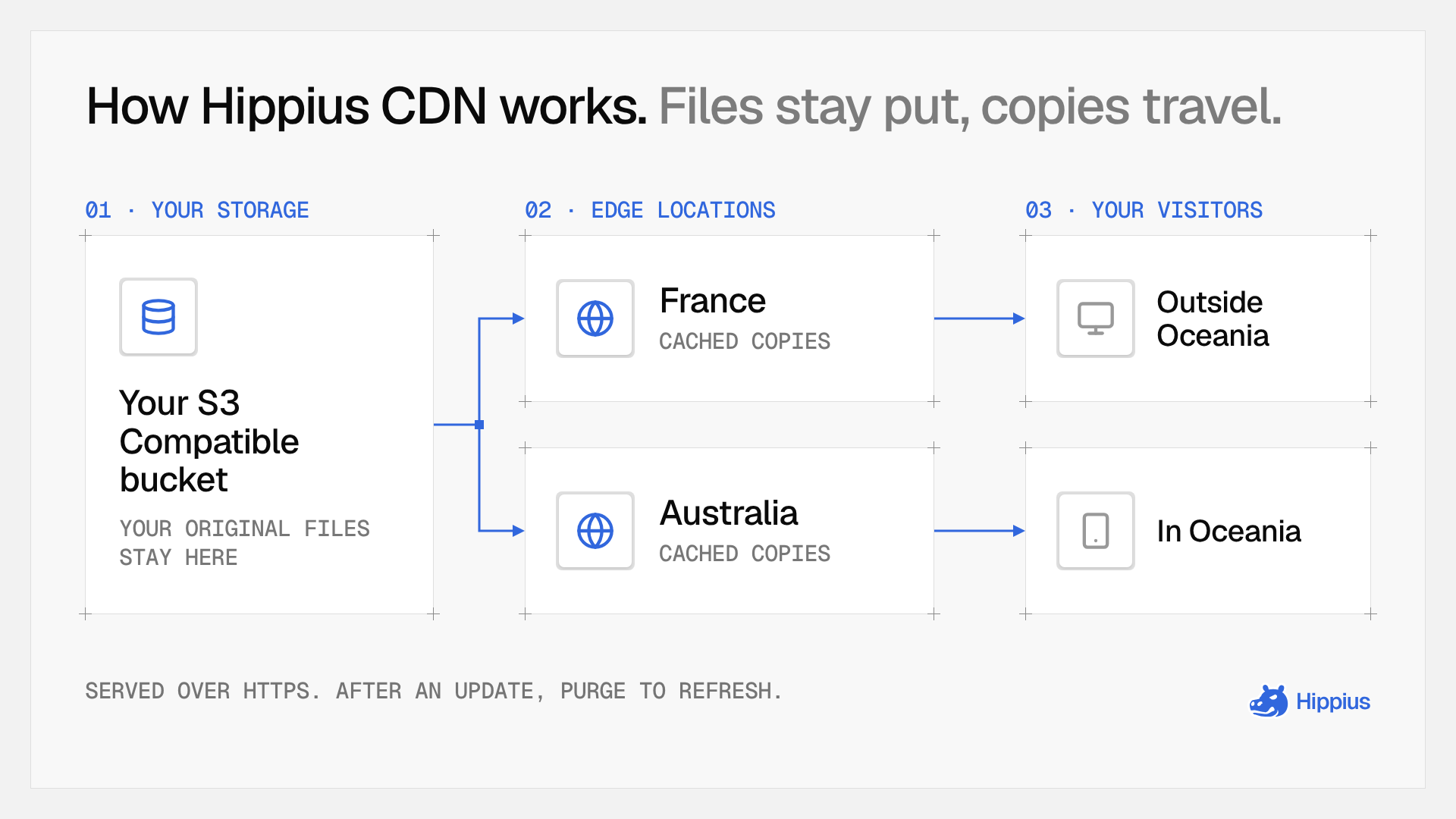
The new delivery service routes traffic by region: visitors in Oceania go to Australia, with France as a fallback if no Australian node is available; everyone else goes to France. Each zone also has a shield region, the cache from which other regions fill. Customers, in turn, choose the shield nearest their bucket, with France selected by default.
Creating a zone on a private bucket gives the cache nodes a read-only key. Every object within the selected bucket or folder then becomes publicly readable through the CDN, so customers should scope a zone to content intended for publication rather than expose a bucket that also holds private files.
Delivery supports GET and HEAD requests, including range requests that retrieve only part of a file, which is useful for media playback and large downloads. The service passes through object metadata such as content type, ETag, and last-modified time, allowing clients to identify file formats and versions.
Usage Pricing With Automatic Spending Pauses
Hippius CDN pricing separates data transfer, request volume, and custom domains. Charges are deducted hourly from the account balance, without a subscription tier or commitment.
| Item | Price |
|---|---|
| Data delivered to visitors outside Oceania | $0.010 per GB |
| Data served from Australia to visitors in Oceania | $0.060 per GB |
| Requests, all regions | $0.002 per 10,000 |
| Custom domain | $1 per domain per month, billed hourly |
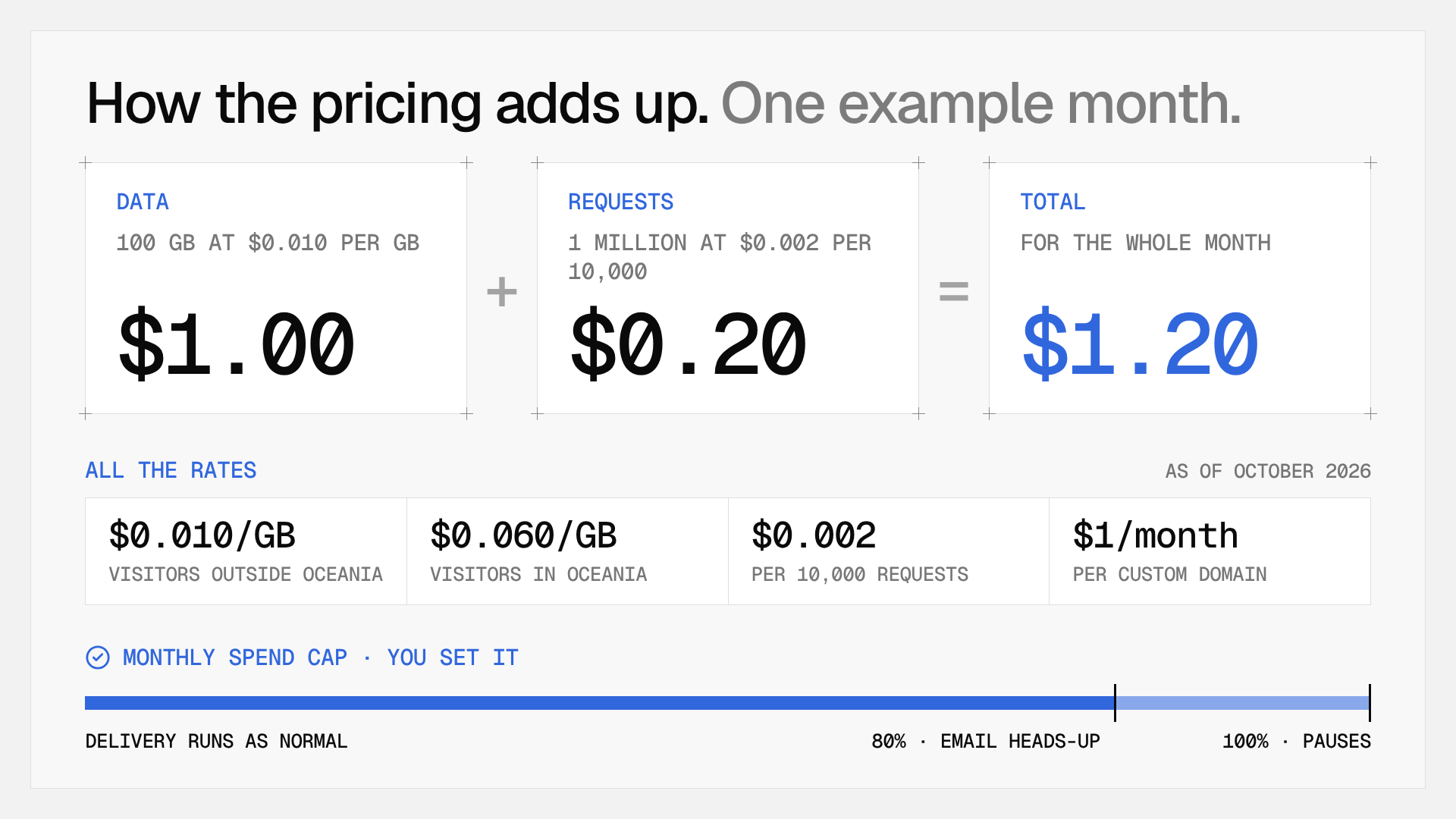
Delivering 100 GB at the France rate with 1 million requests costs $1.20: $1 for data and $0.20 for requests. One custom domain adds $1 for a full month of active billing. The default zone hostname is included, and data is measured in decimal gigabytes of 1 billion bytes, including headers.
For each byte, Hippius applies the cheaper rate associated with the serving region and the visitor's region. An Oceania visitor served from France during a fallback therefore receives the lower France rate rather than the Australia rate.
Each zone starts with a $20 monthly cap, adjustable from $1 to $100,000. The account owner receives an email at 80% of the limit. At the cap, the zone pauses delivery and rejects requests without billing them. Raising the cap restores service immediately; otherwise, delivery resumes on the first day of the following month.
The cap is checked every minute, so spending can finish slightly above the selected amount. It controls costs by interrupting delivery once the budget is exhausted.
Static Sites, Cache Rules, and Deployment Controls
The service can host static websites and single-page applications directly from bucket contents. An index-document setting maps directory requests to a file such as index.html, while an optional fallback sends unknown paths to the application's entry page so its client-side router can handle them. Excluded asset folders retain their normal 404 responses, preventing a missing script or image from receiving HTML instead.
Every zone gets an HTTPS hostname. Customers can add their own domain using the DNS records shown in the console, including records for ownership verification and certificate issuance. Hippius manages the certificate, and automated DNS setup is available for Cloudflare and Amazon Route 53.
Website deployments need a custom domain because HTML, SVG, and XML served on the default hostname receive a sandbox security policy. The CDN documentation directs customers to use their own domain for sites. HTML also needs an explicit content type when uploaded, because the CDN does not infer it from the file extension.
By default, successful responses are cached for one hour and missing-file responses for one minute. Redirects and server errors are not cached. Up to 50 ordered rules per zone can change edge and browser cache lifetimes, include selected query parameters in cache keys, bypass caching, or control handling of the Set-Cookie header.
Customers can invalidate individual paths, folder prefixes, or the entire zone through the console or an API call. Hippius says purges usually reach every node in under a minute. For static-site updates, purging /index.html, or a prefix containing it, clears the cached entry document; purging / as a single path does not.
Cross-origin resource sharing, or CORS, is configurable for applications that fetch files or load fonts from another domain. It is off by default, and developers can allow specific origins, methods, and headers as needed.
Accounts can create up to 10 zones, with up to 20 custom domains per zone. To begin, customers select a bucket or folder in the Hippius console, choose a shield region and spending cap, and create the zone. The default HTTPS hostname becomes available within seconds.