

Table of Contents
Etao changes how a subnet distributes the alpha emissions it already receives. It does not change the total TAO emission schedule, how much a subnet earns, or how Dynamic TAO allocates emissions across subnets.
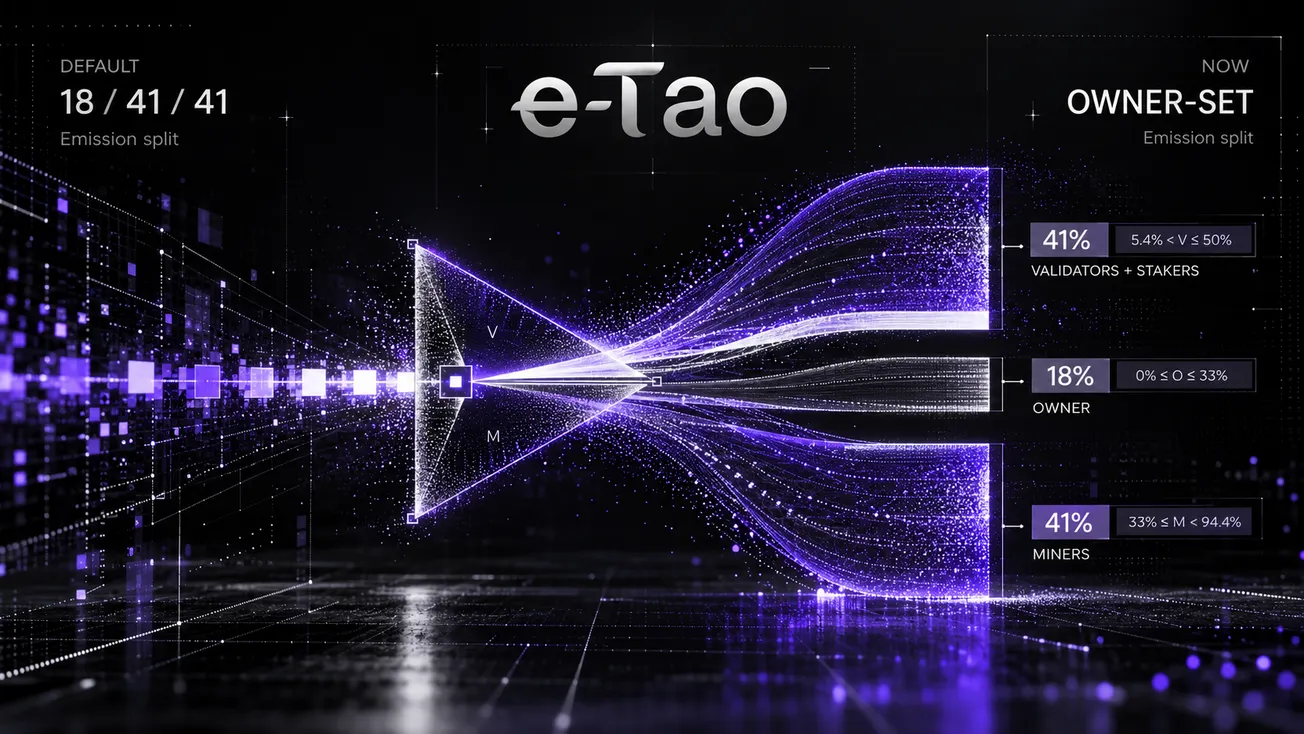
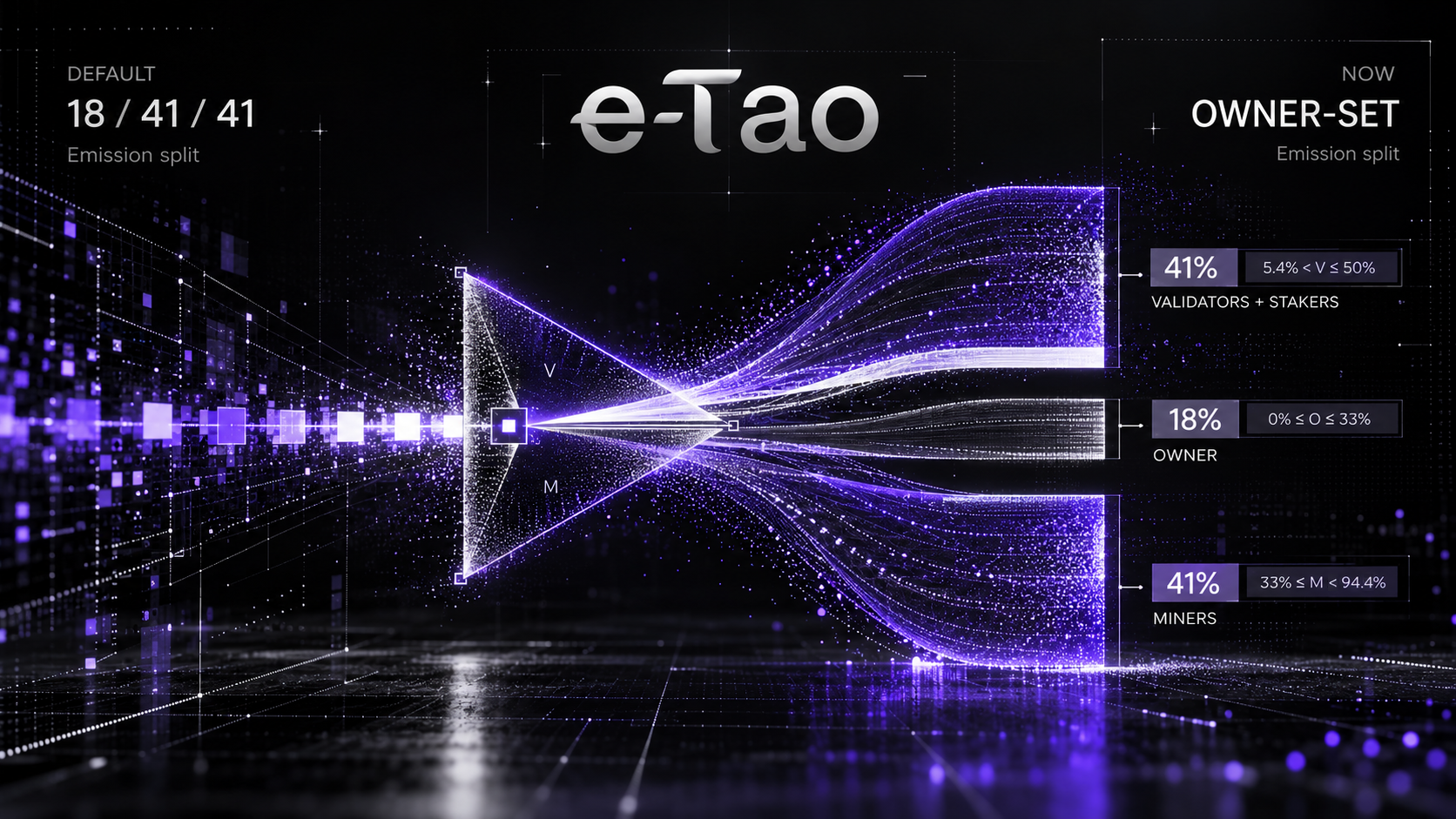
Before Etao, the standard subnet split was fixed across the network. A subnet's owner received 18%, validators and their stakers received 41%, and miners received 41%. That model made the reward structure simple, but it treated very different subnets as if they had the same cost structure.
After Etao, each subnet has its own emission weight vector. The official release describes the vector as [burn, recycle, owner, validator, miner], although burn and recycle are reserved at zero in the first version.
In practice, a subnet owner can shift more of the subnet's alpha toward miners, validators, or the owner slot, subject to the protocol's limits. A compute-heavy subnet may want to increase the miner share to pay for expensive work. A subnet that depends heavily on evaluation may want a larger validator budget. Another subnet may cut the owner share to zero if it wants every available point to flow to network participants.
Etao is now live on mainnet.

What Are the Etao Emission Split Limits?
Etao gives subnet owners flexibility, but the split is not arbitrary. The vector has to total 100%, and each slot has its own rule.
| Slot | What It Pays | Etao v1 Rule |
|---|---|---|
| Burn | Alpha destroyed | Reserved at 0 |
| Recycle | Alpha returned to the unissued pool | Reserved at 0 |
| Owner | Subnet owner hotkey | 0% to 33%; lease-created subnets must keep at least 18% |
| Validator | Root baseline first, then alpha validator dividends | Up to 50%, and strictly above root's live baseline share |
| Miner | Miner incentives | At least 33% |
The official example is an owner share of 18%, a validator share of 20%, and a miner share of 62%, assuming that 20% clears the live root-protection threshold for that subnet.
Owners can update a subnet's vector once every 50,400 blocks, or roughly once a week. The first change is free, the rate limit stays with the subnet if ownership changes, and root-authorized changes are exempt from the rate limit.
Etao introduces a configurable reward split with firm limits. Miners must receive at least one-third of the subnet's emissions, validators cannot receive more than half, and the owner slot is capped at one-third.
Who Can Change a Subnet's Split?
The subnet owner's coldkey or root can change a subnet's emission split. The low-level call is AdminUtils.sudo_set_subnet_emission_weights, and the operator-facing interface is the btcli subnets emission command set.
The documented CLI commands include:
btcli subnets emission showbtcli subnets emission setbtcli subnets emission set-valuebtcli subnets emission increasebtcli subnets emission decrease
Operators can also use --dry-run to preview a change before signing it. The tooling exposes the live validator floor, root's baseline share, capped-state warnings, and timing information for the next permitted owner update.
Ordinary stakers, miners, and validators do not vote directly on a subnet's Etao split through this interface. The decision sits with the subnet owner, while root retains an administrative path.
Does Etao Change How Much a Subnet Earns?
No. Etao changes how a subnet divides its alpha emissions after the subnet has already earned them. It does not change the amount of TAO or alpha injected into a subnet's pool, the subnet's emission share, prices, swaps, or the broader Dynamic TAO mechanism.
Bittensor now has multiple layers of emission logic.
Dynamic TAO, or dTAO, is the system that introduced per-subnet alpha tokens and market-driven subnet allocation. It helps determine how emissions are directed across subnets. For a broader primer on that system, see:

Etao operates one level later. Once a subnet has its emissions, Etao determines how that subnet's alpha is split among owners, validators, and miners.
Existing subnets also do not automatically jump to a new owner-selected split. Live subnets were seeded from their legacy allocation so the first post-upgrade payout matched the last pre-upgrade payout, and new subnets start with the default [0, 0, 18%, 41%, 41%] vector.
What Happens to Root Stakers?
Under Etao, root TAO stakers keep the baseline share they would receive from an untouched subnet under the default validator allocation. Root is paid first from the validator slot, and alpha validators receive what remains.
In Bittensor terms, root TAO is weighted against subnet alpha through the global TaoWeight, set to 0.18 on mainnet at the time of the Etao documentation. The chain computes root's baseline share every block using live root stake, the subnet's alpha issuance, and the default validator share.
In plain English:
Root baseline share = 0.41 × weighted root TAO / (weighted root TAO + subnet alpha issuance)
The release page expresses the baseline as r = V0 × x / (x + A), where V0 is the default validator share of 0.41, x is root TAO multiplied by TaoWeight, and A is the subnet's alpha issuance.
The guide's worked example uses 5.44 million TAO on root, 6.46 million alpha issued, and a TaoWeight of 0.18. Under those assumptions, root's baseline is about 5.40% of the subnet's emission, so the validator slot can be lowered only to a value strictly above that floor.
This is why lowering validators from 41% to 20% in the official example does not reduce root's baseline share. Root's portion is paid off the top first, and the cut comes from alpha validators and their alpha stakers. If the live baseline later grows above a low validator slot, root receives the whole validator slot and alpha validators receive nothing until the owner raises the validator share again. The guide calls this the capped case, and btcli subnets emission show flags it.
What Etao Means for Validators and Miners
Etao makes the economics of each subnet more specific. Instead of every subnet offering the same top-level owner, validator, and miner split, each subnet can align its rewards with the work it wants to attract.
Miners can see a larger reward budget on subnets that raise the miner share. That matters most for subnets where the cost of useful work is high, such as networks that depend on expensive compute, bandwidth, data collection, or other ongoing resources.
Alpha validators face more variation. A subnet that lowers the validator slot below the old 41% default leaves less for alpha validators after root's baseline is paid. A subnet that raises the validator slot can increase the alpha validator budget, though the validator share cannot exceed 50%.
Root stakers keep the default baseline, but the cap still applies. Root cannot receive more than the validator slot itself. If the baseline later rises above a low validator share, root takes the full slot and alpha validators receive none of it until the owner adjusts the share upward.
This makes subnet-level monitoring more important. A validator, miner, or staker can no longer assume that every subnet's top-level split is 18/41/41. They need to check the actual emission weights for the subnet they are evaluating.
Etao vs. dTAO
Etao and dTAO are related parts of Bittensor's economic architecture, but they answer different questions.
Dynamic TAO decides how emissions are allocated across subnets by introducing subnet-specific alpha tokens and TAO/alpha market dynamics. Etao decides how a subnet divides the alpha emissions it receives among the owner, validators, and miners.
They split along two questions:
| System | Main Question | Practical Effect |
|---|---|---|
| dTAO | How much emission does a subnet receive? | Subnet allocation is tied to alpha-token market dynamics and staking demand |
| Etao | How does a subnet divide what it receives? | Subnet owners can adjust the owner, validator, and miner split within protocol limits |
How to Check a Subnet's Etao Split
To view a specific subnet's emission split, run btcli subnets emission show --netuid N.
The relevant hyperparameters now include:
owner_emissionvalidator_emissionminer_emission
Those values show how the subnet's alpha emissions are divided among the owner, validator, and miner buckets. For broader context on subnet settings:

Conclusion
Etao gives Bittensor subnets more control over their internal reward design. Instead of forcing every subnet into the same 18/41/41 allocation, the upgrade lets owners adjust how alpha emissions flow to owners, validators, and miners, while preserving root's baseline share through a live validator-slot protection mechanism.
The change does not alter total TAO emissions, a subnet's emission allocation, or the mechanics of dTAO. Subnets can now tune participant incentives around the kind of work they need, so miners, validators, stakers, and subnet teams can no longer treat the fixed split as enough context. The actual subnet-level Etao weights now matter.
FAQs
What Is Etao or eTAO?
Etao, also written as eTAO in some official communications, is a Bittensor upgrade that lets subnet owners set how their subnet's alpha emissions are divided among the owner, validators, and miners within protocol limits.
Is Etao Live on Bittensor?
Yes. Etao is live on Bittensor mainnet (runtime 481, live since Oct 19, 2026; Opentensor announced it on Oct 20). It is a Runtime v480 to v481 upgrade delivered as a sudo runtime upgrade from main. The GitHub v481 release includes the Etao root-baseline mechanism in spec 481.
What Was the Old Bittensor Subnet Split?
The old standard split was 18% to the subnet owner, 41% to validators and their stakers, and 41% to miners. Etao turns that default into a configurable subnet-level split.
Can a Subnet Owner Take More Than 18%?
Yes. Under Etao, the owner slot can range from 0% to 33%, although lease-created subnets must keep at least 18% in the owner slot.
What Is the Minimum Miner Share Under Etao?
The miner slot must be at least 33% in Etao v1. A subnet can raise the miner share above that level if the owner and validator slots remain within their limits and the full vector totals 100%.
What Is the Maximum Validator Share Under Etao?
The validator slot can be at most 50%. Its minimum is not a fixed number because it must stay strictly above root's live baseline share at the time of the change.
How Often Can Subnet Owners Change the Split?
Subnet owners can change a subnet's emission vector once every 50,400 blocks, or about once a week. The first change is free, and the rate limit follows the subnet rather than the coldkey.
Does Etao Reduce Root Staking Rewards?
Etao preserves root's baseline share. Root is paid first from the validator slot using a live baseline calculation, though root's payout is capped by the size of the validator slot itself.
Does Etao Change How Much TAO a Subnet Gets?
No. Etao changes how a subnet distributes the alpha emissions it receives. It does not change how much TAO or alpha is injected into the subnet's pool, subnet prices, swaps, or the subnet's total emission allocation.
Is Etao the Same as dTAO?
No. dTAO helps determine how emissions are allocated across subnets through alpha-token market dynamics. Etao determines how a subnet divides its own alpha emissions among owners, validators, and miners.
Did My Subnet's Split Change Automatically?
Existing subnets were seeded from their legacy allocation so the first post-upgrade payout matched the last pre-upgrade payout. New subnets start with the default [0, 0, 18%, 41%, 41%] vector.