

Table of Contents
Metanova's miners on Bittensor Subnet 68 screen molecules against disease targets through NOVA, the subnet's screening and incentive platform, and earn TAO only when a submission beats the current best score. In May, a molecule that clears that screen started reaching a chemist's bench in five to seven business days, down from the months a synthesis order usually takes. Metanova closed that gap through a partnership with ONEPOT.AI, an AI-driven robotic synthesis lab backed by OpenAI co-founder Wojciech Zaremba and Google Chief Scientist Jeff Dean.
That partnership shipped inside a six-month stretch that moved more than $4.3 billion in disclosed capital toward AI drug discovery. Isomorphic Labs raised $2.1 billion in May, Eli Lilly and Nvidia opened a $1 billion co-innovation lab, and GSK licensed cancer models from Noetik while building toward a $1.2 billion AI-powered biologics factory. Anthropic launched Claude Science and its own internal drug discovery program the same month OpenAI's GPT-Rosalind started running inside Amgen and Moderna.
Every one of those bets sits behind an enterprise contract, a research partnership, or a corporate account someone else controls. Metanova spent the same six months tightening the mechanism that lets anyone holding TAO compete for those same discoveries: a rebuilt incentive layer, a growing agent fleet, and a synthesis pipeline that turns a screening win into a physical compound in days. The first wet lab results land in the second half of the year.
— METANOVA (@metanova_labs) July 8, 2026
The Money Chasing AI Medicine Also Chose to Wall It Off
Isomorphic Labs, the Alphabet-founded drug design company, closed its $2.1 billion Series B in May. Forbes ranked it the second-largest biotech fundraise on record, behind only Altos Labs, and its deals with Eli Lilly, Novartis, and Johnson & Johnson carry a combined milestone ceiling north of $3 billion. None of that pipeline is visible to a researcher without a partnership agreement.
Eli Lilly and Nvidia followed with a $1 billion, five-year co-innovation lab and switched on LillyPod, a supercomputer the companies call the most powerful in the pharmaceutical industry. Roche assembled a hybrid-cloud AI factory that now runs more than 3,500 GPUs across the United States and Europe, the largest disclosed compute footprint any drug company has announced. GSK licensed two cancer foundation models from Noetik for $50 million and is building toward the $1.2 billion AI-powered biologics factory it committed to last year.
Even the AI labs picked medicine as the next fight. Anthropic launched Claude Science on June 30 and used the same announcement to confirm an internal drug discovery program targeting neglected diseases. OpenAI's GPT-Rosalind, live since April, already runs inside research programs at Amgen, Moderna, and Thermo Fisher Scientific. Boltz, whose affinity-prediction models sit behind two of NOVA's own scoring oracles, moved its newest version behind a closed, API-only paywall in June.
The pattern repeats at the chip layer. Export controls tied to U.S. national security policy suspended global access to Anthropic's own Fable and Mythos models for about three weeks in June, proof that even the companies building frontier AI can lose access to their own tools when a government redraws the map. Scientific talent sits everywhere. The tools to act on it keep concentrating in the hands of whoever a corporate account or an export license lets in.
Metanova Rebuilt Its Incentives So Only Real Improvement Gets Paid
NOVA has now screened more than 11 million molecules across nine disease targets, and Metanova spent the first half of the year making sure that volume turns into quality instead of noise.
Blueprint, NOVA's open search competition, produced a winning method that beat the industry-standard Thompson Sampling benchmark on PBX1, a transcription factor tied to leukemia and treatment resistance. The winning approach borrowed a technique from a field outside drug discovery entirely, the kind of cross-disciplinary result a closed lab rarely stumbles into.
The chemical universe is too massive for brute-force computing.
— Openτensor Foundaτion (@opentensor) June 2, 2026
"It would take over 170 years to brute force this data set by running inference on every single possible molecule." @metanova_labs#SN68 "Nova blueprint" incentivizes global miners to design and open-source their… pic.twitter.com/IaZGqbAAMw
To confirm that the win reflected skill rather than luck, Metanova raised the bar to a Quadruple Crown. A method now has to beat three different targets across four straight rounds to hold the top spot, and the subnet rewrote how miners get paid around the same logic.
- Bounty-based payouts release TAO only when a submission beats the current best, so accumulated emissions carry no reward for standing still.
- Blueprint now rejects molecules that sit too close to submissions miners have already made, forcing genuine coverage of chemical space instead of small variations on a known winner.
- Code stays private until it earns TAO, giving miners room to refine an approach before the network can copy it.
- NOVA Compound pays winning submissions directly regardless of what happens to a miner's identifier during evaluation, closing an edge case that let some winners go unpaid.
- Miner burn dropped to 0%, a change Metanova says benefits every token holder.
A Second Modality Doubled the Competition Inside NOVA
April brought nanobodies, a molecule class built for targets small molecules can't reach cleanly. Small molecules still cover oral, chronic therapies. Nanobodies specialize in high-affinity binding to hard targets a pill can't reliably hit, and Metanova's early nanobody rounds focused on interleukins, the signaling proteins tied to autoimmune disease, chronic inflammation, and cancer.
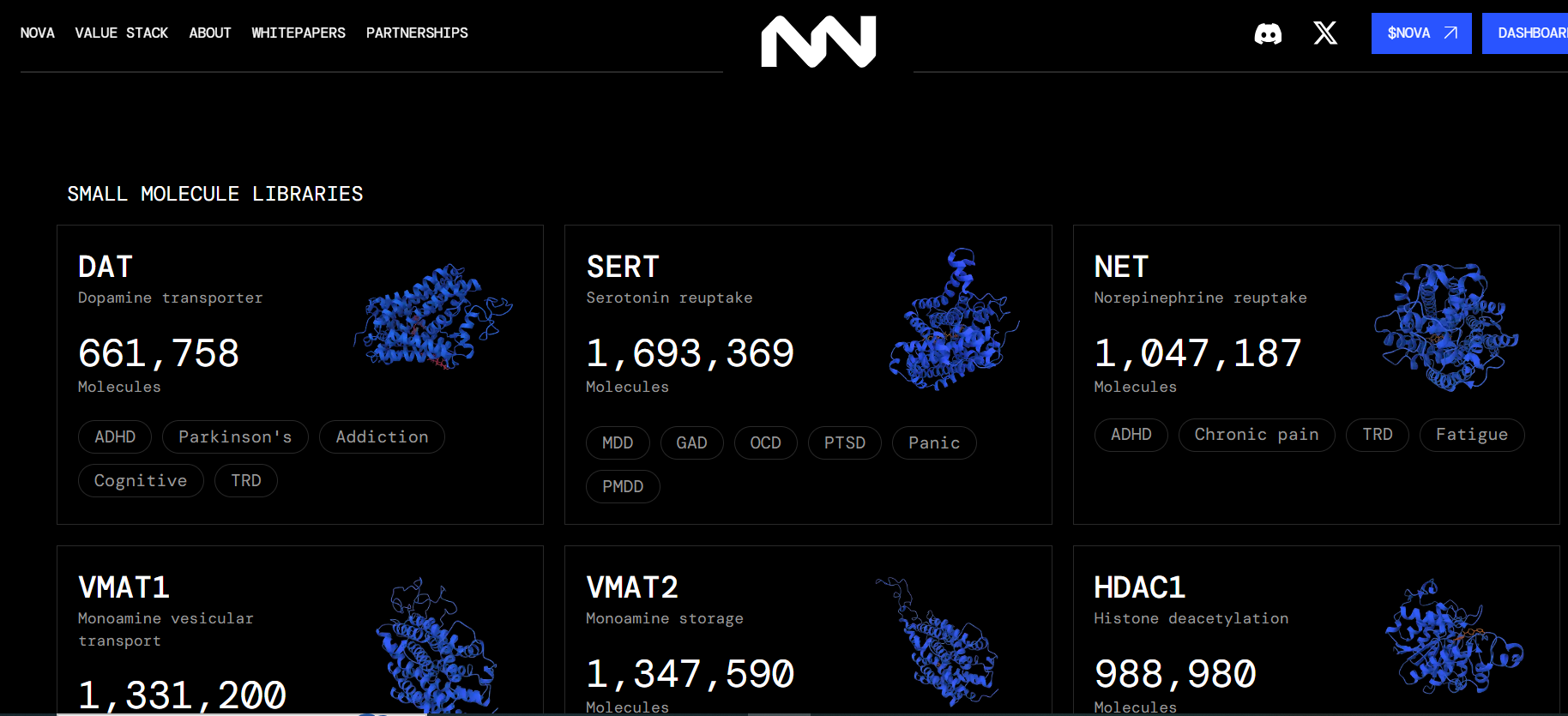
Submission quality moved fast once miners started competing. Metanova reports binding confidence roughly tripled between the first and last submissions in the competition's opening weeks, and top nanobody candidates are now queued for wet-lab validation through a partnership with Yalotein.
An agent fleet took shape alongside the human miners. ArboPatents, one of four agents Metanova built this year, ran an 18-iteration patent-to-molecule matching loop against roughly 1,500 molecules tied to ADHD patents and reached an 85.4% best hit rate using open data alone, a result the team says took about 12 hours to produce.
The Team Locked Its Own Stake Before Anyone Asked
Bittensor's Conviction mechanism now auto-locks subnet owner emissions the moment they arrive, replacing a system where an owner could exit a subnet without warning. Metanova moved ahead of the requirement. Half the company's tokens are locked, among the highest commitments any subnet owner has made, and the owner's share now locks automatically going forward.
Founders split 20% of what the subnet earns four ways, tying the founding team's upside to NOVA's growth instead of a fixed salary. That structure carries more weight now that subnet ownership itself is a public, stake-weighted contest rather than a one-time registration fee.
The Second Half Decides Whether Predictions Become Medicine
Metanova expects its first wet-lab results across both small molecules and nanobodies in the second half of the year, the point where a computational hit either becomes a real candidate or gets folded back into the next round of training data. A new models competition opens the predictive layer itself to the same pressure that already sharpened the search. Even the strongest affinity models in the field perform unevenly target to target, and NOVA's new competition rewards model heads fine-tuned to the specific targets where accuracy still lags.
Isomorphic Labs has $2.6 billion in committed capital and a research bench most biotechs can't recruit against. Metanova has a synthesis loop anyone holding TAO can compete inside, and 11 million screened molecules already on the board before its first wet-lab result even lands.
You don't need an enterprise account, a research partnership, or an export license to hold a stake in NOVA's next discovery. The second half decides whether that access turns into medicine, not just molecules on a screen.
Disclaimer: This article is for informational purposes only and does not constitute financial, investment, or trading advice. The information provided should not be interpreted as an endorsement of any digital asset, security, or investment strategy. Readers should conduct their own research and consult with a licensed financial professional before making any investment decisions. The publisher and its contributors are not responsible for any losses that may arise from reliance on the information presented.
%3A%20How%20Bittensor's%20Drug%20Discovery%20Subnet%20Answered%20Pharma's%20Billion-Dollar%20AI%20Race)