
Table of Contents
Notion has rebuilt its AI agents to work on tasks for up to 24 hours, equipped them with a computer and browser, and introduced a credit system that separates everyday AI work from manually selected models and Custom Agents.
The Notion AI upgrade also includes a smarter Auto model router, which Notion says produced results similar to leading models at about 90% lower average cost in its tests. Users can now connect an existing ChatGPT subscription to their personal Notion Agent, while Enterprise customers can seek access to a private alpha for using their own model-provider keys.
Agents can now take on substantially longer workflows, while model choices and agent ownership determine which credit balance pays for the work. The new billing system launched for new Business and Enterprise workspaces on October 19; existing workspaces move over on November 2.
How Notion Keeps Agents Running for Longer
The sixth-generation agent harness is the software that manages a model's tools, context, and execution. It replaces a five-minute task window with workflows lasting as long as a day. Each session runs on a dedicated service with a queue-backed worker loop, allowing work to continue through restarts and temporary interruptions.
Agents can also write and execute short scripts on their own computer. That lets them perform suitable operations as code rather than spending language-model tokens working through each step. Browser access extends the tools available for completing tasks beyond Notion itself.
Longer sessions also require managing what the model rereads. Notion compacts extended conversations, using model providers' native compaction where possible, and offloads large tool results instead of keeping them in the context window. Reducing that repeated input lowers the computation required at successive steps.
A new "Review for me" approval mode uses a separate model to check an action's safety before the agent proceeds. In its technical account of the rebuild, Notion reports infrastructure uptime above 99.9% and Custom Agent runs costing about 30% less in testing. It also reports agents running up to 50% faster on web and mobile.
Auto Routes Work Across Models
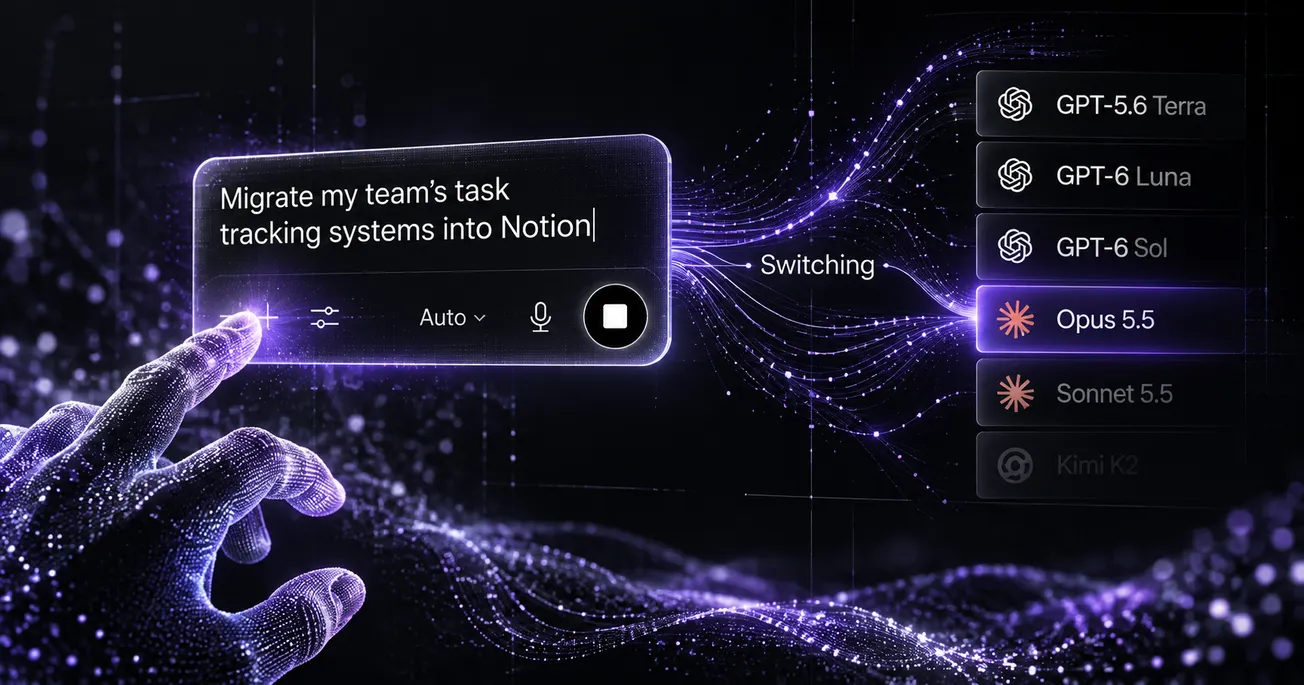
Auto is a routing system rather than a new Notion-trained foundation model. It sends quick questions, edits, and summaries to faster, more efficient models, while assigning demanding analysis, coding, and multistep work to more capable ones.
The selection can change during a workflow. Auto can use a stronger model for a difficult step, return to a cheaper one for simpler work, or reroute a task when the current model stops making meaningful progress. It only uses models permitted by the workspace's provider and model settings.
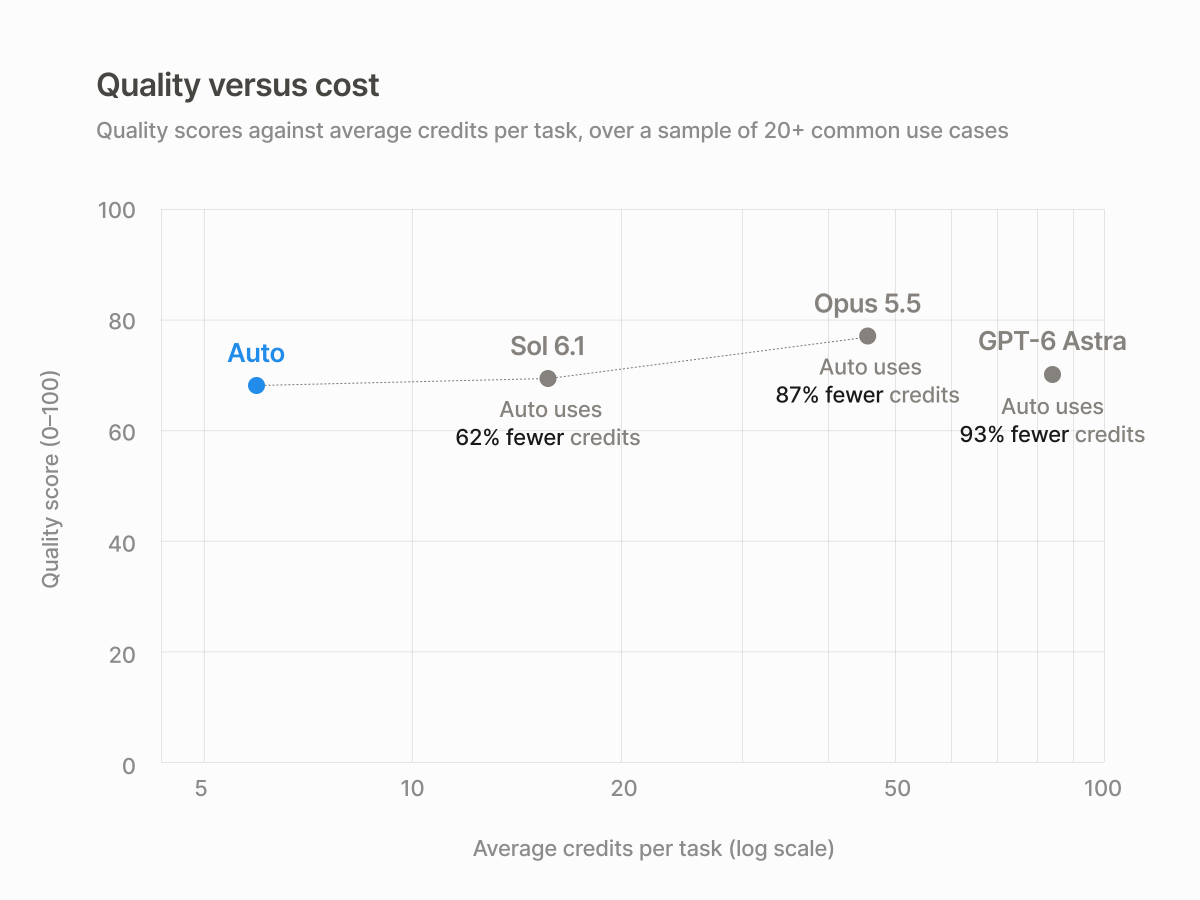
Across more than 20 common use cases, Notion says Auto delivered quality similar to Opus 5.5 and Astra at about 90% lower average cost.
For that evaluation, Notion replayed thousands of real-world tasks in a simulated workspace. A panel of leading models compared outputs in head-to-head matchups, which were used to assign Elo scores, relative ratings based on wins and losses. Notion then trained an AI judge to reproduce those rankings at greater scale.
The company also publishes a separate Knowledge Board tracking model performance on live knowledge-work requests, including resolution rate, cost per task, and completion time. That ongoing measurement uses randomly assigned traffic and an ensemble of model judges, rather than the replay-based comparison used to evaluate Auto.
ChatGPT Subscriptions and External Agents
The ChatGPT connection, built with OpenAI, supports Plus, Pro, and Go subscriptions. It works in a user's personal Notion Agent, not Custom Agents, and lets users draw on their existing ChatGPT plan instead of consuming Standard or Select credits.
Bring Your Own Key offers a separate route for Enterprise customers to use their own model-provider credentials. That option is in private alpha, with access handled through Notion's account teams.
Notion has also overhauled its Model Context Protocol integration. MCP provides a standard way for external AI tools to access a service's context and capabilities. In Notion's case, agents such as ChatGPT, Claude, Grok Bot, and Muse can use the workspace to retrieve information, retain useful context, and create shareable artifacts.
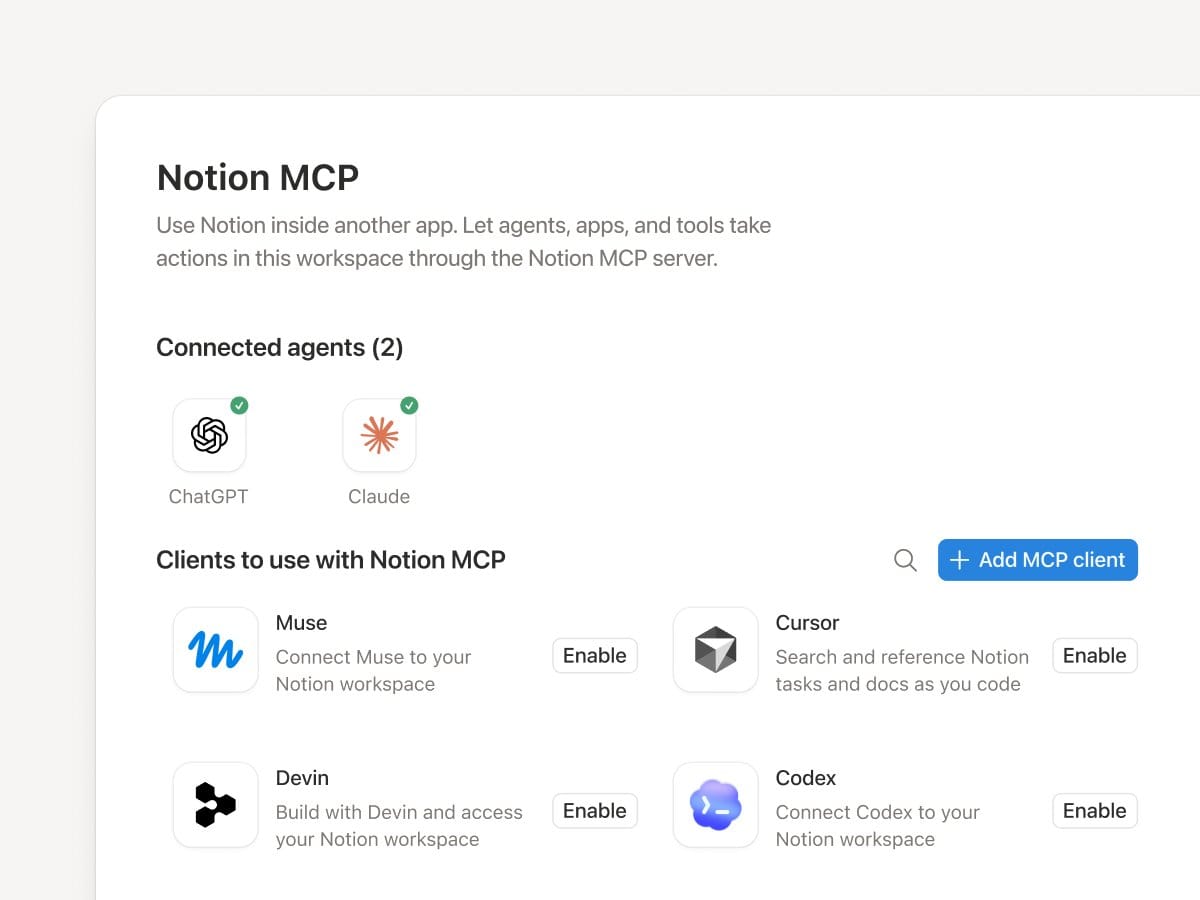
Memory synchronization is available now, while Skills through MCP are planned. Notion co-founder Akshay Kothari says the company's agents can now connect to hundreds of tools through MCPs and connectors, compared with a few dozen earlier in the summer.
Which Credits Pay for Each Workflow
The new credit system gives Business and Enterprise members two separate monthly allowances. Standard credits pay for work where Notion chooses the model; Select credits cover manually chosen models and owner-funded Custom Agents. Included amounts can vary with the plan and purchasing arrangement.
| Credit Type | Monthly Allowance | What It Covers |
|---|---|---|
| Standard | 1,500 per member | Personal Notion Agent on Auto, writing, translation, and other eligible AI features |
| Select | 500 per member | Manually selected models and Custom Agents funded by their owner |
| Notion | Purchased by workspace admins | Approved overflow, high-consumption models, workspace-funded Custom Agents, and agent runs through the API or connected apps |
Standard and Select balances cannot be combined, transferred between members, or rolled over. When a balance runs out, the affected features pause until the monthly reset unless an admin has enabled continued usage through the workspace's purchased Notion credits. Standard credits remain available for Auto even if a member exhausts their Select balance.
Custom Agent billing follows ownership by default. An agent uses its owner's Select credits even when colleagues run it. Owners can cap spending per agent, and admins can fund an agent directly with a workspace budget instead. Existing Custom Agents created before November 2, 2026, will continue drawing from shared workspace credits.
That makes it possible to begin building and sharing Custom Agents without first purchasing workspace credits. In a separate explanation of the pricing changes, Kothari said Notion was consolidating AI capabilities under credits while offering users more control over model choice and spending.
A planned AI Command Center will bring usage by member, feature, and agent into one dashboard, with alerts and spending limits. Admins will also be able to manage model access and permissions to create, pause, or archive Custom Agents; members will see their own usage and per-agent spending.
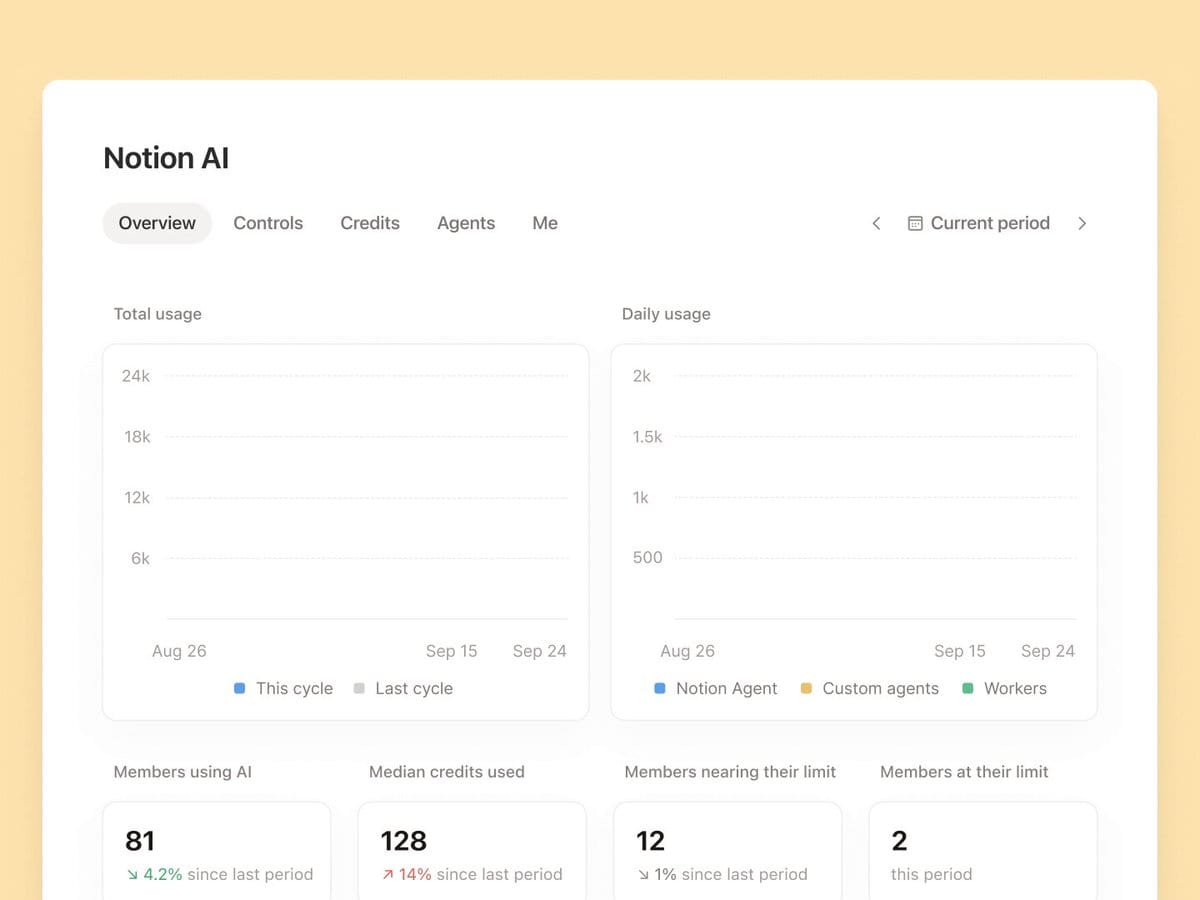
AI Meeting Notes will begin consuming Standard credits on December 1, 2026. Notion estimates that transcribing and summarizing a one-hour meeting will use about 10 Standard credits.


