Table of Contents
NVIDIA has announced a five-year, $250 million compute donation for U.K. agentic safety and security research, extending the chipmaker’s recent push to make AI agent safety an infrastructure problem rather than only a model-alignment concern.
The commitment will provide $50 million in annual compute access for research into secure agents, open-model security, real-world threat mitigation, sandboxes, reproducible research, and safety assessment benchmarks. The announcement came alongside a broader U.K. ecosystem update and a new partnership with The Earthshot Prize, where NVIDIA will provide AI resources and engineering support to climate and sustainability innovators.
The move places one of the world’s largest AI infrastructure providers behind a research program for autonomous-agent safety.
NVIDIA’s AI Agent Safety Commitment
The program is a $250 million compute donation over five years to strengthen the U.K.’s agentic safety and security research capability. The majority of the commitment will support the wider U.K. AI safety and security research community, while a portion will support work with the British Open-Ended Learning and Discovery Lab, the Science of Fundamental AI Research Lab, and Imperial College London.
BOLD, led by the University of Oxford, is working on AI systems that can learn, adapt, and operate alongside people. SOFAIR, led by University College London, is focused on open-source AI architectures and more accessible AI development. Imperial’s work will include safety engineering and robotics, placing part of the program directly in the path of physical AI systems.
NVIDIA said compute access will be funded through U.K.-based NVIDIA Cloud Partners, with infrastructure hosted in the U.K. Provider selection, technical architecture, and commercial terms have not been finalized.
That structure makes the commitment partly a research grant and partly a domestic compute-capacity play. Instead of shipping credits through a generic global cloud program, NVIDIA is tying the initiative to U.K.-hosted infrastructure and local AI research priorities.
Jensen Huang, NVIDIA’s founder and CEO, framed the donation as a way to advance AI capability and safety together.
“AI capability and safety must advance together,” Huang said in NVIDIA’s announcement. “The U.K. brings world-class scientific rigor to this essential engineering challenge. With this $250 million commitment, NVIDIA will put accelerated computing in the hands of U.K. researchers to develop, test and strengthen safeguards for increasingly powerful AI.”
Safety Research Moves Closer to Agent Infrastructure
The commitment follows NVIDIA’s launch of its Open Agent Safety Platform, which pairs OpenShell, an open-source secure runtime for sandboxing agent activity, with Sentry, a BlueField-4-based reference design for monitoring agent behavior from an out-of-band hardware layer.
Agent safety is becoming more operational. As AI systems move from chat interfaces into software development, enterprise workflows, finance, research, robotics, and infrastructure management, the safety question shifts from whether a model gives a bad answer to whether an autonomous system can access tools, credentials, APIs, files, networks, or machinery outside its intended scope.
In centralized AI stacks, NVIDIA’s answer is increasingly full-stack: secure runtimes, hardware-backed monitoring, domestic cloud infrastructure, and dedicated safety compute. In decentralized AI, similar questions are emerging around how agent networks evaluate behavior, price compute, detect malicious outputs, sandbox execution, and assign trust across independent operators.
Earthshot Partnership Extends NVIDIA’s U.K. Push
Alongside the safety-research commitment, NVIDIA also joined The Earthshot Prize as a Global Alliance Founding Partner. Earthshot said the partnership will give finalists technical training, engineering support, access to AI computing resources, and entry into NVIDIA’s Inception startup program.
The partnership is focused on climate and sustainability work, including climate-risk prediction, nature monitoring, scientific discovery, and complex systems optimization. Earthshot said finalists will also gain access to educational resources covering open models and Earth-2, NVIDIA’s climate and weather-modeling tools, as well as DGX Spark systems for local AI development.
The Earthshot tie-in gives NVIDIA’s U.K. announcement a second track: agent safety for research institutions and AI infrastructure for environmental innovators. Both fit into the company’s broader European positioning ahead of GTC Berlin, where sovereign AI, local compute capacity, and sector-specific deployments are central themes.
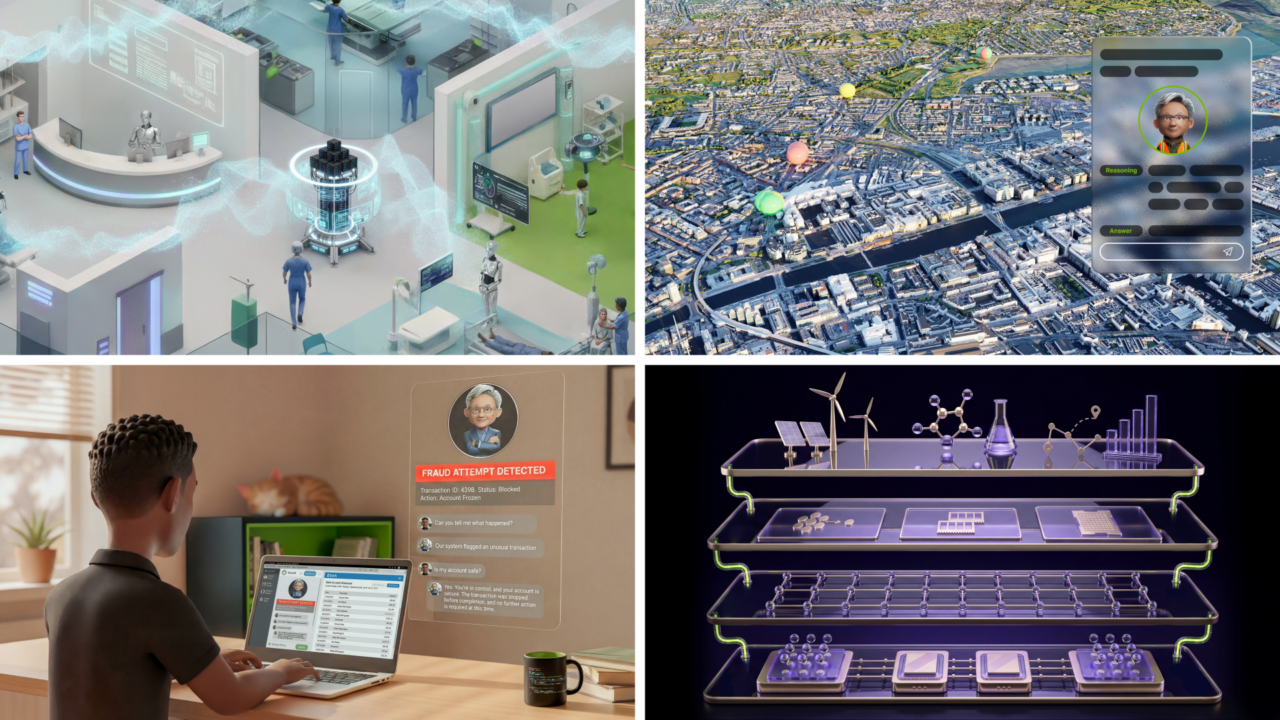
U.K. Deployments Span Energy, Healthcare, Cities, and Finance
NVIDIA’s U.K. update also highlighted a long list of customer and partner deployments. In energy, Fuse Energy is moving customer AI onto in-house infrastructure built on NVIDIA B300 Blackwell Ultra, serving more than 450,000 U.K. households.
In synthetic data, Locai Labs released Nemotron-Personas-UK, an open-source dataset of 1 million synthetic personas designed to reflect the U.K.’s demographic, regional, and cultural diversity. In healthcare, OneAdvanced is deploying a primary-care AI triage model for the NHS, while Heidi, Speechmatics, Apian, SYNLAB, and Danaher are using NVIDIA systems across clinical evidence, medical speech recognition, hospital logistics, and autonomous lab workflows.
The update also points to public-sector and finance use cases. Liverpool City Region is building an NVIDIA-powered “City Brain” as part of a sovereign AI strategy, while LSEG, Revolut, Lloyds Banking Group, Starling, NatWest, and Modulr are working on GPU-accelerated analytics, banking foundation models, voice AI, and payment-agent systems. NVIDIA also said more than 3,100 U.K. companies are part of its Inception startup program.
The announcements place agent safety, climate AI, and sovereign infrastructure under the same U.K. growth story. They also show how compute access is becoming a strategic tool for training frontier models and for shaping the safety standards, evaluation methods, and local infrastructure that will govern autonomous agents as they move into production.
The next public milestone is NVIDIA founder and CEO Jensen Huang’s GTC Berlin keynote, scheduled for Oct. 21 at 11 a.m. CEST.