

Table of Contents
OpenAI and Cisco have launched Shirudo, an open-source runtime that lets security teams apply targeted protections to running Linux systems while they test and deploy permanent patches. The software uses eBPF controls to block vulnerable behavior without requiring a service restart.
In a controlled test, a shield generated with OpenAI's Codex blocked a Java4Shell exploit attempt against a running Elasticsearch service.
Shirudo, Japanese for "shield," addresses the interval between identifying a vulnerability and safely fixing every affected system. It also gives AI agents a programmable way to develop and test temporary defenses, with security teams retaining control over deployment.
Protecting Services While Patches Are Pending
Testing and rolling out a patch can take days or weeks. During that interval, blocking an entire Linux operation may stop an exploit but also interrupt legitimate requests that depend on the same operation.
Shirudo's shields are intended to make that protection more selective. Teams can test whether a proposed safeguard stops the behavior exposing a vulnerability while allowing normal traffic through. They can also monitor how a shield would affect an application before switching it to enforcement. An operator approves the protection before it is deployed to the running service.
In the Elasticsearch test, the team attached the Codex-generated shield directly to the running process. It added an input check to Java's Base64 decoder, rejecting malicious input while Elasticsearch continued operating.
"We're giving defenders better models and tools to find and fix vulnerabilities faster, but finding a bug today doesn't mean you can patch every system tomorrow," said Greg Brockman, OpenAI's president and co-founder.
How Shirudo Controls and Verifies Live Protection
Shirudo uses eBPF, a Linux technology that allows small programs to run at specific points inside the operating system. Those programs provide a way to observe suspicious activity and apply narrowly targeted security controls to systems already in use.
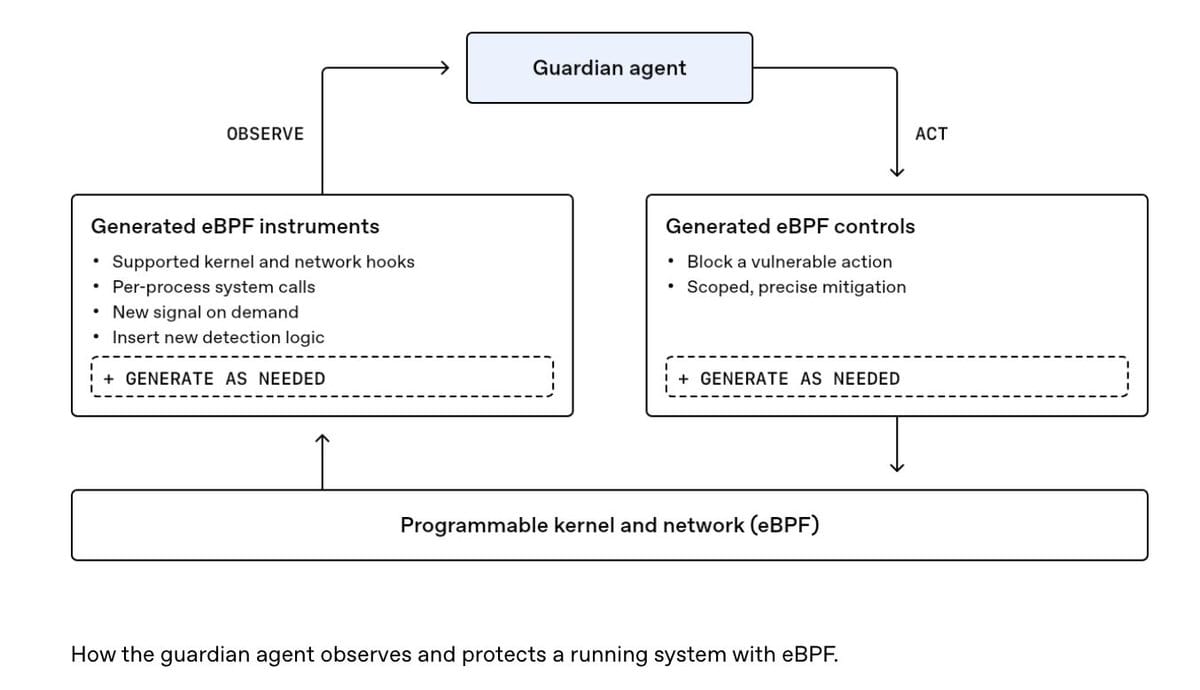
OpenAI and Cisco are designing the runtime to let agents investigate vulnerabilities, develop shields, and validate those defenses against both exploits and real workloads. OpenAI's launch post describes agents writing dynamic eBPF controls to give defenders more time to test and roll out patches.
The deployment process combines several checks with different roles. Shields are cryptographically signed, and their signatures are verified before loading. Linux's eBPF verifier checks programs against its safety rules, while kernel security controls restrict unauthorized changes. Testing a shield against an exploit and legitimate workloads addresses its intended behavior; the loading checks govern which programs can be installed and whether they meet the verifier's requirements.
Shirudo also uses a Trusted Platform Module, or TPM, to support a hardware-backed, verifiable record of protections being loaded or removed. Operators can use that record to check whether a system meets their security requirements. This adds evidence about the protections present on a machine alongside the controls governing their deployment.
Open Development and Hands-On Testing
The Shirudo code is available under the BSD 2-Clause license, with BPF programs dual-licensed under BSD and GPL. OpenAI and Cisco are inviting developers, security researchers, and infrastructure operators to inspect the runtime, test protections, and contribute improvements.
The partners aim to make tested shields available alongside vulnerability disclosures so operators can evaluate temporary protections while preparing patches. Their longer-term plans include hardening the kernel and core services, limiting workload permissions, and making updates and recovery safer, with security policies generated and maintained automatically.
The VM quickstart walks developers through signing, loading, and verifying a test protection. Isovalent's self-guided lab provides another hands-on route, while the Linux Plumbers Conference technical walkthrough covers applying a shield and verifying it on the target host. A technical deep-dive webinar is scheduled for December 15.