


Table of Contents
Boston Dynamics has fitted its Atlas humanoid with wheels in place of feet to test whether reinforcement-learning controllers can handle real motors pushed toward their operating limits. The research robot rolls, makes sideways dashes, and performs a 360-degree jump, giving engineers a demanding way to check how closely simulation-trained movements match physical hardware.
The wheeled Atlas demonstration is an experiment in connecting motor control with whole-body learning, rather than a new commercial robot. Wheels keep the ankle actuators working through sustained motion under load, exposing behavior that engineers need to reproduce accurately in training.
Xiaoyu (Andy) Wu, an Atlas controls engineer with more than a decade of experience in electric motors and their power electronics, led the work. Lessons from the project are already being applied to Atlas’s standard configuration, while Wu is also working on how learned controllers respond when actuators fail.
Turning Ankle Motors Into a Rolling Testbed
The mechanical conversion required only one new component: a custom adapter that attaches an off-the-shelf scooter rim to an existing ankle actuator. The motor that normally controls the ankle instead drives the wheel. Boston Dynamics credits Atlas’s serviceable design with making the retrofit straightforward.
In the software model, each wheel becomes an ankle that can rotate continuously. That allowed the team to modify the baseline robot model rather than build an entirely separate machine and control system.
Rolling gives the engineers a useful combination of demands. Accelerating, turning, and stopping carry the motors across their torque-speed range while they support and move the robot. Torque is the turning force a motor produces; speed describes how quickly it rotates. A controller has to work with the motor’s actual behavior across both, not simply request a movement that looks possible in simulation.
Boston Dynamics drew the motivation for testing these extremes partly from customer experience with Spot and Stretch. Robots encounter conditions outside the lab that are difficult to recreate fully during development. Here, wheels provided a way to stress the relationship between the hardware and its controller under a different set of movements.
Teaching the Simulation How the Motors Behave
Reinforcement learning trains a control policy, the system that selects the robot’s actions, through repeated simulated attempts that use rewards to favor desired behavior. For Atlas, that learned whole-body behavior must work through low-level motor controls that govern how the physical actuators respond.
A simulation with overly idealized motors can reward movements the real machine cannot execute. Making the motor model more faithful changes what the policy learns, so it must find actions that remain achievable when transferred to hardware.
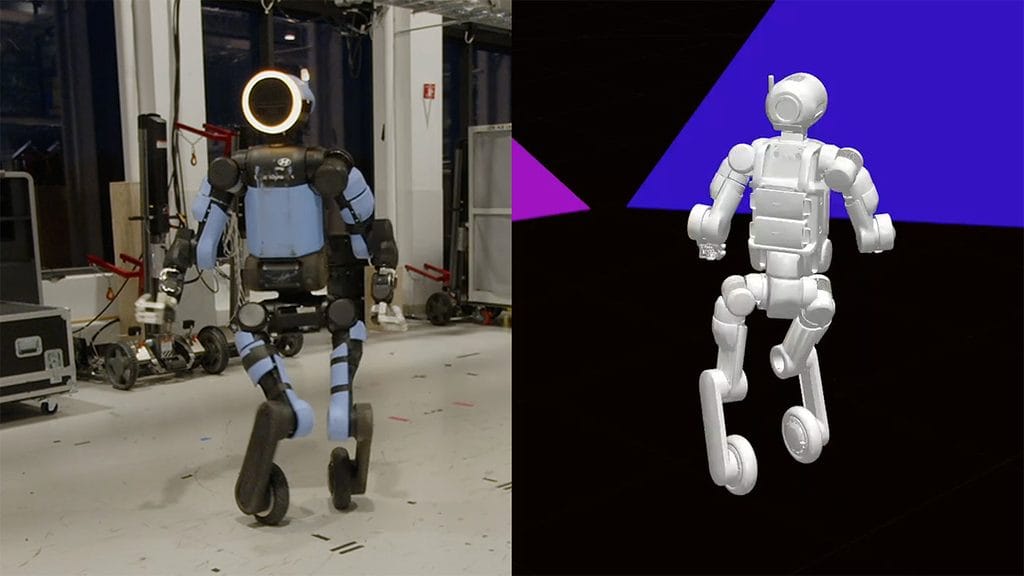
Much of the work involved measurement and consistency rather than inventing a new learning framework. The team checked that low-level control parameters matched across software setups, ran experiments to characterize actuator behavior, and tuned the simulated motors against measurements from the robot. It also examined which modeling approximations were acceptable and which shortcuts a learned policy might exploit.
Wu’s technical account of the project describes adapting established policy frameworks with targeted changes to the rewards, the range of commands used during training, and posture holding. Those adjustments were enough for smooth rolling behavior to emerge while keeping the robot stable and responsive to driving commands.
Wu, whose background is in classical motor controls, described this as his first substantial experience with reinforcement learning. He said seeing the behavior transfer from simulation “basically perfectly” to the hardware was a highlight of the project. The training and simulation work used MuJoCo, the open-source physics engine maintained by a team at Google DeepMind.
Human Motion, Different Traction
Some of the more distinctive movements began with human motion-capture recordings. Wu selected clips with substantial foot sliding to explore how a policy would adapt those trajectories to wheels.
For sideways dashes, the learned controller steered the wheels and rolled through movements that a person would perform by sliding their feet. The sequence also included a jump. The policy retained the intended movement while finding a different way to produce it through contact with the floor.
The 360-degree jump used a trajectory-tracking policy trained to follow a recording of a person performing the turn. Wu said it worked on the first try. During the windup, the robot’s lower body rolled quickly into position before pushing upward, using traction differently from Atlas on feet.
Those adaptations connect the demonstration’s athletic movements to the engineering objective of understanding how learned behavior changes when the available actuation and contact mechanics change. The team is bringing the resulting insights back to the standard Atlas, with a focus on tighter integration between actuator dynamics and whole-body reinforcement learning.
Wu’s next project examines how to improve policy responses to failed actuators, including whether reinforcement learning can produce compensating behaviors when part of the robot’s actuation stops working.


