

Table of Contents
Hippius, the cloud platform running on Bittensor’s Subnet 75, has announced iPhone and Android availability for its mobile app, bringing encrypted file storage, sharing, and automatic camera backup to the same account users access on desktop and the web.
The app encrypts files on the phone before uploading them to a network of independent storage nodes. It extends Hippius Drive beyond a desktop file-syncing workflow, so photos and videos can now back up from a phone and appear alongside documents and other files in the user’s existing storage.
In its mobile launch update, Hippius says the service includes 10 GB of free storage, with paid monthly plans starting at $4. The mobile release sits within a broader cloud platform built by The Nerve Lab, whose products also include S3-compatible object storage, confidential compute, a CDN, and a registry for AI models and containers.
File Management and Camera Backup
The mobile app supports photos, videos, documents, and other file types rather than a photo library alone. Users can create folders, rename and delete items, search their drive by filename, and switch between list and grid views. A storage breakdown shows how much space different file categories occupy.
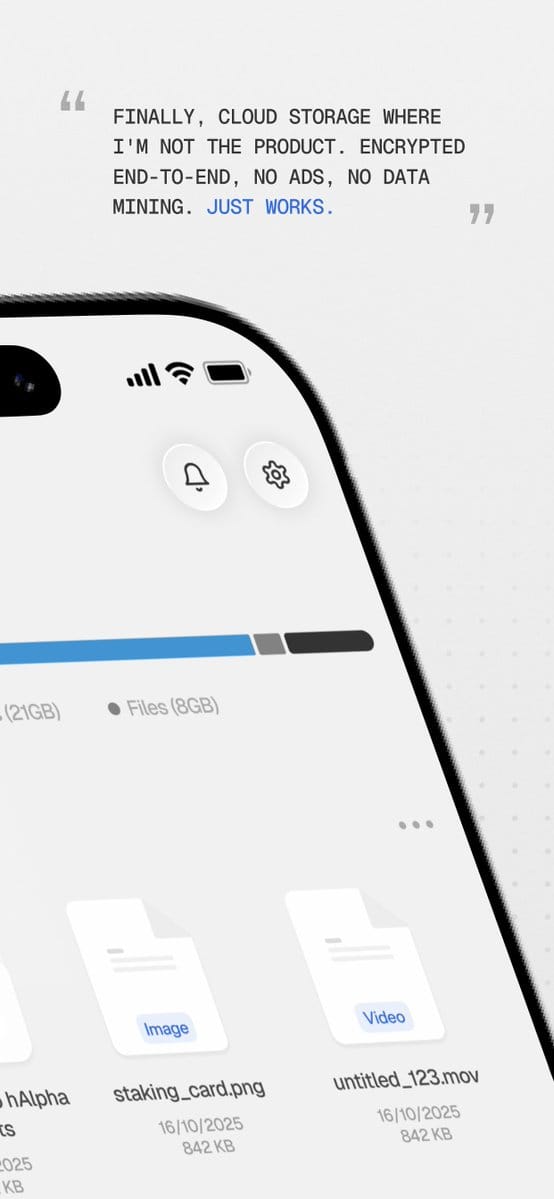
Built-in previews open images, videos, PDFs, Word documents, spreadsheets, presentations, Markdown, JSON, and plain text inside the app. On iPhone, the app also supports audio and Live Photos, retaining the motion component of Apple’s photo format.
Camera Uploads lets users choose which albums to back up and where the resulting files land in their drive. Settings control Wi-Fi-only transfers, video backup, and photo format. Users who do not want automatic backup can select photos manually instead.
Sharing works through links to individual files or entire folders. Shared items are marked in the drive, so users can see which content is accessible to others and stop sharing it when needed. The same account works across mobile, desktop, and the web console, so a phone backup does not create a separate storage library.
Encryption Before Upload
Hippius Drive’s privacy model starts on the device, rather than at the server. File contents are encrypted before transfer, and storage operators receive encrypted data instead of readable originals. Distributing files across independent machines determines where the data is stored; client-side encryption determines who can read it.
Users sign in with Apple, Google, GitHub, or an existing access key. A separate unlock password protects access to the key used to decrypt their files. That password works across mobile, desktop, and the console, and Hippius says it cannot reset or recover it. Account login and file unlocking are therefore separate steps. Authenticating to the service does not, by itself, unlock encrypted content.
The app listings identify four cryptographic components:
| Component | Role |
|---|---|
| XChaCha20-Poly1305 | Encrypts and authenticates file contents. |
| Argon2id | Derives encryption keys from user credentials. |
| Ed25519 | Provides digital signatures. |
| BLAKE3 | Produces cryptographic hashes. |
For local protection, iPhone users can require Face ID or Touch ID before the app opens, while Android users can require fingerprint or face authentication. The recovery phrase is held in the iPhone keychain or Android keystore and, according to the listings, never leaves that protected storage in readable form.
Behind Drive, Hippius operates a distributed storage network and its own blockchain, which records storage claims, payments, and miner actions. Its role as Bittensor’s Subnet 75 connects that infrastructure to the network; the mobile app presents it through familiar file-management and backup controls.
Storage Plans and Getting Started
Hippius’s published Drive plans range from the free 10 GB tier to 25 TB. Paid subscriptions are month-to-month, with no long-term contract.
| Drive Plan | Storage | Monthly Price |
|---|---|---|
| Free | 10 GB | $0 |
| Starter | 500 GB | $4 |
| Plus | 2 TB | $7 |
| Max | 10 TB | $22 |
| Scale | 25 TB | $50 |
The 2 TB plan costs $7 per month. Hippius markets that tier as roughly 30% cheaper than Google’s $9.99 monthly 2 TB plan. Its pricing page separately lists Dropbox’s monthly 2 TB plan at $11.99. Those are monthly list-price comparisons, rather than comparisons with annual subscriptions.
The app is available through the App Store and Google Play. The iPhone listing requires iOS 15.1 or later. Google Play already shows a September update, so Android availability predates the announcement that both mobile platforms are now supported.
Hippius has also published download links for the two platforms. After installation, users sign in, set their unlock password, and either enable Camera Uploads or choose files manually.
Plans and account credits are managed through the Hippius web console. A plan selected there applies to the same account across phone, desktop, and web access.