

Table of Contents
Chutes says it has completed a decentralized AI training test showing that a pure recurrent model can train across distributed GPUs with fully non-blocking synchronization and finish within 0.6% of a centralized baseline at matched steps.
"To our knowledge, no one has published decentralized non-blocking training for a recurrent architecture before. Parallax is the first. This is new ground. "
Put more simply for the non-technical folks, Chutes has essentially shown that AI models can be trained across computers spread around the world without requiring them to constantly stop and wait for one another, while still producing results that are nearly identical to traditional centralized training. Until now, that style of AI training has largely depended on keeping all of the necessary hardware together in the same data center, giving centralized systems a significant advantage in speed and coordination over decentralized approaches.
The team announced the result in an X post and expanded on the work in a dedicated blog post, framing it as a research milestone for Parallax, its effort to make model training less dependent on tightly coupled data center infrastructure.
What The Run Demonstrated
Chutes says the test avoided a common tradeoff in distributed training: either GPUs pause to synchronize, slowing the run, or synchronization is reduced and model quality can degrade.
In this case, the run used fully non-blocking synchronization and finished within 0.6% of the centralized baseline at the same number of training steps.
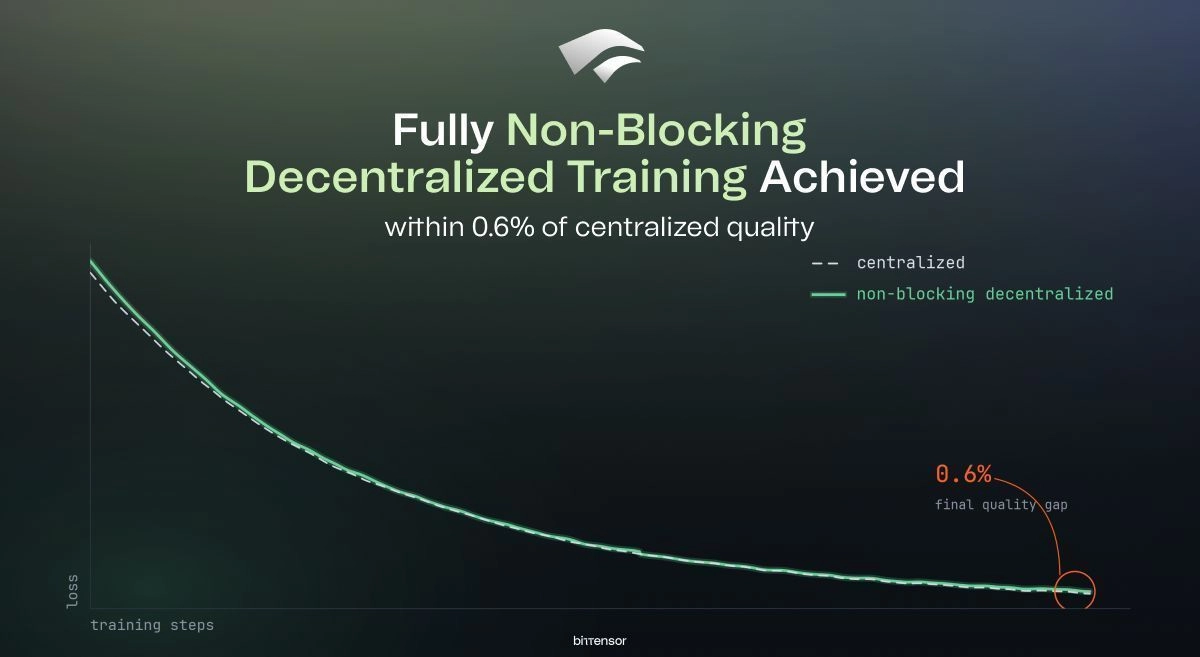
The test used Gated DeltaNet, a pure recurrent architecture, instead of a transformer or mixture-of-experts model. That choice matters because recurrent models process information sequentially, with each step depending on the state produced by the previous one, making synchronization more difficult in a distributed setting.
Why Recurrent Models Make the Test Harder
Chutes said it chose a recurrent model because it represents a harder synchronization problem than architectures that are easier to parallelize. Transformers, which dominate modern large language models, can process many operations in parallel during training. Recurrent models are different because sequence order is built into the architecture.
That creates a tougher environment for decentralized training. If every step depends on the previous step, stale updates, delayed synchronization, or inconsistent state can have a larger effect on training quality. Chutes' argument is that if non-blocking decentralized training can hold up under those conditions, then less sequential architectures should be easier to address later.
The architecture also connects to Chutes' broader efficiency thesis. In its blog post, the team said recurrent models avoid the key-value cache that grows with every token in transformer-based inference. Chutes argues that this makes the design attractive for Parallax because the goal is not only to train models across distributed hardware, but to improve useful work per watt.
That framing is consistent with Chutes' earlier Parallax work, which we previously covered in our report on Chutes' approach to decentralized AI training:
 Bart Hillerich
The earlier Parallax architecture focused on distributing training work across non-co-located hardware while lowering memory and compute requirements. This new recurrent-model result extends the same general direction into a harder synchronization setting.
What Comes Next for Parallax
Chutes described Gated DeltaNet as the current target architecture for Parallax and said the experiment represents one milestone in an active research effort rather than a completed product.
The company also noted that its recently open-sourced MSA attention kernels are separate from the recurrent training experiment, but part of the same broader effort to improve AI efficiency on distributed hardware.
For now, the significance of the announcement lies in the benchmark itself. Parallax now has its clearest technical milestone to date and offers a measurable result for future research to build upon.
Disclaimer: This article is for informational purposes only and does not constitute financial, investment, or trading advice. The information provided should not be interpreted as an endorsement of any digital asset, security, or investment strategy. Readers should conduct their own research and consult with a licensed financial professional before making any investment decisions. The publisher and its contributors are not responsible for any losses that may arise from reliance on the information presented.