


Table of Contents
Main Takeaways:
- Covenant AI exited Bittensor on April 9, 2026, citing governance and centralization concerns, triggering a sharp selloff across TAO and Covenant-linked subnet tokens.
- The controversy quickly escalated into rug pull accusations as the ecosystem realized that Covenant sold approximately 37,000 TAO worth of alpha tokens while leaving the ecosystem, exposing concerns around subnet owner accountability.
- Bittensor responded by accelerating Conviction, a new governance system that locks subnet owner emissions and makes exits publicly visible on-chain before meaningful sell pressure can occur.
- The network has continued moving forward, with Teutonic (SN3) beginning training of an 80B AI model, the largest decentralized training effort attempted on Bittensor to date.
When Covenant AI announced its departure from Bittensor on April 9, the ecosystem was plunged into chaos.
Covenant, the team behind some of Bittensor’s highest-profile subnets including Templar (SN3), Basilica (SN39), and Grail (SN81), said it was leaving over concerns involving governance, centralization, and what it described as outsized control by key ecosystem actors. Within hours, uncertainty spread across Crypto Twitter. TAO fell, subnet tokens sold off sharply, and confusion mounted over whether the announcement itself was even real.
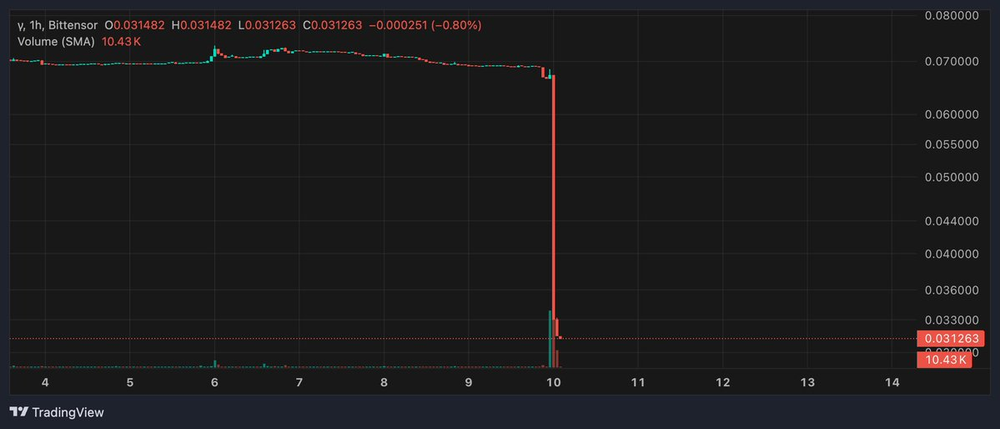
Shortly after the announcement, the situation escalated from a governance dispute into accusations of a coordinated rug pull (which now, can be classified as true with a very high degree of certainty) because Covenant sold approximately 37,000 TAO worth of alpha tokens while leaving the network. The episode sparked intense debate about accountability, subnet ownership, and whether Bittensor’s governance systems were mature enough to protect participants as more capital entered the ecosystem.
 Bart Hillerich
In response, the Bittensor ecosystem pushed Conviction, a long-discussed governance upgrade designed to make subnet owner exits visible on-chain and tie ownership more directly to long-term economic commitment, and also began a journey to beat Templar's 72B parameter training run, a moment that sparked a surge in global attention for Bittensor.
On May 11, that journey reached a new rung in the ladder. Teutonic (SN3), the subnet that emerged following Covenant’s departure, started training an 80-billion-parameter model, the largest decentralized AI training effort attempted on Bittensor to date.
One month later, Covenant AI’s departure looks less like a standalone event and more like a stress test: one that exposed weaknesses in Bittensor’s subnet economy while forcing the network to evolve in real time.
In this article, we break down what happened, how Bittensor responded, and what comes next for the network.
What Happened: Covenant AI Leaves Bittensor
On April 9, Covenant AI announced that it was departing the Bittensor ecosystem, triggering one of the sharpest moments of uncertainty the network had ever experienced.
The team behind Templar (SN3), Basilica (SN39), and Grail (SN81) published a lengthy public statement arguing that Bittensor’s governance structure had diverged from its decentralization ethos. Specifically, Covenant alleged that former Opentensor Foundation CEO Jacob Steeves, better known as Const, maintained outsized influence over the network despite Bittensor’s decentralized branding. This, however, made little logical sense as Const had stepped down from his CEO role in February.
 Tristan Hillerich
In its statement, Covenant claimed a single actor had the practical ability to suspend subnet emissions, override community authority, deprecate projects without transparent process, and exert economic pressure through token sales. According to the team, those dynamics made it impossible to continue building on the network in good faith.
“When a single actor can suspend a subnet’s emissions, override an owner’s authority over their own community spaces, publicly deprecate projects without process, and use token sales as a coercive mechanism to compel compliance, that is not decentralization,” Covenant wrote at the time. “It is centralized control with decentralized branding.”
The announcement landed with immediate market consequences.
TAO fell roughly nearly 30% following the news, erasing ~$900 million in market cap while subnet tokens sold off broadly. Templar, Covenant’s flagship subnet, dropped by more than 50% as investors rushed to price in the departure.
Initially, many participants questioned whether the announcement itself was authentic. Some speculated Covenant’s account may have been compromised given the abrupt nature of the statement and the team’s previous positioning within the ecosystem. That uncertainty faded after Covenant founder Samuel Dare publicly reaffirmed the decision.
The exit was especially jarring because Covenant had previously become one of Bittensor’s biggest technical success stories.
Earlier in 2026, Templar completed Covenant-72B, a decentralized 72-billion-parameter training run coordinated across more than 70 contributors. At the time, the achievement was widely viewed as one of Bittensor’s strongest proofs that open, distributed AI training could compete with more centralized approaches. It was even praised by Nvidia CEO Jensen Huang on the All-In podcast.
The Fallout: Chaos, Market Reaction, and Rug Pull Claims
In the hours following Covenant AI’s departure, confusion quickly turned into accusations as evidence was collected.
What initially appeared to be a dramatic governance dispute soon became something more contentious after it became more widely known that Covenant had sold approximately 37,000 TAO worth of alpha tokens tied to its subnets while exiting the ecosystem, a position estimated at roughly $11 million at the time.
Alpha tokens represent financial exposure to individual subnets. When a subnet owner accumulates emissions and exits by selling a large position, the resulting price impact is absorbed by token holders still in the market.
From the alpha token selloff, critics argued the sequence of events suggested the exit had been planned well before Covenant’s public statement. In this telling, allegations around governance and centralization served as cover for a premeditated departure.
The situation intensified as ecosystem participants attempted to reconstruct a timeline.
According to accounts shared publicly by Bittensor community members and subnet operators, tensions between Covenant and Const had escalated after disputes involving subnet emissions and token sales. Const stated that he had sold “less than 1%” of the tokens he had invested into Covenant-affiliated projects, arguing that normal market activity had been reframed as targeted retaliation.
Const also directly disputed several of Covenant’s allegations.
He said he did not possess the unilateral ability to suspend emissions, denied removing Samuel Dare as a Discord moderator beyond a temporary timeout tied to moderation disputes, and pushed back on claims that subnet infrastructure had been deprecated. He further argued that Covenant’s framing ignored his long history of supporting the team, including helping incubate Templar and contributing early resources.
But, while Bittensor-natives were compiling actual facts, at the same time, social media amplified the controversy in a damaging way, focusing on overblown and incorrect headlines.
KOLs, traders, and ecosystem commentators spread competing narratives across Crypto Twitter. Some framed Covenant’s departure as evidence that Bittensor’s governance remained too centralized, while others viewed the episode as a textbook founder exit that exploited investor trust. As the debate intensified, fear spread beyond Covenant-related tokens and weighed on broader ecosystem sentiment.
Regardless of which interpretation participants believed, what became clear from all the related discussions was that Covenant’s departure had exposed a structural vulnerability in how subnet ownership worked.
A founder could accumulate emissions, build community trust, and leave without any meaningful advance warning to investors. That realization shifted the conversation from blame to something more constructive: how could Bittensor stop this from happening again?
 Antonio Verrico
What Covenant Exposed About Bittensor
Under the existing Bittensor model at the time of the Covenant rug pull, once a team launched and secured control of a subnet, there was no protocol-level requirement tying ownership to continued economic commitment. Subnet owners could accumulate emissions over time, build community trust, attract alpha token holders, and eventually reduce or fully exit their position without advance notice.
In passive cases, this dynamic resulted in abandoned subnets, projects that slowly lost momentum while remaining technically active. In a more aggressive scenario, critics argued it created the conditions for exactly what happened with Covenant: a founder building credibility and investor confidence before leaving with a large accumulated position.
This, clearly, was a misalignment between subnet operators and the people financially backing them.
Alpha token holders had economic exposure to a subnet’s success, but little visibility into whether the people running it remained committed over the long term. Unlike traditional startups, where founder vesting schedules and lockups help align incentives, Bittensor had no built-in equivalent.
The Covenant episode effectively accelerated a governance question Bittensor had already been discussing internally:
How should subnet ownership actually work in an open network?
For some, the answer was that ownership should not merely be the reward for launching a subnet. It should reflect continued, measurable commitment over time.
That idea would take shape through a governance model called Conviction.
 Antonio Verrico
How Bittensor Responded: Locked Stake and Conviction
In the days following Covenant AI’s exit, discussion across the ecosystem quickly shifted from what happened to how Bittensor could prevent something similar in the future.
The answer that emerged was not entirely new.
Before Covenant’s departure, Bittensor contributors had already been discussing a governance concept known as Locked Stake, an idea designed to tie subnet ownership more directly to long-term economic commitment. The Covenant episode accelerated that conversation from theory into priority.
Const publicly highlighted the proposal in the aftermath of the controversy, describing it as a way to align subnet control with visible, long-term conviction rather than indefinite ownership.
At a high level, the concept was that subnet ownership should not be permanent by default. Instead, ownership should increasingly reflect who is willing to commit meaningful capital to a subnet for meaningful periods of time.
Under the proposed system, participants could voluntarily lock alpha tokens toward a subnet operator, creating an on-chain measure of commitment called Conviction. The longer and larger the stake commitment, the higher the Conviction score.
Most importantly, subnet operators themselves would have to demonstrate their own commitment transparently.
Rather than simply controlling a subnet indefinitely after launch, owners would increasingly need to show visible economic alignment with the communities and token holders backing them. In effect, the proposal introduced something crypto had often relied on socially, but hadn't enforced programmatically: founder skin in the game.
The framework also opened the door to a new ownership model.
Instead of abandoned or poorly run subnets remaining indefinitely under one operator, ownership could eventually become contestable. Participants could direct locked stake toward alternative operators they believed would better serve a subnet, creating a mechanism for succession that did not depend on informal social consensus.
On May 13, just over a month after Covenant’s departure, Conviction officially reached mainnet.
From that point forward, every emission a subnet owner earns would automatically lock the moment it arrives in their wallet. If an operator wanted to leave, they would first need to submit an unlock transaction on-chain, creating a public signal visible to everyone in the ecosystem.
Instead of disappearing overnight, exits would become observable events with advance warning, fundamentally restructuring the alpha token risk equation.
What’s Next for the Network: Teutonic’s 80B Training Run and the Road Ahead
While Conviction addressed the governance side of the Covenant fallout, there was still the journey of besting Covenant's training run at hand. On May 11, Teutonic (SN3) officially began training an 80-billion-parameter language model on Bittensor, marking the largest decentralized AI training effort attempted on the network to date.
 Bart Hillerich
Teutonic’s new 80B effort aims to surpass the earlier Covenant milestone, not through a fixed training schedule, but through a competitive “king-of-the-hill” architecture in which miners continuously compete to improve model performance. Participants train independent model updates, validators compare those submissions against the current leading model, and the best-performing checkpoint becomes the new benchmark.
The approach turns model training into an open market.
Instead of relying on centralized GPU infrastructure and tightly controlled internal teams, Teutonic coordinates independent compute providers competing to lower loss and improve performance in real time. If successful, it would represent one of the strongest demonstrations yet that decentralized AI infrastructure can scale beyond experimentation.
For Bittensor, the implications extend beyond model size.
The Covenant saga created a narrative challenge for the network. Momentum slowed, uncertainty spread, and critics questioned whether one of the ecosystem’s most visible contributors leaving would permanently damage confidence. They even questioned the viability of Bittensor itself, from a technical standpoint.
Teutonic represents an opportunity to move past all of it. Success means the Covenant episode may ultimately be remembered as a Bittensor turning point instead of a breaking point.
Conclusion
One month after Covenant AI’s departure, the episode remains one of the most consequential moments in Bittensor’s history.
What began as a sudden, controversial exit quickly evolved into a broader debate about governance, accountability, and the risks embedded in Bittensor’s subnet economy. Covenant’s departure exposed a gap in how subnet ownership functioned, particularly as more capital entered the ecosystem and alpha tokens became increasingly meaningful financial assets.
Bittensor’s response so far has been as rapid, determined, and postive-sum.
Rather than treating the incident as isolated drama, the network accelerated Conviction, a governance system designed to make subnet owner commitment visible and exits observable before meaningful sell pressure arrives. At the same time, development has continued, with Teutonic’s 80B training effort reminding everyone that Bittensor is much more than one subnet.
Whether Conviction fully solves the problems Covenant exposed remains to be seen. Phase 2 subnet elections have yet to arrive, and the long-term balance between founder flexibility and investor protection will likely continue evolving.
What is clear, however, is that the Covenant saga became more than a controversy. It became a stress test for Bittensor itself, one that forced the network to confront weaknesses in public and begin adapting in real time.
Now, we all move forward with a stronger, more proven Bittensor.
Frequently Asked Questions
What happened to Covenant AI on Bittensor?
Covenant AI announced its departure from the Bittensor ecosystem on April 9, 2026, citing concerns around governance, decentralization, and alleged centralized control within the network. The team behind Templar (SN3), Basilica (SN39), and Grail (SN81) said it would continue decentralized AI development outside of Bittensor.
Why did Covenant AI leave Bittensor?
According to Covenant AI, the team left due to concerns about Bittensor governance, including allegations that key ecosystem actors held too much influence over subnet operations and emissions. Critics within the Bittensor ecosystem disputed those claims and argued the exit was premeditated.
Was Covenant AI a rug pull?
The characterization of Covenant AI’s departure remains debated. Many Bittensor ecosystem participants described the exit as a rug pull after Covenant reportedly sold approximately 37,000 TAO worth of alpha tokens while departing the network. Covenant itself framed the departure as a principled exit over governance concerns.
How much TAO did Covenant AI sell?
Following Covenant AI’s departure, reports circulated that the team sold roughly 37,000 TAO worth of alpha tokens, valued at approximately $11 million at the time, contributing to sharp price declines across related subnet tokens.
What is Templar on Bittensor?
Templar (SN3) was a Bittensor subnet focused on decentralized large language model training. Before Covenant AI’s departure, the subnet completed Covenant-72B, one of the largest decentralized AI model training efforts attempted on Bittensor.
What happened to Templar after Covenant AI left?
Following Covenant AI’s departure, subnet activity transitioned toward Teutonic (SN3), which began training a new 80-billion-parameter language model in May 2026. The effort is widely viewed as an attempt to continue and expand on the decentralized AI training momentum previously associated with Templar.
What is Conviction in Bittensor?
Conviction is Bittensor’s new subnet governance layer designed to improve accountability among subnet operators. The system automatically locks subnet owner emissions and creates public on-chain signals when operators begin unlocking tokens, making silent exits significantly more difficult.
Why did Bittensor launch Conviction?
Bittensor had already been discussing subnet governance improvements before Covenant AI’s exit. However, the Covenant episode accelerated Conviction’s release by exposing how subnet owners could accumulate emissions and exit without advance warning to investors.
How does Conviction work on Bittensor?
Under Conviction Phase 1, subnet owner emissions are automatically locked when earned. To access those funds, owners must submit an unlock transaction visible on-chain. This creates a warning period before meaningful sell pressure can occur. Future phases are expected to introduce subnet owner elections.
Can subnet owners still sell their tokens after Conviction?
Yes, but not immediately. Subnet owners must first initiate an unlock process on-chain. Under the current system, meaningful liquidity becomes available gradually, giving alpha token holders advance notice before large exits.
What are alpha tokens in Bittensor?
Alpha tokens are subnet-specific tokens that give holders economic exposure to individual Bittensor subnets. Their value often reflects market expectations around a subnet’s technical performance, growth, emissions, and operator quality.
What is Teutonic on Bittensor?
Teutonic (SN3) is a Bittensor subnet focused on decentralized AI model training. In May 2026, the subnet began training an 80-billion-parameter language model, the largest decentralized training effort attempted on the network to date.
Why is Teutonic’s 80B model important?
Teutonic’s 80B model represents a major milestone for decentralized AI infrastructure. The effort aims to surpass Bittensor’s earlier 72B training run, demonstrating that large-scale language models can be trained through open, distributed compute markets rather than centralized data centers.
What is decentralized AI training?
Decentralized AI training refers to coordinating model development across distributed compute providers instead of relying on centralized infrastructure owned by a single company. In Bittensor, miners compete to improve models and receive rewards based on performance.
Did Covenant AI permanently damage Bittensor?
The long-term impact remains uncertain. Covenant’s exit caused significant short-term disruption and exposed governance weaknesses. However, Bittensor has since launched Conviction and continued technical development through initiatives like Teutonic’s 80B training run, which many see as signs of ecosystem resilience.
What’s next for Bittensor after Covenant AI?
Bittensor’s next phase will likely focus on two priorities: improving subnet governance through future Conviction upgrades and continuing to expand decentralized AI capabilities. Upcoming subnet elections and large-scale model training efforts are expected to play a major role in shaping the network’s future.
Disclaimer: This article is for informational purposes only and does not constitute financial, investment, or trading advice. The information provided should not be interpreted as an endorsement of any digital asset, security, or investment strategy. Readers should conduct their own research and consult with a licensed financial professional before making any investment decisions. The publisher and its contributors are not responsible for any losses that may arise from reliance on the information presented.