

Table of Contents
DeepSeek has officially launched DeepSeek-V4-Flash-0731 in public beta, unveiling a major upgrade to its lightweight API model that significantly improves coding and agent performance while maintaining the same underlying architecture and parameter count.
The release positions V4-Flash as one of the most aggressive value propositions in the frontier AI market. The model delivers performance approaching Anthropic's Opus 4.8 on a range of coding-agent benchmarks while costing 18x less on input tokens and 28x less on output tokens.
The announcement comes as DeepSeek is reportedly planning a major gigawatt-scale AI data center in Inner Mongolia to compete with top Silicon Valley teams.
Major Jump in Agent Performance
Perhaps the most surprising aspect of the announcement is that DeepSeek achieved the performance gains without changing the model itself.
According to the company, DeepSeek-V4-Flash-0731 uses the exact same model architecture and size as the preview version, with the improvements coming from upgrades to the API deployment and agent stack rather than a larger foundation model.
The benchmark improvements are substantial. On Terminal Bench 2.1, V4-Flash scores 82.7, compared to 72.1 for the V4-Pro Preview and 85.0 for Anthropic's Opus 4.8.
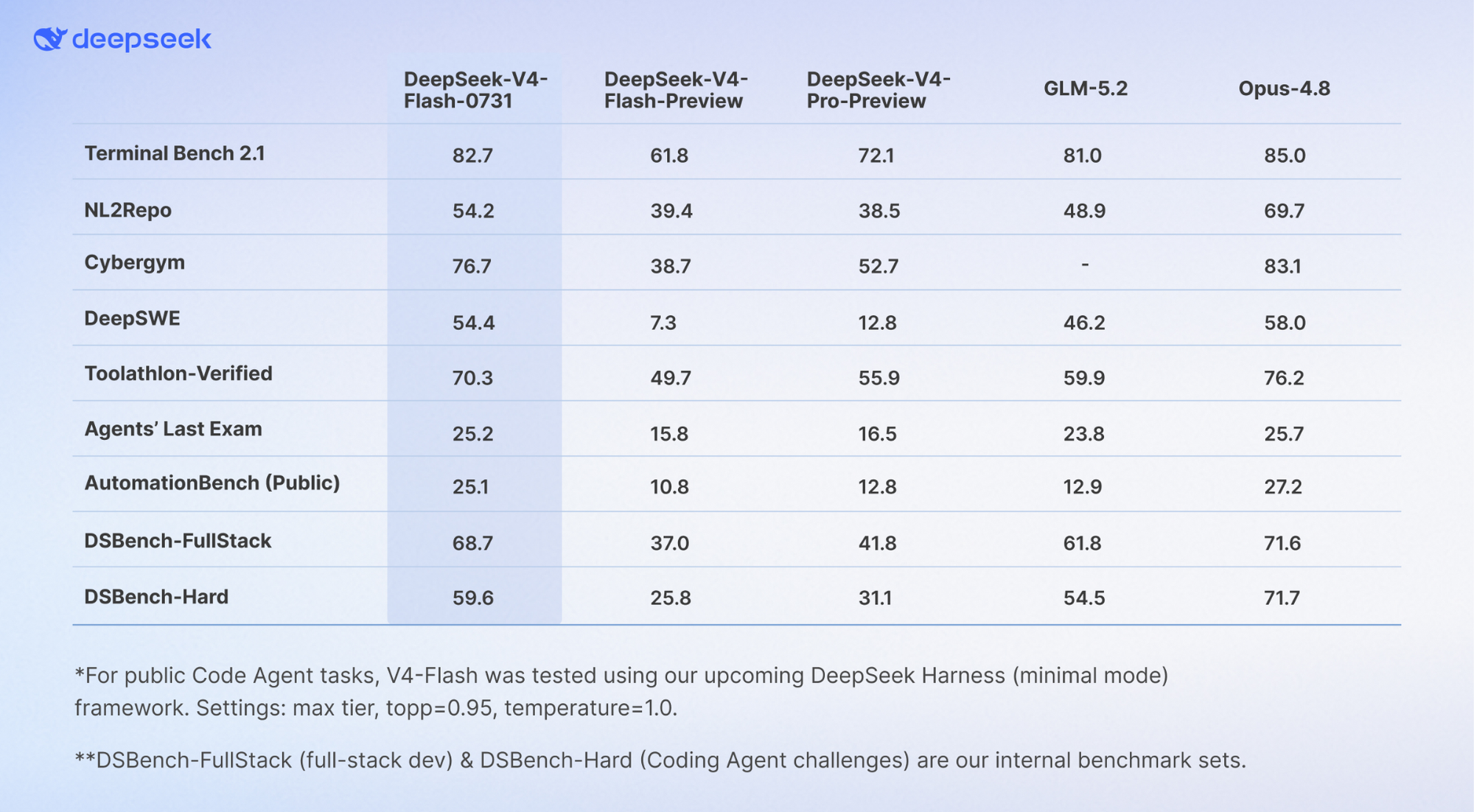
The gains are even more pronounced across software engineering benchmarks:
- DeepSWE: 54.4 vs. 12.8 (V4-Pro Preview)
- Cybergym: 76.7 vs. 52.7
- Toolathon-Verified: 70.3 vs. 55.9
- DSBench-FullStack: 68.7 vs. 41.8
- DSBench-Hard: 59.6 vs. 31.1
Across nearly every published benchmark, the official V4-Flash release substantially outperforms the earlier preview version and narrows the gap with Anthropic's premium offering.
The update applies only to the DeepSeek-V4-Flash API. The company's V4-Pro API and consumer App/Web models remain unchanged, although DeepSeek said an official V4-Pro release is "coming ASAP."
Built for Coding Agents
DeepSeek also announced native support for the Responses API format, making the model compatible with modern agent frameworks and fully adapted for OpenAI Codex workflows.
That focus is reflected in the benchmark suite itself, which emphasizes autonomous software engineering, terminal use, tool calling, and complex coding tasks rather than traditional chatbot evaluations.
As AI agents increasingly become responsible for writing code, navigating terminals, and orchestrating development workflows, these benchmarks are becoming more representative of real-world developer use than conventional reasoning tests alone.
Price Pressure on Frontier Models
While the benchmark improvements are notable, the pricing may have the biggest industry impact.
Matching (or in several cases closely approaching) the performance of Opus 4.8 while charging a small fraction of the inference cost puts additional pressure on premium proprietary models, which became heavier this week with OpenAI's substantial price cuts.
 Bart Hillerich
Instead of scaling model size, DeepSeek is demonstrating that deployment quality, agent optimization, and inference efficiency can dramatically improve real-world capability without increasing compute requirements.
Looking Ahead
Today's release only updates the Flash API, but DeepSeek has already confirmed that the official V4-Pro release is on the way.
If the same level of optimization carries over to its flagship model, the competitive landscape for AI coding assistants could shift again, particularly as pricing becomes as important a differentiator as raw benchmark performance.
Developers building coding agents will find it increasingly difficult to justify paying significantly more for comparable performance.