

Table of Contents
OpenAI has now cut prices for two GPT-5.6 models and introduced a faster API tier for GPT-5.6 Sol.
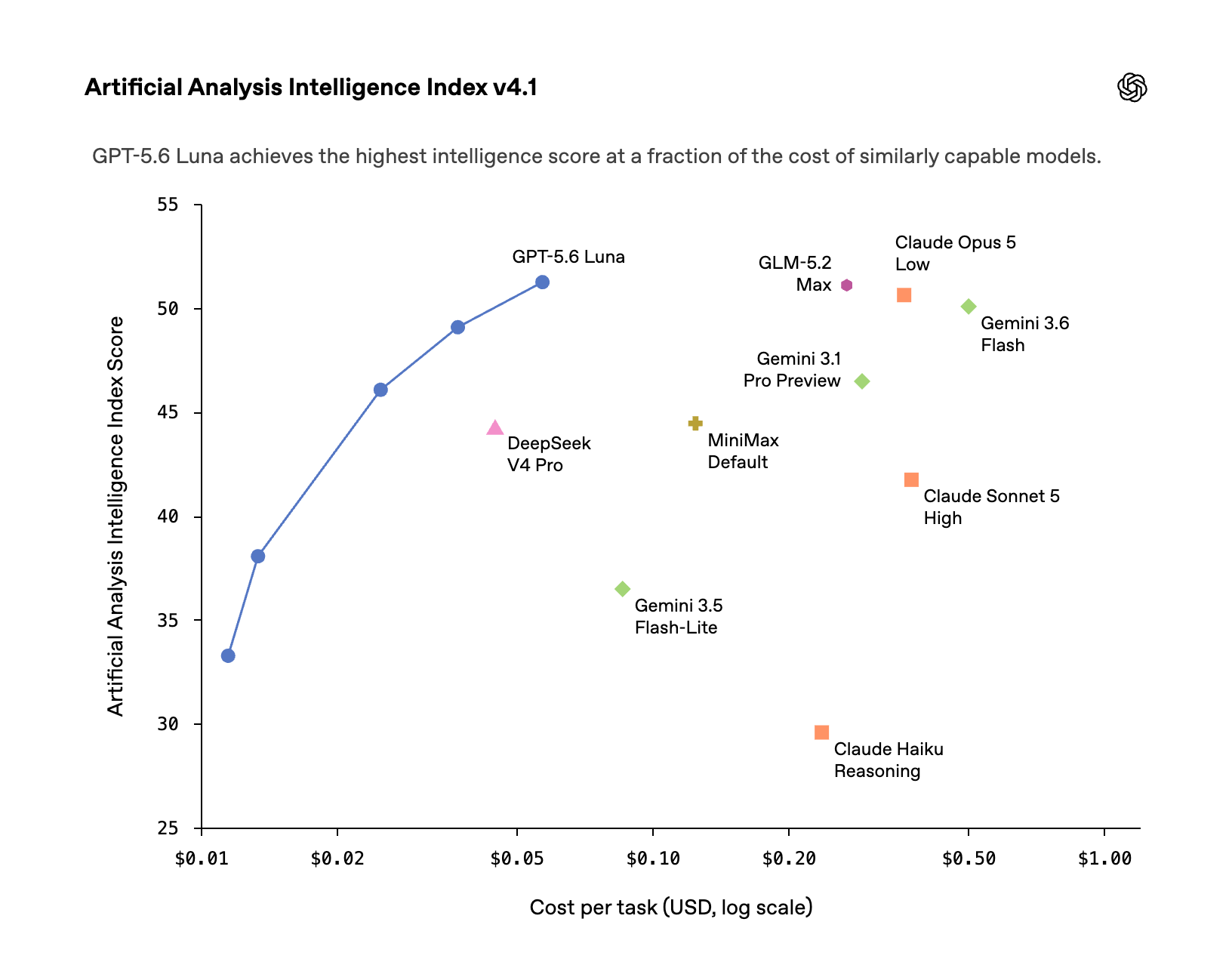
In an announcement on X, OpenAI said GPT-5.6 Luna prices are falling by 80% and GPT-5.6 Terra prices are falling by 20%. Sam Altman said separately that Luna now costs $0.20 per million input tokens and $1.20 per million output tokens, while Terra moves to $2 per million input tokens and $12 per million output tokens.
The company is also adding Fast mode for GPT-5.6 Sol in the API. Altman said the option offers up to 2.5 times the speed for twice the price while keeping the same intelligence.
What OpenAI Changed
The price cut is concentrated on Luna and Terra, the lower-cost and mid-tier models in OpenAI's GPT-5.6 lineup.
Before the change, OpenAI's GPT-5.6 preview pricing listed Luna at $1 per million input tokens and $6 per million output tokens, while Terra was listed at $2.50 per million input tokens and $15 per million output tokens. The new prices reduce Luna to $0.20 and $1.20, a fivefold drop, and Terra to $2 and $12. OpenAI's API pricing page also shows lower rates for batch and flex usage.
For GPT-5.6 Sol, OpenAI is not cutting the base model price in the announcement. It is adding Fast mode at $10 input and $60 output per million tokens, twice the standard Sol price, for up to 2.5 times the speed.
OpenAI said the lower Luna and Terra prices are also reflected in how usage is counted in Codex and ChatGPT Work, so the change affects API customers as well as users consuming model capacity through OpenAI's developer and enterprise products.
Why The Price Cut Matters
Altman described the goal as offering "the best price/intelligence tradeoff at every level." OpenAI wants to compete both at the frontier, with its strongest models, and across the value tiers below them.
Lower model prices can support heavier usage in consumer chat products without immediately raising subscription costs. They also change the economics of developer applications that run many model calls in the background, including coding assistants, support agents, search, and document workflows.
The Luna cut is especially aggressive because it moves OpenAI's lowest-cost GPT-5.6 model into a pricing range where high-volume workloads become easier to justify. Terra remains more expensive, but the 20% cut gives users a cheaper mid-tier option for workloads that need stronger performance than Luna without paying for the flagship Sol model.
The Sol Fast mode addition addresses a separate buyer need, latency. Some workloads can tolerate slower responses if the price is lower, while others need faster output even at a premium. By making speed a paid service tier, OpenAI separates model intelligence from delivery performance and charges separately for faster infrastructure.
Kicking Off the Price War
The move also sharpens OpenAI's positioning in the model market. OpenAI is increasingly acting like the low-cost, mass-market provider across the GPT-5.6 family, especially compared with Anthropic's more premium positioning.
The most immediate pressure may be on cheaper global competitors rather than Anthropic's margins. Zephyr of Citrini Research framed the cut as the start of a price war, alleging OpenAI is now working to pressure Chinese model providers rather than directly attack Anthropic yet.
This is clearly more than just a routine pricing update. OpenAI is lowering the floor for mass-use AI while keeping premium monetization available through stronger models and faster infrastructure. If competitors follow, users could see a widespread shift where more capable models become cheaper to run, while model providers face a harder race to defend margins outside the frontier tier.