Table of Contents
Google DeepMind has launched Gemini 4 Hydrogen, an AI model built for everyday coding, tool-using agents, and multimodal work, with flat API pricing of $1.50 per million input tokens and $7.50 per million output tokens across its 1 million-token context window.
Hydrogen scores 51 on the Artificial Analysis Intelligence Index at its default high thinking setting, narrowly ahead of Gemini 4 Argon's 50. Its new xhigh setting raises that score to 54. Google says Hydrogen completes tasks 2.5 times faster than Gemini 3.8 Flash, while Carbon and Argon remain its models for the hardest, long-horizon reasoning work.
The release also introduces Orchestrator in Google Antigravity, which switches between a frontier planning model and Hydrogen for implementation within the same session. Developers can use Hydrogen independently or assign it execution work alongside Carbon and Argon.
What Changes for Developers
Hydrogen is adapted from Gemini 4 Carbon and accepts text, images, audio, and video. Its model card specifies a unified context window: inputs, reasoning, and generated output share the available space, rather than receiving separate million-token allowances.
The default synchronous output limit is 65,536 tokens. Longer generations can continue through background execution or client-side continuation, up to the remaining capacity of the 1,048,576-token window. That supports workflows producing lengthy specifications, reports, or code, while requiring developers to budget room for both the source material and the response.
Four thinking levels (low, medium, high, and xhigh) control how much reasoning the model performs. High is the default; xhigh spends more tokens and time on difficult problems. Lower settings offer faster responses and reduced token use for simpler work.
The API documentation identifies several migration changes for developers coming from 3.8 Flash. Hydrogen defaults to high rather than medium thinking, rejects the old minimal setting, and uses the model ID gemini-4-hydrogen. The output-token cap covers reasoning and the final response together, so a low cap can truncate an answer before it is complete.
Google has also made Hydrogen the default model for the Antigravity agent in Gemini Managed Agents. The model can batch file reads and searches in parallel for repository work, and adapt when tool calls fail. Google reports tighter instruction following and more than a fivefold reduction in fabricated claims compared with 3.8 Flash.
Coding and Knowledge-Work Results
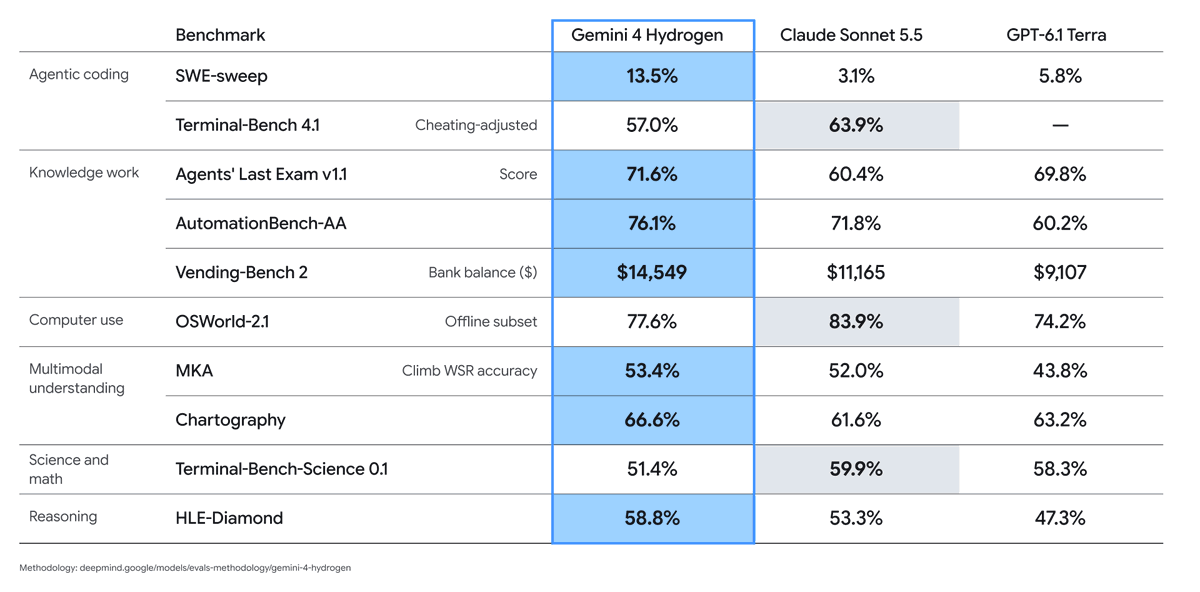
On Terminal-Bench 4.1, Hydrogen scores 57%, more than triple Gemini 3.8 Flash's 18.2%.
Google's published comparisons cover software repair, professional workflows, computer use, and reasoning:
| Evaluation | Gemini 4 Hydrogen | Claude Sonnet 5.5 | GPT-6.1 Terra |
|---|---|---|---|
| Terminal-Bench 4.1, cheating-adjusted | 57.0% | 63.9% | — |
| SWE-sweep, subtask-weighted reward | 13.5% | 3.1% | 5.8% |
| Agents' Last Exam v1.1, rubric score | 71.6% | 60.4% | 69.8% |
| OSWorld-2.1, offline subset | 77.6% | 83.9% | 74.2% |
| HLE-Diamond | 58.8% | 53.3% | 47.3% |
Hydrogen leads the listed models on SWE-sweep, Agents' Last Exam, and HLE-Diamond, while Sonnet 5.5 leads on Terminal-Bench and the OSWorld offline subset.
Google's evaluation methodology specifies high effort for Terminal-Bench 4.1, averaging reward across five attempts per task using a mini-swe-agent vision harness. The comparison uses cheating-adjusted accuracy. OSWorld results cover an 82-task, no-internet subset, rather than the full benchmark. Other Hydrogen evaluations generally use the highest thinking setting unless otherwise specified.
Artificial Analysis lists Hydrogen at 54 with xhigh. That is a different configuration from the default-high score of 51 used in Google's comparison with Argon.
Cursor has also added Hydrogen and reported its own coding result: 54.3% on CursorBench at default effort, up from 39.6% for Gemini 3.8 Flash.
How Antigravity Orchestrator Divides the Work
Orchestrator coordinates planning and implementation dynamically, rather than selecting one model from the initial prompt and keeping the entire task on it.
In the Carbon configuration, Carbon begins with read-only exploration: inspecting dependencies, resolving ambiguity, and producing an implementation plan. Hydrogen then edits files, updates packages, and runs tests. If execution exposes a problem the plan did not account for, control returns to Carbon to inspect the state and revise the approach.
The Orchestrator documentation gives concrete handoff triggers, including a verification step failing twice or an interface behaving differently than expected. The planner also reviews progress on longer tasks. These switches happen automatically within a response, without requiring the user to change models manually.
Google reports that Orchestrator reached near-Carbon task success in Antigravity testing while consuming 24% less quota and finishing 19% faster on average. Those figures describe the combined workflow, not standalone Hydrogen performance.
Hydrogen arrives shortly after Google expanded Carbon access and previewed Antigravity's /swarm. Swarm coordinates parallel agents across isolated workspaces; Orchestrator instead hands a single conversation between planning and implementation models. Developers can also construct explicit multi-model pipelines with the Antigravity SDK, assigning Hydrogen to triage and coding while reserving Carbon for larger refactors or security checks.
Carbon's initial release focused on cyber defense and days-long engineering tasks. Hydrogen supplies a faster execution option for routine implementation without requiring every step to run on that frontier model.
Pricing and Launch Access
Google is making Hydrogen available on both free and paid tiers of AI Studio and the Gemini API.
The developer rollout also includes Android Studio, Gemini for business, and Google Antigravity. Google's launch announcement specifies Antigravity access for paid AI Pro and Ultra subscribers. For Orchestrator, Ultra subscribers receive Carbon and Argon configurations, while paid Pro subscribers receive Argon. Google says enterprise customers can access both through Gemini for business.
Consumers receive Hydrogen through the Gemini app and Google Search. Free Gemini app users get access through automatic model selection when the system chooses Hydrogen for a prompt. Gemini in Google Sheets is starting with AI Pro and Ultra subscribers, alongside eligible business subscriptions.
Outside Google's products, OpenClaw says Hydrogen is supported, extending access to users running its agent software.