

Table of Contents
Macrocosmos has released IOTA Decide 4B, its first public model, fine-tuned across 16 geographically distributed GPUs connected over the internet. The open-weights release makes structured software decisions rather than generating text, returning probabilities that applications can use to route requests, apply policies, and select actions.
Available under an Apache-2.0 license, the four-billion-parameter model uses Macrocosmos’s IOTA training stack to coordinate independent machines instead of a single GPU cluster. It builds on Qwen3.5-4B and records a 78.6 JevBench composite score, with roughly 33 milliseconds per decision in Benchmark Heaven’s measurement.
The release combines two engineering goals, adapting a language model into a fast decision layer for software and carrying out that adaptation on distributed hardware. Developers can download and run the resulting weights locally; the training infrastructure sits behind the release rather than being required for inference.
Structured Decisions Without Text Generation
IOTA Decide accepts a state, such as a support ticket, an agent trace, or a policy paired with a request, along with typed questions about it. Each question receives its own forward pass through the model, with no generated explanation. Multiple questions in a request are answered independently, rather than all being resolved in one pass.
The interface follows the SystemOne /v1/systemone request and response format, with three output types:
| Question Type | Output | Example Use |
|---|---|---|
noul | Probability that a statement is true | Whether a request satisfies a policy |
choice | Selected option, confidence, and probabilities for every option | Which team should receive a ticket |
score | Expected rubric level, confidence, and probabilities for every level | How urgent a ticket is |
Choice questions support two to 26 options. A developer can use the returned probabilities in ordinary application logic, choosing when to automate a response or send a case for review without parsing a paragraph back into a category.
This is the same broad category of software-facing inference explored by TypeSafe AI’s Jev and OpenAI’s Decisions API. IOTA Decide makes downloadable weights available for this style of workload.
Its binary output also follows a specific reporting convention, with yes-or-no answers carrying at least 0.801 probability on the chosen side. Macrocosmos applies that floor because JevBench treats probabilities between 0.2 and 0.8 as abstentions; the selected answer does not change. Developers using confidence thresholds should account for that adjustment rather than treating every reported value as an unmodified uncertainty estimate.
Fine-Tuning Across 16 Internet-Connected GPUs
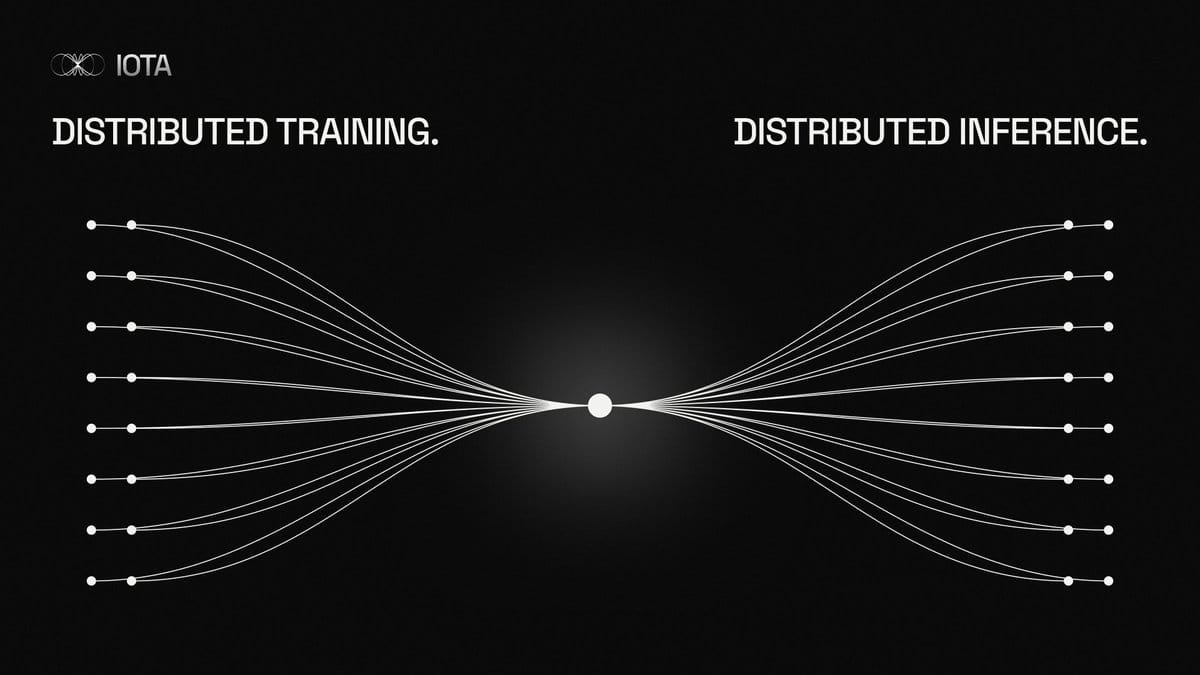
The training run used 16 RTX A4000 GPUs coordinated through streaming DiLoCo, with four fragments, staggered merges, and no synchronous waits. The arrangement lets distributed training progress without requiring every machine to reach the same synchronization point together.
Macrocosmos adapted Qwen3.5-4B using LoRA, a fine-tuning method that trains smaller parameter updates rather than changing every underlying weight directly. The run applied rank-64, alpha-128 adapters to every linear layer of the language model and merged those updates into the released weights after 750 training steps.
The objective was soft-target cross-entropy on teacher probabilities, training against a distribution of likely answers rather than only a single hard label. The system reads answers from option-letter scores at the answer position and uses a learned temperature to adjust their probability distribution.
Training drew on approximately 879,000 deduplicated records. These included human-labeled decision examples, 24 public human-labeled datasets, generated states with verified labels, and synthetic states and reasoning questions labeled by language models.
The release follows Macrocosmos’s IOTA SDK and Liquid Compute announcement at Exploit Summit.

What the Benchmark Results Measure
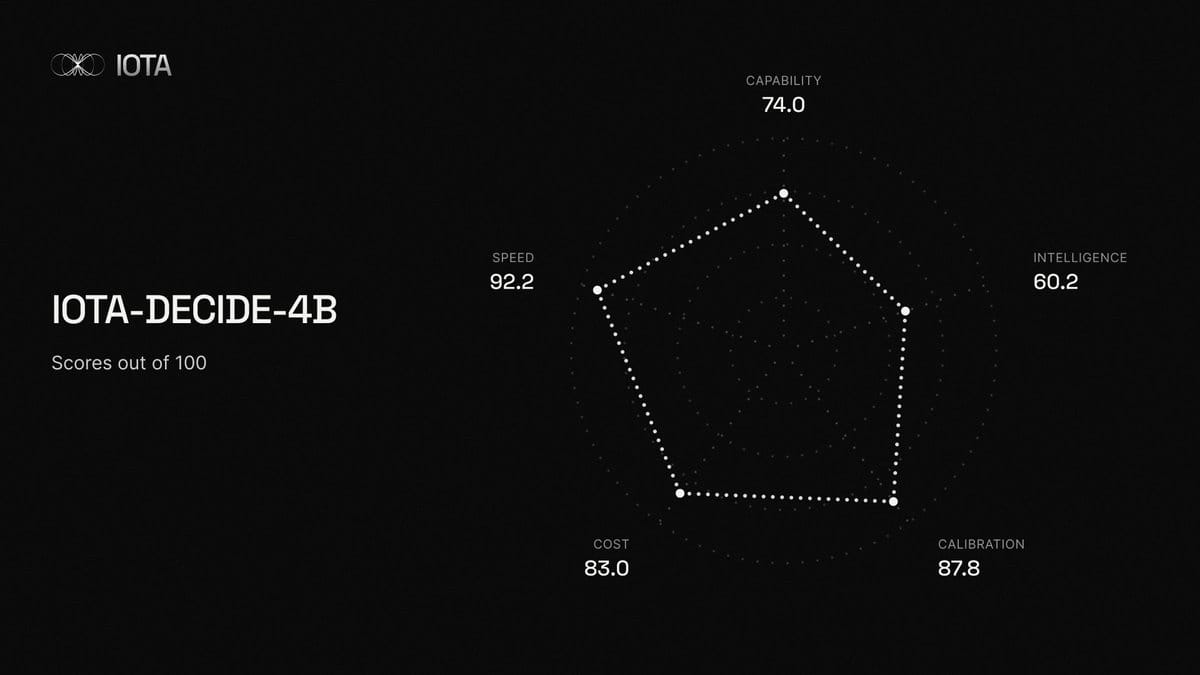
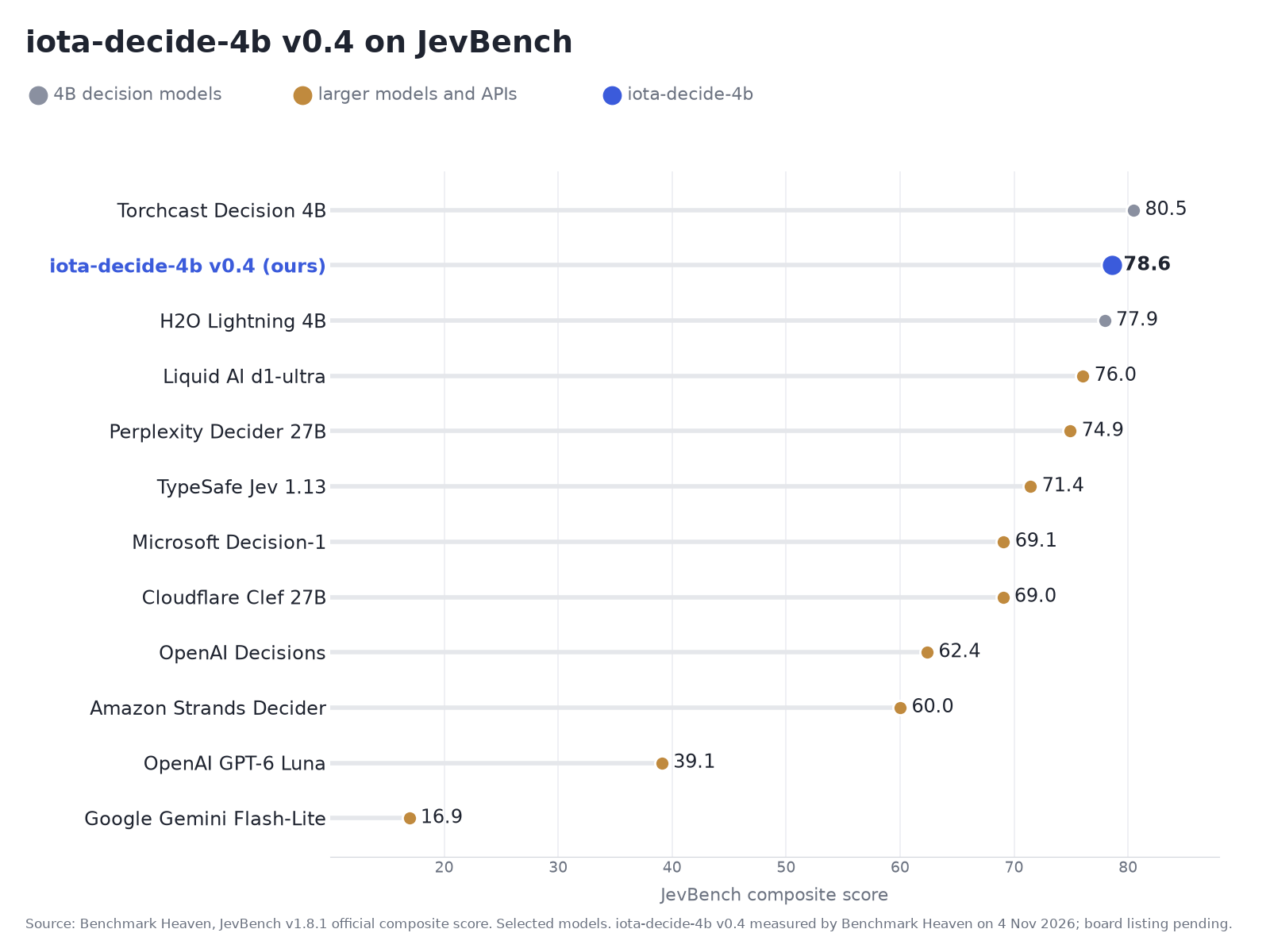
JevBench’s headline composite weights intelligence, calibration, speed, and cost equally. IOTA Decide v0.4 scores 60.2 for intelligence, 87.8 for calibration, 92.2 for speed, and 83.0 for cost, producing the 78.6 composite. Its separate capability score is 74.0.
The comparison published with the release places v0.4 below Torchcast Decision 4B v1.3 and above H2O Lightning 4B v1.1, Liquid AI d1-ultra, and several larger models and hosted APIs.
| System | JevBench Composite |
|---|---|
| Torchcast Decision 4B v1.3 | 80.5 |
| IOTA Decide 4B v0.4 | 78.6 |
| H2O Lightning 4B v1.1 | 77.9 |
| Liquid AI d1-ultra | 76.0 |
| Perplexity Decider v1.1 27B | 74.9 |
| IOTA Decide 4B v0.3 | 72.8 |
| Microsoft Decision-1 | 69.1 |
| Cloudflare Clef 27B | 69.0 |
| OpenAI Decisions | 62.4 |
Macrocosmos reports that Benchmark Heaven measured and independently recomputed v0.4’s result. Its leaderboard listing is pending because the measurement used a newer question draw that has not yet been equated with the board; the comparison systems’ scores come from the v1.8.1 leaderboard.
On Macrocosmos’s own 15-benchmark cross-domain evaluation, v0.4 scores 63.0, up from 55.4 for v0.3 and below Torchcast’s 65.6. An eight-word-span overlap check found shared text between training records and 387 of the 9,012 evaluation questions, or 4.3%. Removing those questions changes v0.4’s score to 62.9.
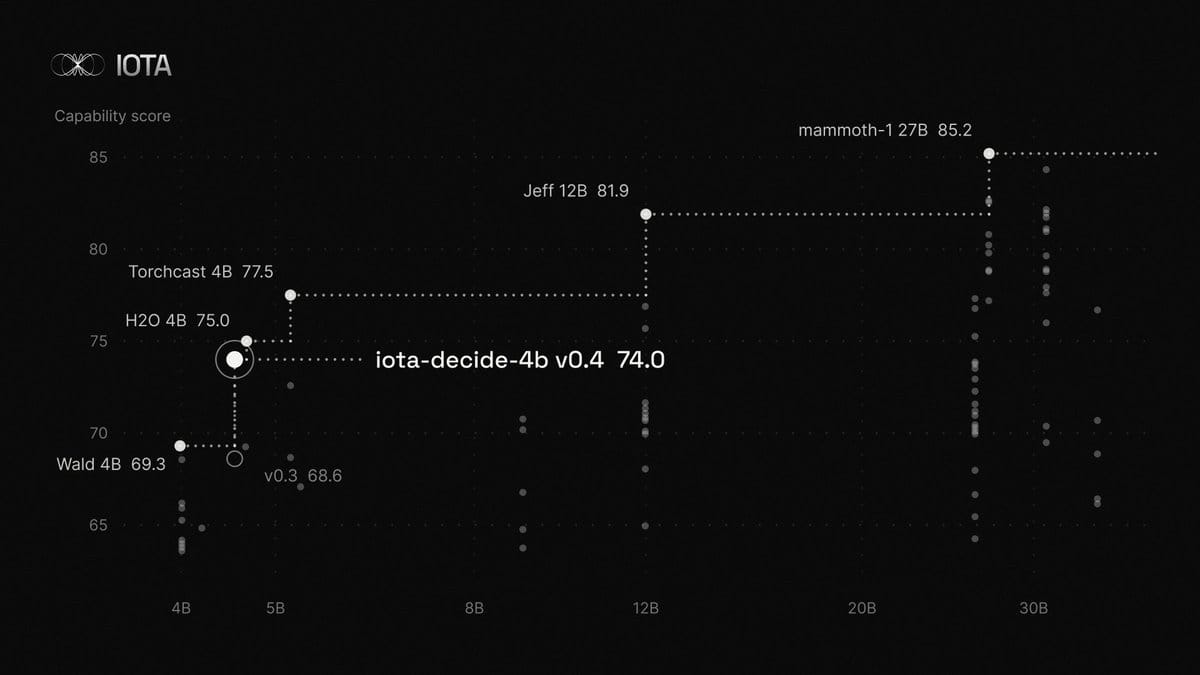
Macrocosmos used the public JevBench split to choose the checkpoint, so that internal result is not an independent performance estimate. Macrocosmos identifies multi-step arithmetic, quantitative reasoning, causal and multi-step narrative reasoning, and humor judgment as weaker areas. The model is text-only, and English is the only language the team evaluated.
Running the Released Model
The IOTA Decide v0.4 repository includes weights and a bundled letter_decide.py loader. Developers need Transformers 5 or later and should use the load_release_model and systemone helpers to reproduce the intended inference behavior.
The loader is needed because v0.4 uses two-way attention in its full-attention layers, allowing the state to be read in light of the question. Its linear-attention layers remain causal. Stock causal inference through model.generate, unmodified vLLM or SGLang, or llama.cpp runs the model differently from its training setup and produces lower scores. There is no GGUF build of v0.4.
The current download contains approximately 8.41 GB of bf16 weights. Macrocosmos removed the base model’s 333.5-million-parameter vision encoder, reducing the upload from 9.08 GB without changing the language-model tensors or decision outputs. The weights carry an Apache-2.0 license, while third-party training datasets retain their own licensing terms.
The IOTA SDK is still listed as coming soon, with registration open for teams interested in the infrastructure used to train the model. Macrocosmos plans to let developers configure their model, data, and objective while the SDK handles orchestration, monitoring, execution, and recovery across disaggregated compute.