

Table of Contents
Large language models can already draft you a recipe. None of them can stand at a cutting board and dice the onion the recipe calls for. That gap between reasoning in text and acting in physics is what Nepher Robotics is built to close, and it runs the project as Bittensor's Subnet 49.
Robot simulation already works at companies like NVIDIA and Boston Dynamics, but the tooling stays locked inside those walls. A smaller robotics team without a simulation budget has no standardized way to train or benchmark a policy before it touches real hardware, so Nepher's stated mission is to become the central hub that gives any engineer access to the same physics-accurate pipeline.
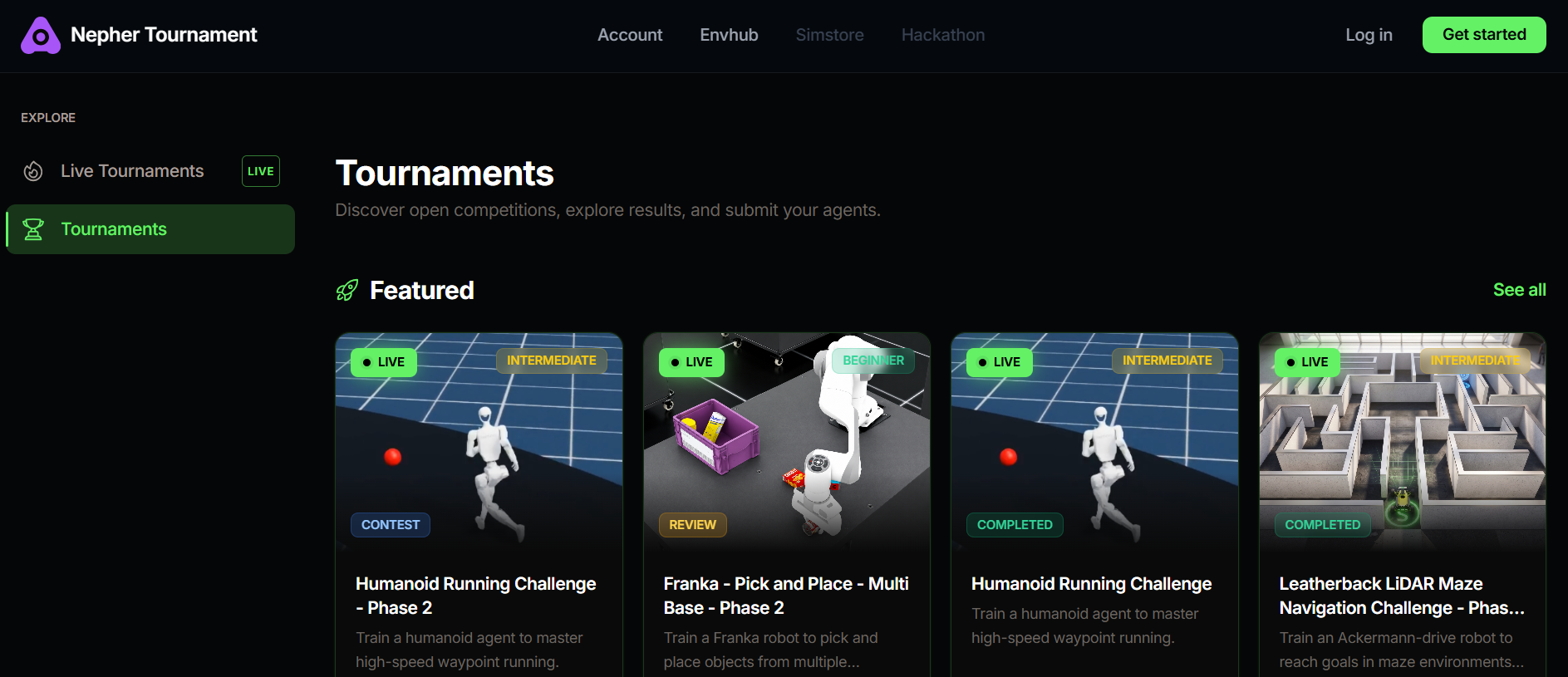
Nepher runs on two live products and one that isn't live yet. Tournaments and EnvHub, the environment library, are in production. Hackathons, the open-ended innovation format, is still deployed on a staging server while the team validates the experience. Everything below covers what's actually running.
A Tournament Cycle Pays One Winner and Zeroes Out Everyone Else
A handful of Bittensor subnets have adopted winner-takes-all scoring for code and trading tasks. Nepher applies the same design to physical robot control, and the mechanics are worth understanding to appreciate the design fully.
Every tournament moves through five stages, each timed to Bittensor's own block numbers rather than the calendar. Miners train a policy on their own machines and submit a signed agent during Contest, and the list of who's eligible to compete is locked in during Submit, so no one can swap in a new agent afterward. Validators score every submission during Evaluation, an admin team checks the top entry for signs of cheating during Review, and the approved winner collects the reward once Reward begins.
The scoring itself happens inside a sandbox, which is a temporary, locked-down container that spins up to test one agent and disappears once it's done. That container runs Isaac Sim and Isaac Lab, NVIDIA's own physics simulation tools, and strips out nearly everything that would let an agent cause trouble. It blocks access to the validator's wallet, limits network traffic to an approved list of addresses, and wipes itself clean once the test ends, so nothing an agent does inside it can follow it back out. A validator never touches Isaac Sim directly, so it can score dozens of agents without ever trusting the code those agents contain.
Once every agent has a score, validators average the results based on how much stake each validator holds, and multiple tournaments can run side by side without interfering with each other. Each tournament that isn't in its reward period still sends a small, fixed slice of the network's weight, 1%, to whichever agent is currently leading, while the tournament in its reward period claims everything left over for its winner. And if no tournament has an approved winner in a given cycle, that leftover weight doesn't just sit unused; it burns and disappears from the network entirely. Right now, the subnet sends 48.2% of its emission to miners and 33.8% to validators and stakers, while the remaining 18% goes to the subnet's owner.
Right Now, the Proving Ground Is a Unitree G1 Learning to Race
The tournament currently running on Nepher's platform is the Humanoid Running Challenge, and it trains a Unitree G1 humanoid to sprint through a sequence of waypoints as fast as it can without falling over, which says a lot about what the platform actually rewards.
The robot's control system stacks three layers on top of each other, and only the top one is what miners actually train. A frozen motion-tracking controller and a frozen locomotion controller, both running 50 times a second, handle the walking and balance and never change during the tournament, while a trainable race policy sits above them, running at a slower 10 times a second, and its only job is choosing where to steer and how hard to push.
🏁 First Nepher Olympics tournament done!
— Nepher Robotics (@nepher_robotics) July 28, 2026
Humanoid Running Challenge wrapped up. My form still isn’t perfect yet — plenty of room to improve.
Expecting a significantly higher success rate in the next one.
Competitive pressure on #Bittensor SN49 is real. This is how we push… pic.twitter.com/W6BadbAY3A
Miners practice on waypoint courses that get randomly generated each run, spaced between 1.5 and 5 meters apart with a top forward speed capped at 5 meters per second, but validators score submissions against a separate, fixed set of courses that never change between runs. That distinction matters, because a policy that only handles random courses well might still fall apart on a course it's never seen, and a fixed course makes every submission directly comparable to every other one. Scoring favors whichever policy finishes fastest without falling, and staying consistent across multiple courses counts too, so a policy that's fast but shaky won't necessarily beat one that's steady and merely quick.
The hardware requirements are specific but not out of reach. Training a policy calls for an NVIDIA graphics card with at least 24 gigabytes of memory, while the validators scoring those policies need much beefier, data-center-grade cards with 40 gigabytes or more. Submitting a finished policy takes almost no hardware at all, since it runs through the Nepher CLI on ordinary hardware, so a miner without validator-grade equipment can still train and compete. Once the tournament ends, the winning policy and the code and environment files behind it get published free on SimStore, so anyone can study or build on it.
The NVIDIA Inception Badge Is More Than a Logo on a Landing Page
Nepher lists an active NVIDIA Inception Program membership on its site, which brings many advantages to the team.
Membership brings developer tools and training, better pricing on NVIDIA hardware and software, and access to a network of investors that NVIDIA introduces members to directly. Some members can also apply for a 60-day program that provides hands-on access to NVIDIA's own GPUs.
None of that makes Nepher rare, since NVIDIA's own venture arm counts more than 30,000 companies inside the Inception network, so the badge works more like a baseline credential than proof of a real edge. What makes it worth mentioning here is that Nepher's entire product runs on NVIDIA's Isaac Sim and Omniverse tools, so preferred access to that roadmap and pricing sits much closer to the center of its business than it would for most members outside robotics.
Where the Bet Actually Sits
Nepher isn't betting that Bittensor needs another inference subnet or another compute marketplace, since plenty of those already exist.
It's betting that the fastest way to get a robot policy out of a simulator and onto real hardware is to make the evaluation adversarial & transparent. It's also betting that paying the rewards out in TAO is better than trusting it to whichever lab wrote the benchmark, and the Spot navigation tournament is the first real test of whether that bet holds up.
You can watch that test play out yourself. The tournament dashboard shows the ladder, the submission window, and the standings in real time, and the CLI takes a policy trained on your own machine straight into the same pipeline that decides who wins.



%20Turns%20Robot%20Policy%20Training%20Into%20a%20Winner-Takes-All%20Tournament)