Table of Contents
NVIDIA has released Nemotron 3.5 Super VL, an open multimodal model that brings reasoning, instruction following, and tool use together with text, image, document, and video understanding. The launch targets specialized AI agents handling multistep work, including processing financial documents and investigating security vulnerabilities.
The model has 120 billion parameters but activates 12 billion per token. NVIDIA is making weights, datasets, and training recipes available so organizations can adapt it to their own tools, policies, and workflows rather than rely solely on an off-the-shelf model.
How Nemotron 3.5 Super VL Handles Agent Work
The architecture combines Mamba-2, attention, and mixture-of-experts layers with a C-RADIO vision encoder and a connector that brings visual information into the language backbone. Sparse expert computation lets the model draw on a larger parameter pool without activating all of it for every token.
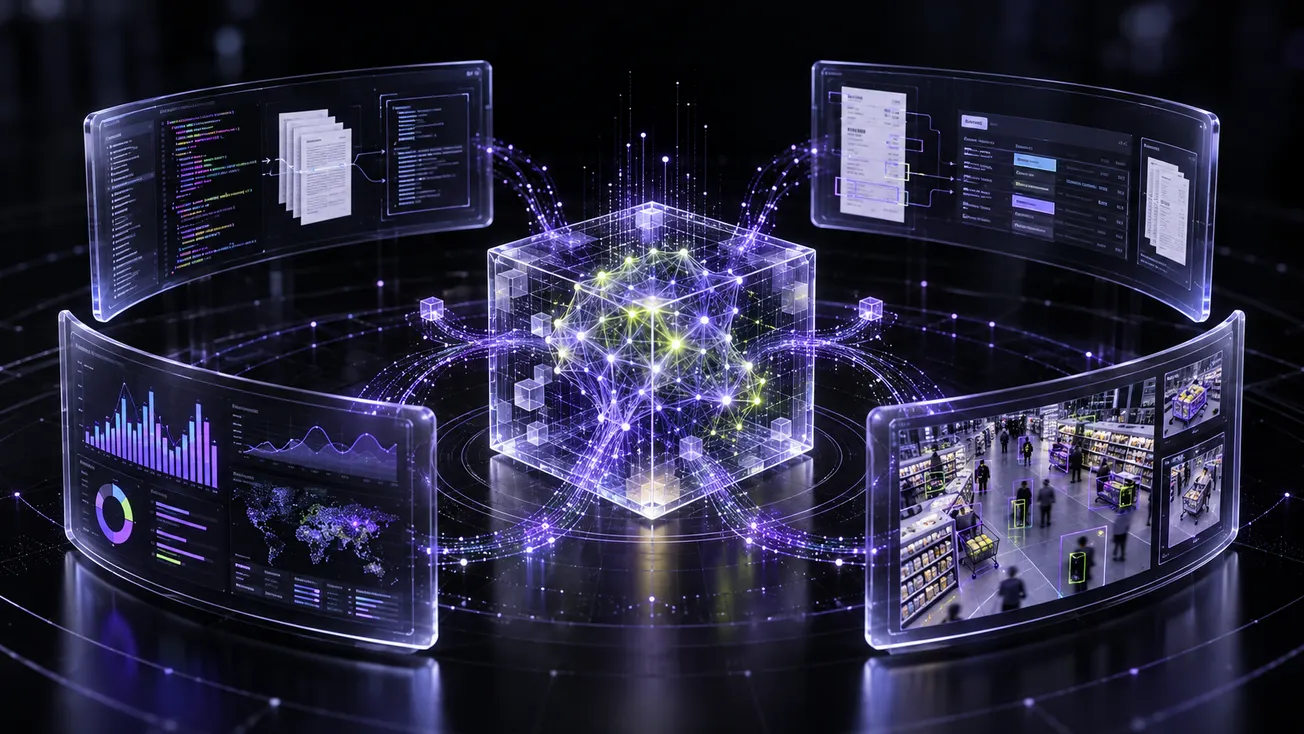
Keeping visual interpretation and reasoning in one model changes how developers build agents. An agent can read a chart, connect it to a table on another document page, and use that evidence in a response or tool-driven workflow without handing the task to a separate vision-language model.
The post-trained BF16 model supports context lengths up to 1 million tokens, shared across prompts, visual inputs, conversation history, tool results, and generated output. Actual serving configurations may use a smaller window to accommodate memory and concurrent requests.
NVIDIA also combines several inference techniques. Multi-token prediction proposes several future tokens for the main model to verify together, while prefix caching reuses computation for repeated instructions, tool definitions, and conversation context. Its serving stack preserves both attention caches and Mamba recurrent states.
NVIDIA's NVFP4 recipe uses 4-bit weights and activations on Blackwell hardware, with quantization-aware distillation training the compressed model to match the original BF16 model's outputs. NVIDIA has optimized the model for local use on DGX Spark, but that deployment path is distinct from the full-precision release, whose documented configurations use four H100 GPUs or two GB200 GPUs.
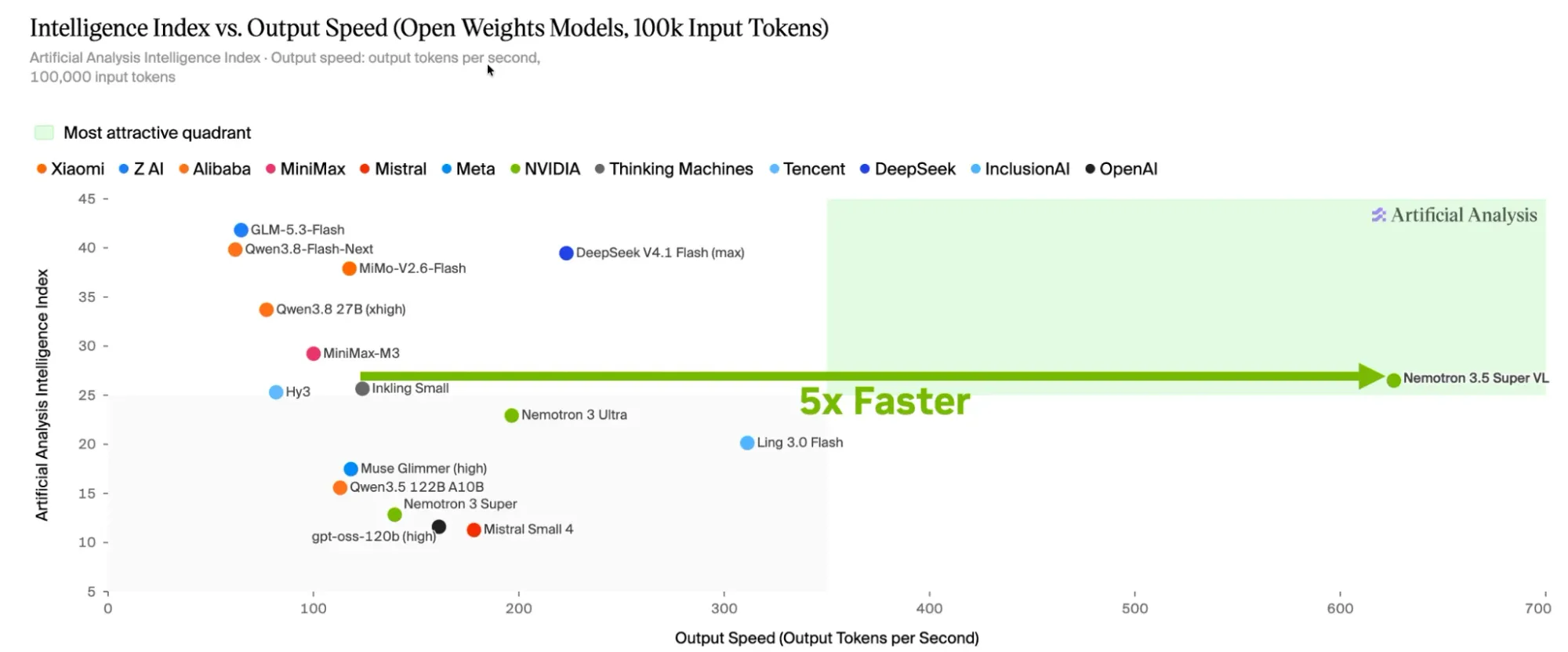
In its technical benchmarks, NVIDIA says up to five times higher single-GPU throughput for agentic tasks than other open models in the same size category. Its published chart shows more than 600 output tokens per second on Artificial Analysis Intelligence Index agentic tasks through the Baseten endpoint.
Post-Training for Financial and Security Workflows
The early customer examples focus on bounded business tasks.
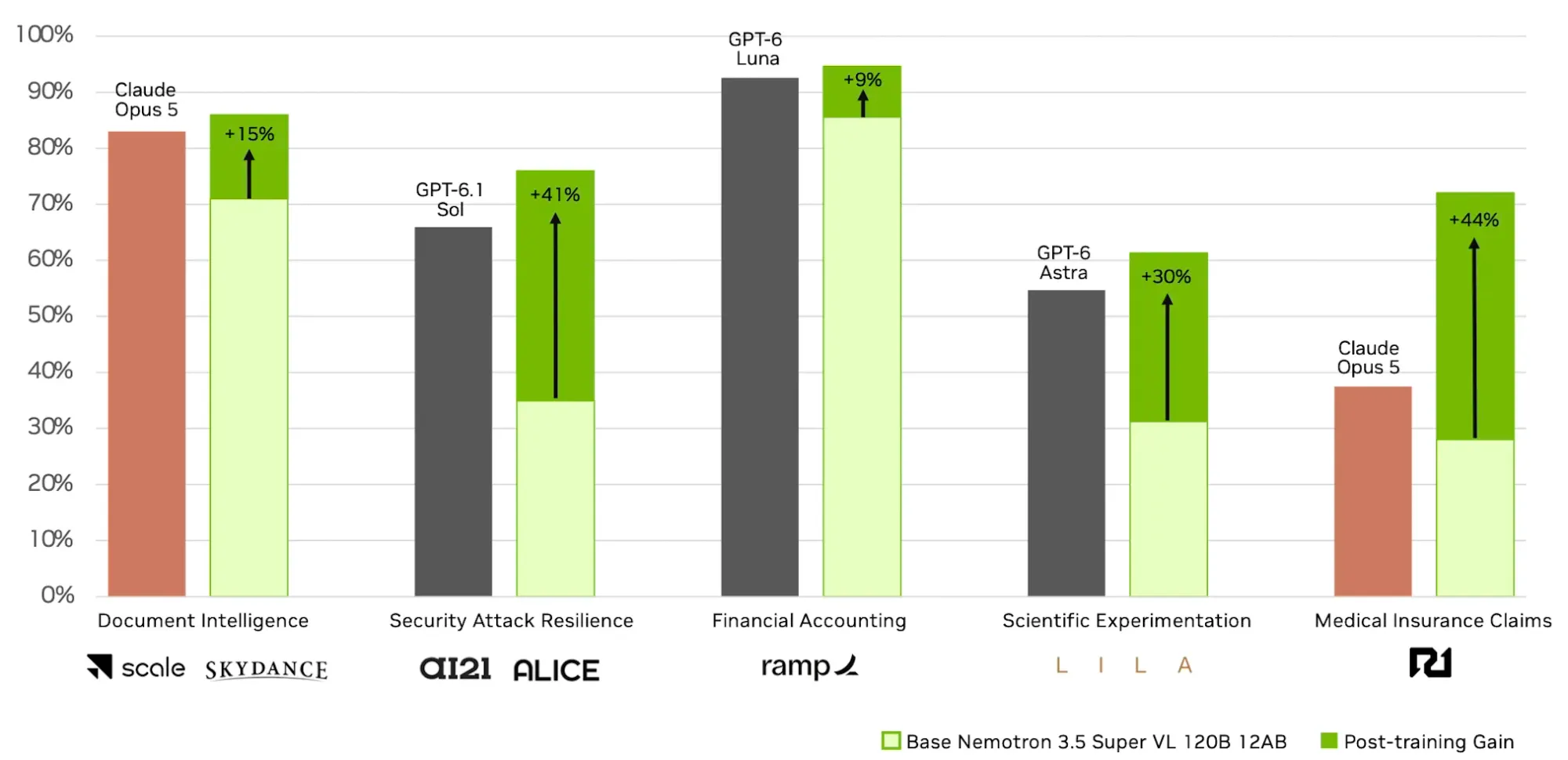
Scale AI adapted the model for automated vendor credit processing at Skydance. Inference costs for that workload will fall by a factor of 40 and latency by a factor of five. Ramp, which is converting receipt images into structured JSON containing merchant details, dates, and payment information, expects up to 50% higher throughput and tenfold lower latency.
AI21 post-trained the model for Alice's threat-intelligence and vulnerability-analysis workflows, with a reported 40% improvement in accuracy.
Developers can follow a similar customization path using NeMo AutoModel for supervised fine-tuning and low-rank adaptation, or LoRA. NeMo RL and NeMo Gym support reinforcement learning and evaluation in environments that reflect an organization's tasks.
Coding, Chart Reading, and Agent Evaluations
NVIDIA's evaluations cover both answer quality and how quickly agents complete work. On Hermes Bench, the company reports a score of 63.44%, compared with 56.33% for Nemotron 3 Ultra. On LangChain behavioral evaluations, the corresponding scores are 87.05% and 84.3%.
NVIDIA reports 80.8% on CharXiv, rising to 84% when Python code interpretation is available. Nemotron 3 Nano Omni scored 63% in the comparison.
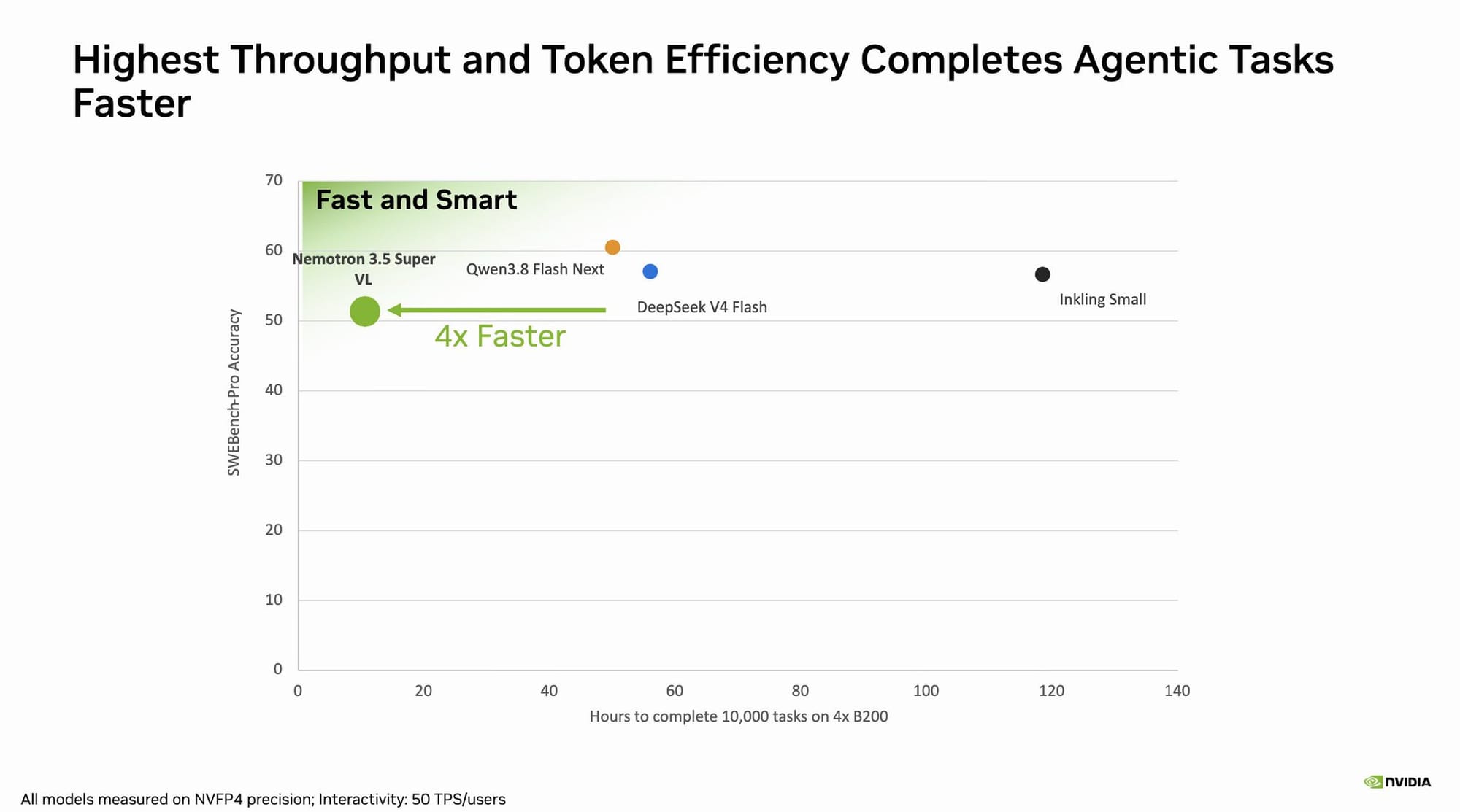
The NVIDIA AI launch thread also highlights coding efficiency. NVIDIA reports completing a batch of 10,000 coding tasks up to four times faster in its B200 GPU comparison while retaining strong SWE-bench Pro accuracy.