
Table of Contents
OpenAI has released GPT-6.1 Terra, a model for visual reasoning and computer use that cuts standard API prices in half compared with GPT-5.6 Terra and GPT-6.1 Sol. It is available through the API and to Plus, Pro, Enterprise, and Edu users in ChatGPT Work and Codex.
The model combines screen understanding, actions across applications, and more natural writing for tasks such as preparing proposals, interpreting technical drawings, filling out forms, and editing videos. OpenAI introduced Terra on October 26, targeting the routine computer-based work that can require repeated model calls and extended interaction with software.
OpenAI reports that Terra completes tasks more than three times faster than GPT-6 Astra and GPT-6.1 Sol on its professional computer-use evaluation. The release also improves factual accuracy and command-line coding over the previous Terra model, while keeping the higher-end models as its recommendation for in-depth research and the most complex coding.
Computer Use at a Lower Cost per Task
Computer-use models need to connect what they see with what they do: read a screen or drawing, identify the relevant controls, and carry out a sequence of actions. OpenAI gives invoice processing as one intended application, with the model reading incoming invoices and entering their details into accounting software.
The main professional-task comparison uses Agents' Last Exam. Its assignments include converting architectural drawings into a 3D model and reviewing an animated film shot by shot to produce a time-coded log for a restoration team. These tasks combine visual interpretation with work inside applications, rather than testing only written answers.
At medium reasoning effort, GPT-6.1 Terra scores 15 percentage points higher than GPT-5.6 Terra at about one-third of the cost, OpenAI reports. Terra also performs on par with GPT-6 Astra at one-tenth of Astra's price per token.
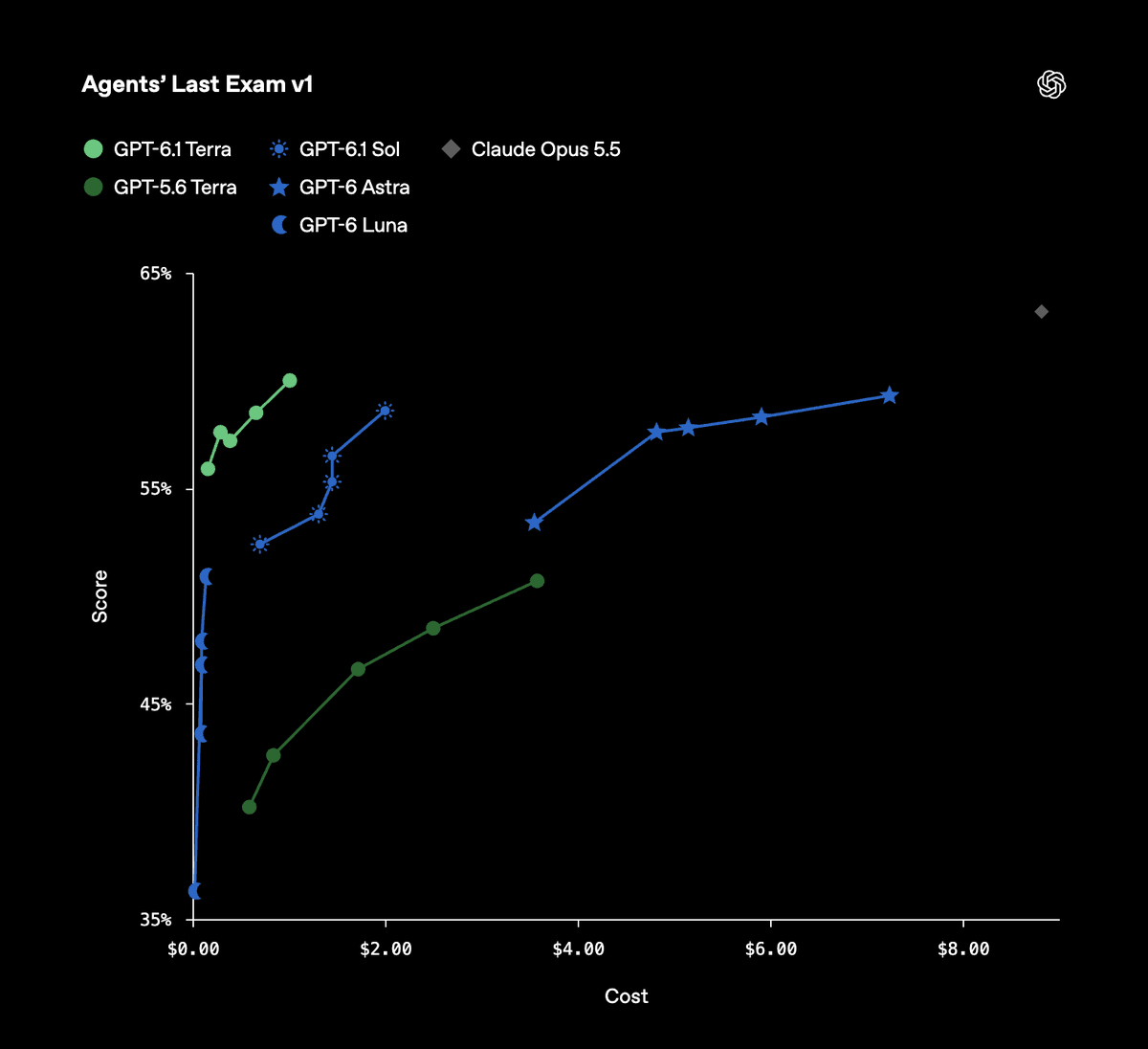
Against Claude Opus 5.5 at maximum reasoning effort, OpenAI reports more than three times the token efficiency and one-fourth the price per token, yielding approximately nine times lower cost per task in its evaluation. Per-token pricing is the charge for processing or generating text units; task cost also depends on how many tokens the model uses to finish the work.
The visual and desktop evaluations show gains across different parts of that workflow. Terra beats GPT-5.6 Terra at every reasoning setting on MMMU-Pro, which measures visual reasoning. On OSWorld 2.1, a benchmark of multistep desktop-app tasks, its medium-effort result exceeds the older model's best score at a lower cost per task.
Improvements in Coding, Factuality, and Agent Behavior
On Terminal-Bench 4.0, which tests command-line software-engineering tasks, GPT-6.1 Terra solves 50.3% of assignments at maximum reasoning effort. GPT-5.6 Terra's published score was 21.5%. The tasks include practical debugging work, such as fixing a webpage whose layout shifts while loading.
Terra also surpasses GPT-6.1 Sol at maximum reasoning on Terminal-Bench-Science 0.1, which tests the use of code for scientific research tasks. OpenAI reports that it comes within five points of Opus 5.5 at less than one-fifth of the estimated cost. An example task involves tracking cell divisions in time-lapse video.
OpenAI's internal factuality evaluation uses prompts designed to elicit errors. At low reasoning effort, Terra's error rate falls to 16.7%, from 53.6% for GPT-5.6 Terra. At maximum effort, the rate falls by 18 percentage points to 4.3%, approaching the results of GPT-6 Astra and GPT-6.1 Sol on that evaluation.
Reliability also depends on how agents behave inside applications. OpenAI reports that Terra is more likely than its predecessor to disclose blockers honestly and remain within scope. Its prompt-injection testing also found strong resistance to malicious instructions, including those embedded in third-party content that try to redirect an agent away from its assigned task.
The Terra system card classifies the model as Critical in cybersecurity and High in biological and chemical capability under OpenAI's Preparedness Framework. Terra uses the safeguards stack developed for GPT-6 Astra and GPT-6.1 Sol, with probes updated for the new model.
API Pricing and Access
Developers can call the model as gpt-6.1-terra. Standard API rates are:
| Token Type | Price per Million Tokens |
|---|---|
| Input | $1.00 |
| Cached input | $0.05 |
| Output | $5.00 |
Cached-input pricing applies to reused input eligible for caching. The lower rates make a difference in workflows that repeatedly supply context and generate actions, as well as those that process large volumes of documents.
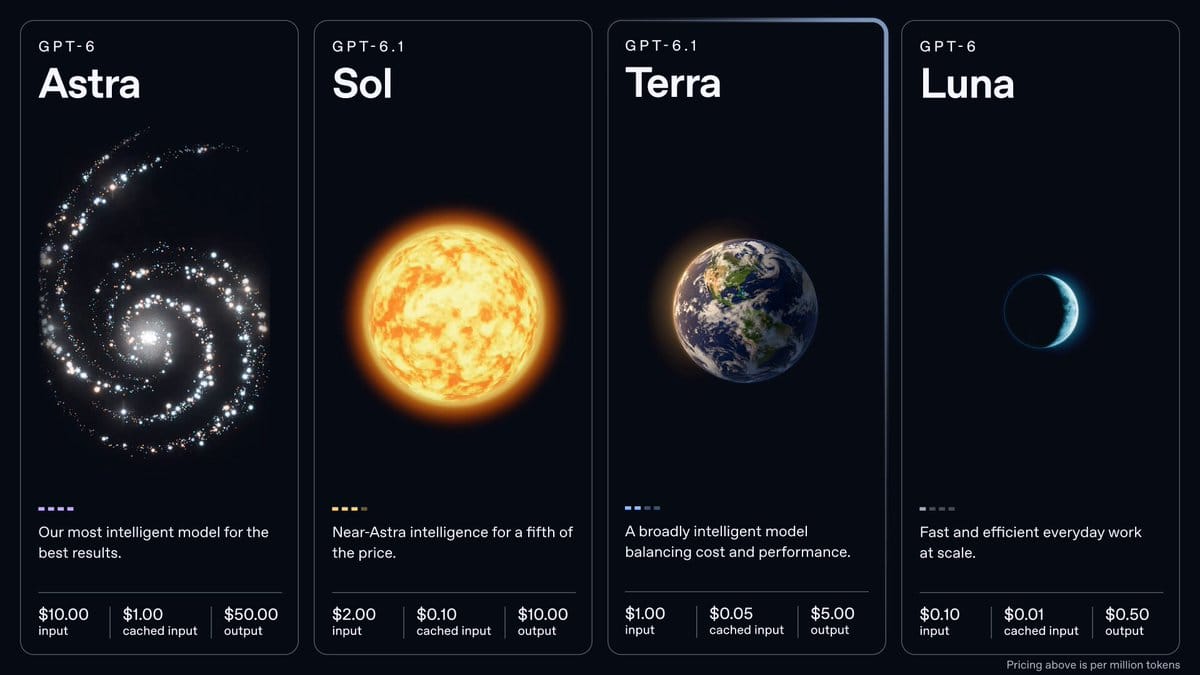
Terra adds a workplace-focused option alongside the models already reaching users through the GPT-6 rollout with Intelligent UI. OpenAI has also begun expanding enterprise distribution through Google Cloud's Model Garden, where the announced private preview includes GPT-6 Astra, GPT-6.1 Sol, and GPT-6 Luna.
In ChatGPT Work and Codex, OpenAI says the same usage allowance covers more tasks with GPT-6.1 Terra than with GPT-5.6 Terra, and substantially more than with GPT-6.1 Sol or GPT-6 Astra. Users can choose Terra for higher-volume work while retaining access to the more capable models for demanding research and coding.