

Table of Contents
OpenAI has opened its Decisions API in public beta, giving developers a dedicated endpoint for turning text and images into structured application judgments.
The new POST /v1/decisions endpoint is currently powered only by gpt-6-luna and returns typed answers for three common decision patterns: predicate probabilities, choices from fixed options, and rubric-based scores. OpenAI says the endpoint is about 10x faster than using GPT-6 Luna through the Responses API, which suits product workflows where latency compounds across routing, classification, ranking, safety checks, and agent loops.
Documentation is now available for developers who want to test the endpoint in the Playground before coding against it.
How the Decisions API Works
The Decisions API handles cases where an application needs a fast, structured answer from a model rather than a free-form response, not general chat or open-ended generation.
Developers send shared evidence through the input field, which can include text, images, or both. They then define one or more questions for the model to evaluate. The API returns an answers array, with each answer matched to a developer-supplied question name.
OpenAI currently supports three question types:
- Predicates, which estimate whether a condition is true and return a probability from 0 to 1.
- Choices, which select from developer-supplied options and return the selected value, confidence, and per-option probabilities.
- Scores, which evaluate an input against ordered rubric levels and return a probability-weighted average score, confidence, and probabilities.
That structure makes the endpoint useful when an application needs a machine-readable result that can immediately drive software behavior. A predicate might determine whether a support ticket is urgent, a choice might select the right department for a request, and a score might rank the severity of a bug report.
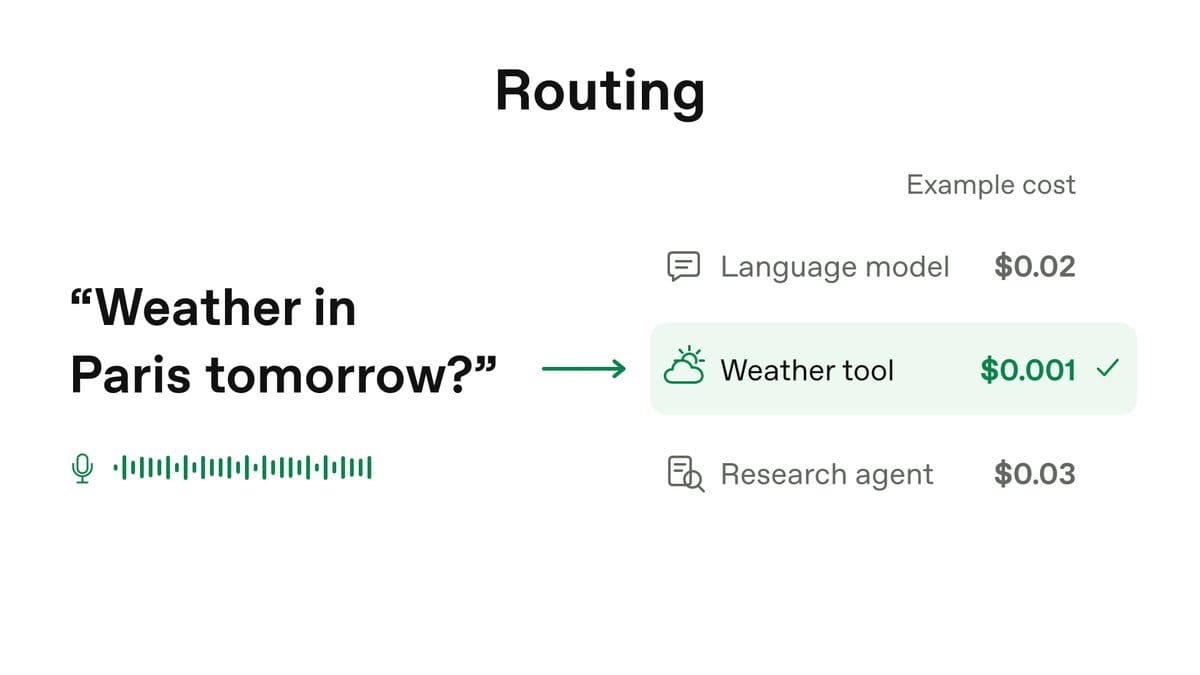
Many AI products do not need a full assistant response at every step. They need a fast judgment that can route a request, choose a tool, rank candidates, label data, reject risky actions, or decide whether a more expensive model should be called. Those decisions often happen repeatedly inside a single user workflow, so latency and price can matter as much as raw model capability.
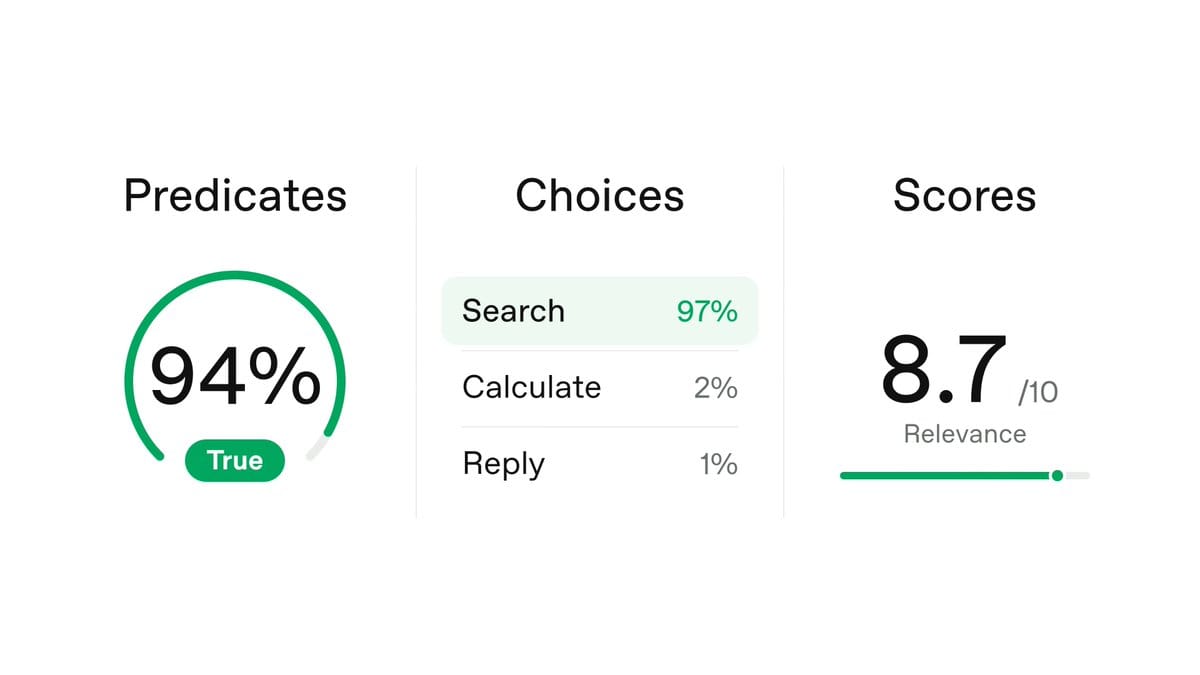
Image Decisions Add a Multimodal Routing Layer
The endpoint also supports image inputs, which expands the decision model beyond text classification. OpenAI’s docs show an image-inspection example where a developer sends a base64-encoded product photo and asks whether the product has visible damage.
Images must be submitted as inline base64 data URLs. Hosted HTTP or HTTPS image URLs and file_id inputs are not supported on the Decisions endpoint. Developers can combine input_text and input_image parts in the same user message when they want the model to evaluate an image with instructions or surrounding context.
That design makes Decisions relevant to workflows such as visual quality checks, screenshot-based UI action selection, and analysis of key video frames. The image support lets agentic systems make fast intermediate judgments from screens or visual evidence before deciding whether to call a tool, hand off to another model, or escalate to a human.
Why Fast Typed Decisions Matter for Developers
The launch follows a growing pattern in AI application design that separates decision steps from longer generation tasks.
The Decisions API gives developers a dedicated endpoint for those moments. OpenAI lists use cases including routing to the right model, tool, or agent; producing labels, rankings, and scores; comparing images or video frames; choosing UI actions from screenshots; flagging risky tool calls; and categorizing large datasets.
The endpoint sits between classic classification APIs and larger agent frameworks. Instead of asking a model to produce prose, an application can ask a narrowly framed question and receive probabilities it can use in code. That can make AI systems easier to audit, tune, and integrate into production workflows where downstream logic expects a typed result.
Pricing, Beta Availability, and SDK Support
OpenAI’s documentation lists Decisions API pricing for gpt-6-luna at $0.10 per 1 million input tokens. The endpoint charges only for input tokens, with no cache-read, cache-write, or output-token charges on /v1/decisions. OpenAI notes that regional processing premiums and long-context input pricing multipliers can still apply.
The API is available in public beta, and OpenAI says general availability is expected in the coming weeks. For eligible customers, the endpoint supports Zero Data Retention and HIPAA use. Data residency and regional processing are supported in the United States and Europe, including the EEA and Switzerland.
Developers using OpenAI’s official SDKs need Python 3.26.0 or later, JavaScript 7.30.0 or later, Go 3.73.0 or later, Ruby 0.101.0 or later, or Java 4.78.0 or later.