Table of Contents
OpenAI has started rolling out GPT-6 with Intelligent UI to ChatGPT users, expanding its newest model generation from paid access into the broader ChatGPT product.
OpenAI announced the rollout on October 7. Plus, Pro, Business, and Enterprise users began receiving the update first, with Free and Go users scheduled to follow starting October 8. Paid tiers run on GPT-6 Sol, while Free and Go tiers run on GPT-6 Luna. OpenAI says both models are tuned for everyday conversation.
The update applies to ChatGPT's main Chat tab and changes more than the model behind the response. Intelligent UI lets ChatGPT answer with text, visuals, and interactive elements, allowing the product to generate small interfaces inside the conversation rather than returning only written replies.
The release follows OpenAI's first GPT-6 models for paid customers in September. In its launch post, OpenAI described this rollout as built for ChatGPT's full user base, which the company says now exceeds 1.2 billion weekly users.
GPT-6 Brings Intelligent UI to ChatGPT
Intelligent UI is OpenAI's term for model-generated interfaces inside ChatGPT answers. Instead of choosing between a text answer and a separately built application, GPT-6 can combine written explanation with components such as charts, maps, forms, buttons, visual explanations, and small tools.
GPT-6 was trained to decide when an interactive or visual response is useful and when plain text is the better format. A travel question might produce a map. A planning question might generate a checklist or form. A comparison might appear as a side-by-side layout. A user can also ask ChatGPT to create a simple tool for the moment, such as a calculator, bill splitter, or game.
It moves ChatGPT closer to a generative software surface. The model is not only producing content for a fixed chat window; it is deciding what kind of interface the task needs and building that interface as part of the answer.
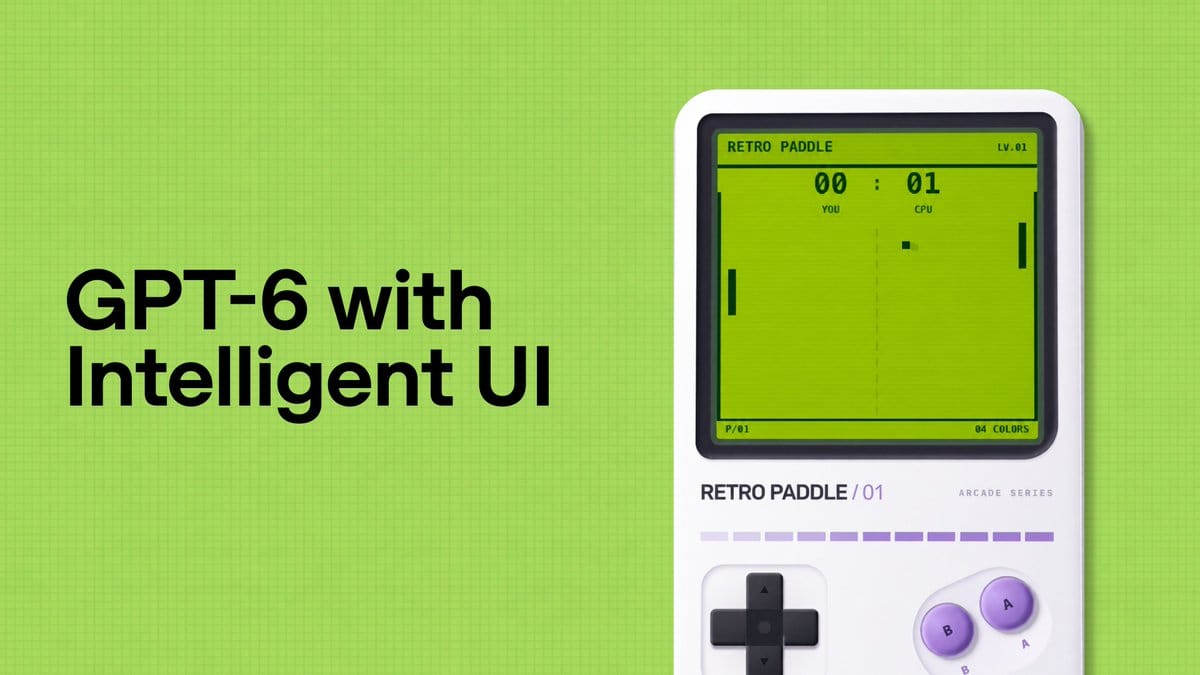
"Instead of people adapting to software, software will adapt to people," the company wrote in its launch post.
How OpenAI Says the System Works
Intelligent UI uses a library of native, streamable components and a compiler that renders the interface while the model generates it. The component library gives ChatGPT a consistent visual and interaction base, while the model decides how to arrange those elements for the user's request.
Rather than waiting for a complete answer before displaying an interface, ChatGPT can progressively render the response as it is being generated. Making more complex answers feel faster and letting the system combine explanation, visuals, and interaction in one flow.
GPT-6 was trained for design judgment, including how to structure information, when interactivity improves comprehension, and when an interactive interface would add unnecessary friction. OpenAI said generated interfaces were evaluated for clarity, usefulness, and completeness, while acknowledging that there is "still work ahead to improve the model's design judgment and expand what it can create."
The feature depends on the model making product-design decisions in real time. A useful generated interface can make a task easier to understand or complete, while a poorly chosen one can slow the user down. OpenAI's rollout will test whether that judgment holds up across everyday consumer and workplace use, not just polished demos.
GPT-6 Also Changes How ChatGPT Answers
Beyond the interface layer, GPT-6 can begin responding while it continues reasoning through a task. The company calls this interleaved thinking: ChatGPT can start with partial output, keep working in the background, and build the answer across multiple generated steps.
GPT-6 Instant starts answering web-search questions 44% sooner on average than GPT-5.6 Instant. The company also said GPT-6 Extra High began answering in the same amount of time as GPT-5.6 Medium in an internal evaluation of everyday agentic tasks, while scoring better overall than GPT-5.6 Extra High.
GPT-6 is better than GPT-5.6 at deciding when to search the web and at finding information that supports its responses. That should help most with questions where the answer depends on current information, sourced claims, or multi-step research.