

Table of Contents
We have a new subnet on our hands; this time, one that's bringing Bittensor's incentive model to robotics models.
OpenRoboto has now launched on Bittensor mainnet after acquiring subnet 80, opening a competition designed to continuously improve robotics models through public scoring, open model submissions, and on-chain challenges.
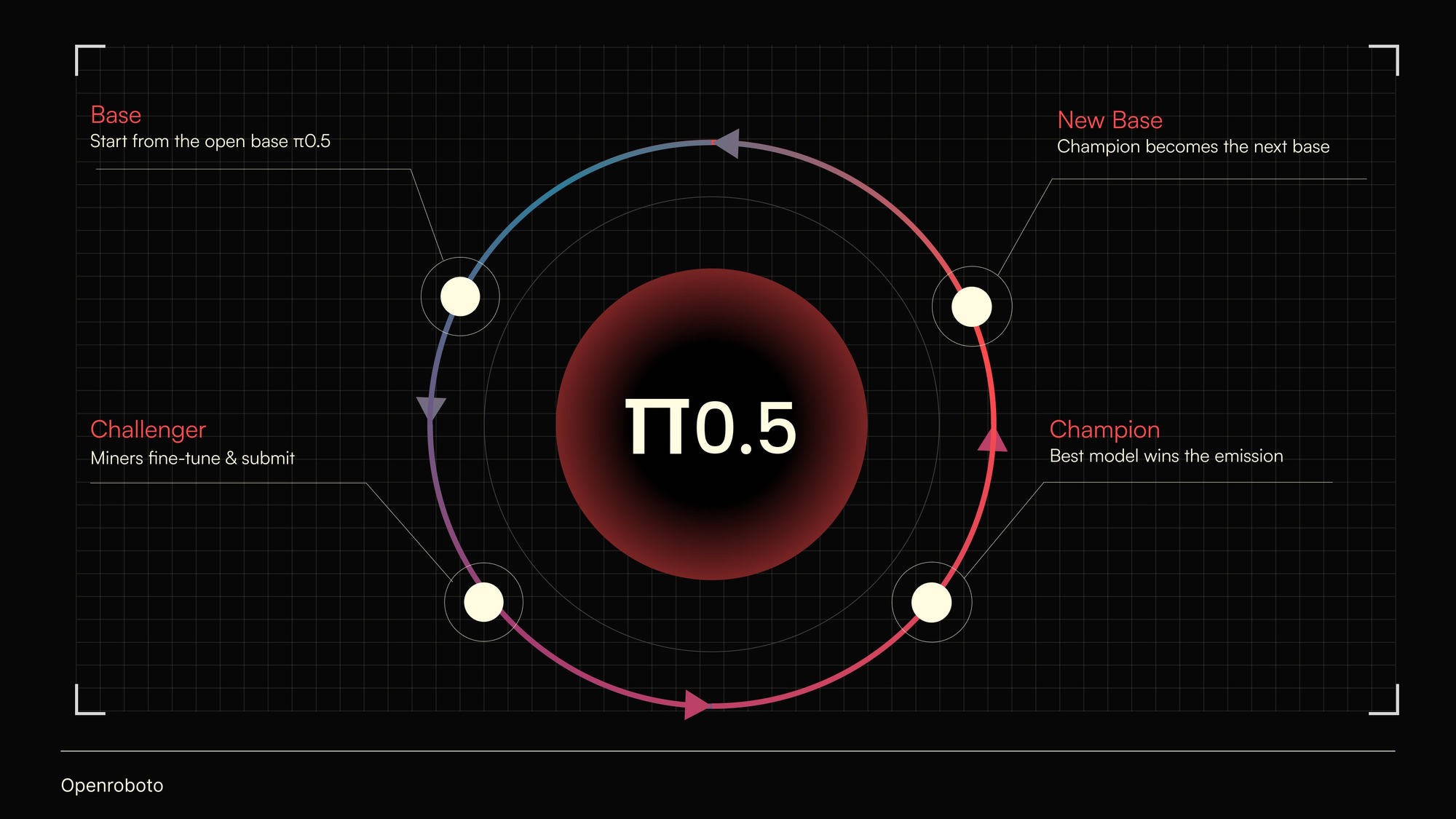
The subnet starts from π0.5, a vision-language-action robotics model, and asks miners to fine-tune the current base model, upload their weights to Hugging Face, and announce the exact commit on-chain. Each round, challengers are evaluated on randomized LIBERO-Pro benchmark tasks. A model only becomes the new base if it outperforms the current champion.
Put more plainly: OpenRoboto starts with one robot AI model, then invites people to make it better. They submit their improved versions, and the network tests them on randomized robot tasks. If a new version performs better than the current best model, it becomes the new starting point for everyone else.
Instead of relying on a single lab to publish periodic model upgrades, the subnet is built around an open competition in which each winning model becomes the next starting point for the network.
How OpenRoboto Works
In OpenRoboto's core loop, miners pull the current base model, fine-tune it, submit the resulting weights, and compete to replace the champion.
The project says it begins with π0.5, a robotics model developed by Physical Intelligence. π0.5 belongs to a class of vision-language-action models, or VLAs, that connect visual perception and language instructions to robot actions. Hugging Face describes π0.5 as a model built for open-world generalization, meaning it is designed to operate in new environments and situations beyond a narrow training setup.
The base model is not meant to remain static; the subnet turns it into a moving frontier. When a challenger produces a higher score, that model becomes the new base for the next generation of submissions. In theory, this creates a compounding process in which every improvement becomes shared infrastructure for future miners rather than a private checkpoint controlled by one team.
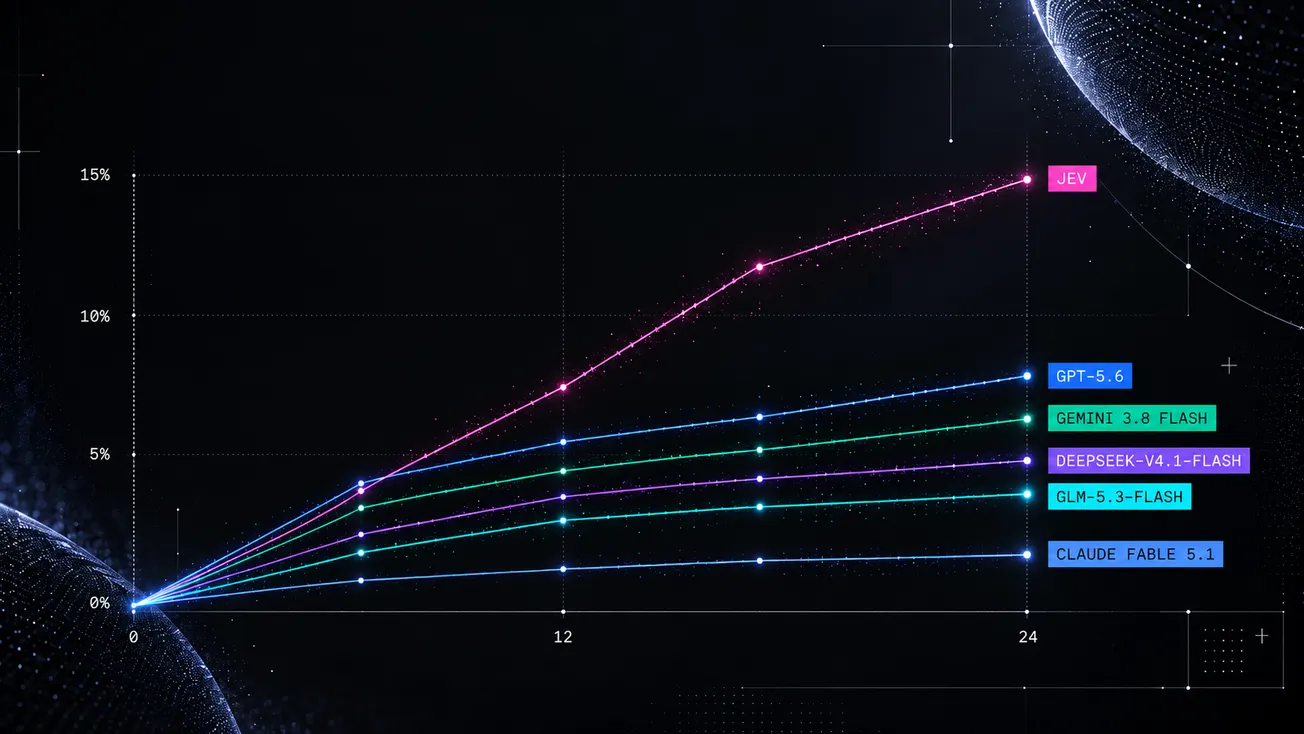
The project's site currently shows the arena as live, with a π0.5-based champion scoring 0.725 on LIBERO-Pro success compared with a 0.605 baseline. It also lists 107 submissions and one live round, signaling that the competition has already moved beyond a blank launch state.
The process depends on several public artifacts. Miners use the OpenPI runner, publish weights to Hugging Face, and record the relevant commit on-chain. That combination gives validators and observers a way to connect a submitted model to a reproducible set of weights instead of relying only on off-chain claims.
Why LIBERO-Pro Matters
Robotics benchmarks are difficult because high scores can reflect memorization, narrow task design, or overfitting to a known environment instead of actual robust control. It makes it difficult to assess and reward useful robotics progress.
To help work around this, OpenRoboto uses randomized LIBERO-Pro evaluation to score challengers. LIBERO-Pro was introduced as an extension of the LIBERO benchmark, with perturbations across manipulated objects, initial states, task instructions, and environments. Its authors argue that standard LIBERO results can overstate model capability because models may perform well under familiar settings while failing when reasonable variations are introduced.
OpenRoboto's roadmap further reflects the scoring challenge. The project describes its progression as moving from a live leaderboard and first champion to mainnet challenges with public scoring artifacts, then toward a Benchmark v1 with expanded tasks, reproducible evaluation, and stronger robot-transfer gates. The final roadmap stage points to factory deployment, where winning models would graduate from benchmark rows into real workcells.
"Robotics could become one of the largest industries of the coming decades. The hard part won't only be building more robots. It's giving them models that can perform real-world tasks," the team said.
What Comes Next
OpenRoboto is entering mainnet with miners as its first audience. The immediate task is to encourage participation, which means pulling the base model, fine-tuning it, submitting weights, and attempting to beat the current champion under the subnet's evaluation process.
More long-term, if the scoring remains reproducible and the benchmark continues moving toward real-world transfer, OpenRoboto could become an important experiment in using decentralized incentives to advance physical AI rather than only digital AI services.