

Table of Contents
On Bittensor, the word "burn" does not always mean TAO is destroyed forever.
Bittensor handles supply accounting differently from many crypto networks. Some TAO that users casually describe as "burned" is actually recycled, meaning it is removed from the issuance counter and can be issued again later. Truly burned TAO is permanently gone while still counted in total issuance.
In supply terms, recycled tokens are subtracted from issuance, while burned tokens are gone forever and never re-emitted. Recycling slows the network's movement toward its supply cap, while burning permanently retires supply.
Recycled and burned TAO can both leave circulation, but they do not have the same long-term effect.
| Term | What Happens | Can It Be Issued Again? | Effect On Issuance |
|---|---|---|---|
| Recycled TAO | Removed from the issuance counter | Yes | Lowers total issuance |
| Burned TAO | Destroyed permanently | No | Stays counted in issuance |
This is why Bittensor's vocabulary can be confusing. A transaction, guide, or feature may use the word "burn," but the economic result may be recycling rather than permanent destruction.
Why Total Issuance Matters
Bittensor halvings are based on total issuance thresholds, not a fixed block date.
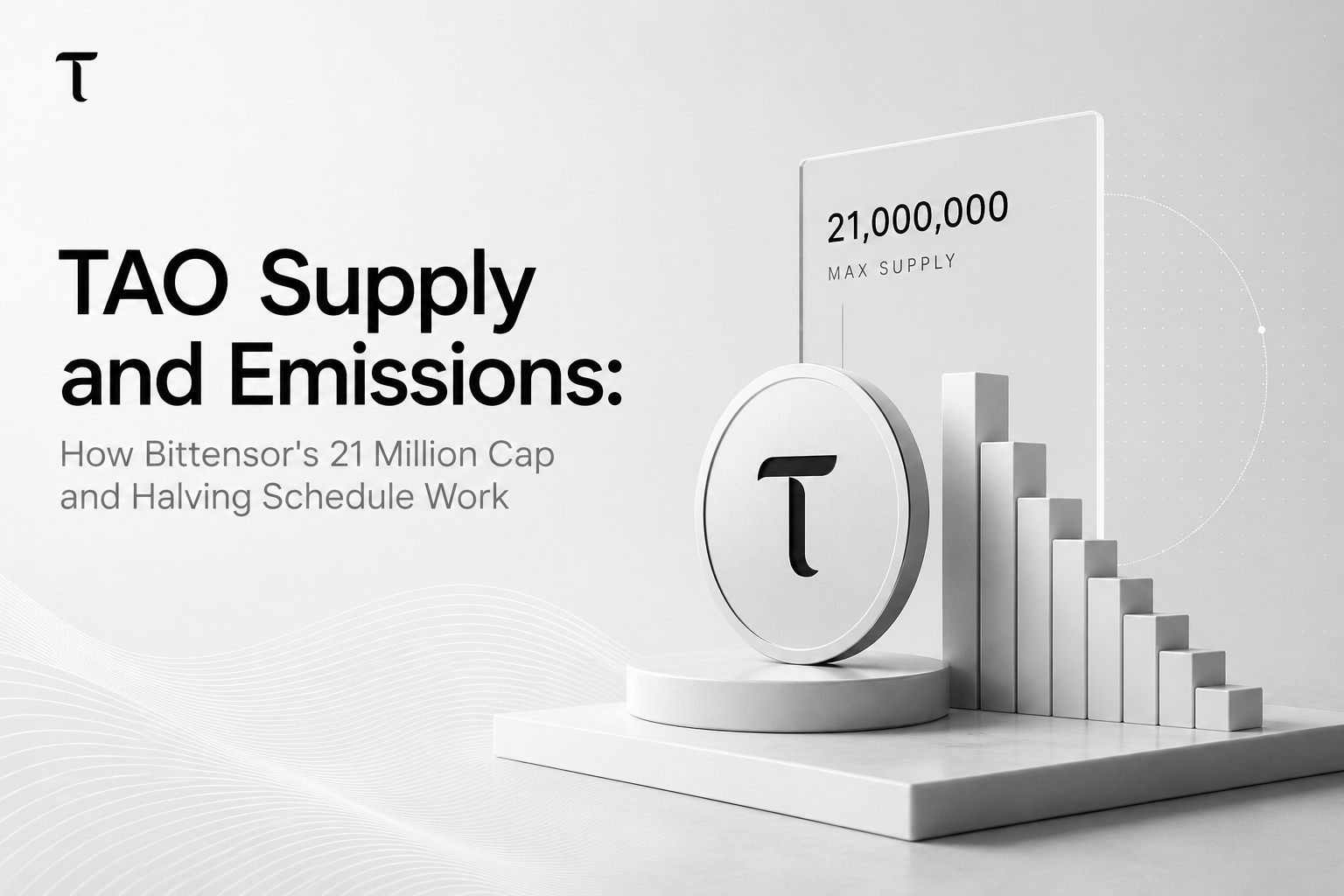
TAO has a 21 million token cap. The network halves emissions when total issuance crosses the midpoint of the remaining supply, such as 10.5 million TAO, then 15.75 million TAO, and so on. Recycling pushes halvings out because recycled TAO reduces total issuance and can be emitted again later.
If TAO is recycled, the cap does not change and the tokens are not gone forever. The issuance counter moves backward relative to where it would have been, so the network takes longer to reach the next halving threshold.
For more background on Bittensor's issuance curve:

Is The Registration Burn Really Burned?
The neuron registration "burn" is not a simple permanent burn. Bittensor's documentation describes the registration price paid by miners as burned during registration, but that TAO is recycled rather than permanently destroyed.
Neuron registration is how miners join a subnet and receive a UID. Each subnet has a floating registration price, often called the burn price. Under the hood, the TAO paid for registration is swapped into the subnet's pool, and the resulting alpha is removed from the subnet's outstanding supply.
The registration payment is not a refundable stake. If a miner is later deregistered or pruned, the registration cost is not returned. But the TAO side of the burn is recycled in Bittensor's supply accounting, which is why registration burns can delay halvings instead of permanently shrinking the supply.
Subnets can also use a collateral setting called collateral_lock_share. If that setting is greater than zero, part of the registration payment is locked as collateral rather than burned or recycled. The chain default is zero, so the classic registration model uses the full registration price as the burned/recycled share.
This is separate from subnet creation. Registering a new subnet is not the same as registering a miner UID.
Subnet Registration Is Neither Recycling Nor Burning
Subnet registration has its own cost, but that cost is not recycled at registration.
When a new subnet is created, the registration lock becomes the subnet's initial TAO reserve. The entire lock is transferred into the subnet's pool, and nothing is recycled at registration.
That makes subnet registration different from neuron registration:
| Event | What The Cost Does |
|---|---|
| Neuron Registration | The burn/recycled portion reduces issuance and can be emitted again |
| Subnet Registration | The lock becomes the new subnet's initial TAO pool reserve |
| Transaction Fees | Fees are recycled by reducing total issuance |
| Pool Swap Fees | Fees go to the block author |
Where Bittensor Transaction Fees Go
Bittensor transaction fees are recycled rather than paid to block authors.
For normal fee-bearing extrinsics, the chain charges a weight fee and a length fee. The length fee is one rao per byte, and one TAO equals 1 billion rao. The final fee and any tip are recycled by reducing total issuance instead of going to the block author.
EVM base fees and priority fees follow the same recycling path. For some unstake-side calls, a signer without TAO can pay the fee in alpha. The alpha is then sold for TAO, and the resulting TAO is recycled atomically.
This is another place where Bittensor differs from the mental model many readers bring from other networks. Transaction fees are not automatically validator revenue. The ordinary transaction fee path reduces total issuance, so the fee can be re-issued later through the emission schedule.
Some validator hot-path calls are fee-free. Calls such as set-weights, commit-weights, reveal-weights, serve-axon, and take changes pay no transaction fee.
Swap Fees Are A Different Thing
Staking and unstaking swaps pay a pool swap fee, which is not the same as a transaction fee.
When users stake, unstake, or move stake across Bittensor subnets, they may interact with a subnet pool. Every swap against a pool pays a fee of amount × FeeRate / 65,535. The default FeeRate is 33, or roughly 0.05%, though it is per-subnet and governance-settable.
Unlike transaction fees, pool swap fees are paid to the block author. If the fee is taken on the alpha side, it is converted to TAO first.
The distinction comes down to two fee types:
- Transaction fees are recycled.
- Pool swap fees go to the block author.
When Tokens Are Truly Burned
True burning still exists on Bittensor, but it is narrower than the casual use of the word "burn" suggests.
One example involves miner emission directed at subnet-owner hotkeys. Subnet owners should not mine on the owner hotkey, because miner emission directed at owner hotkeys is burned or recycled, never paid. The subnet's recycle_or_burn setting determines whether that withheld miner emission is destroyed or recycled, and the default is burn.
There is a further nuance. Withheld miner incentive counts toward MinerBurned either way, so switching the subnet setting from burn to recycle does not let a subnet avoid the emission-share scaling effect.
Another example is account reaping. Bittensor has an existential deposit of 500 rao. If an account balance drops below that floor, the account can be reaped and the remaining dust is destroyed. It is a small case, but it shows that permanent destruction is part of the system in specific places.
Project-level buyback-and-burn programs are different from protocol recycling. If a subnet team buys and burns its own token, that is a decision about that subnet's token economy, not the same as Bittensor's protocol-level recycling of TAO transaction fees or neuron registration costs.
Conclusion
Recycled and burned TAO both reduce circulating supply in the moment, but they do not do the same thing to Bittensor's long-term supply accounting.
Recycled TAO is subtracted from total issuance and can be emitted again. Burned TAO is permanently destroyed while staying counted in issuance. That is why neuron registration burns and transaction fees can push halvings later, while true burns permanently retire supply.
The takeaway is to read "burn" carefully. The word may describe the user-facing cost of an action, but the actual supply effect depends on whether the protocol recycles the tokens, burns them, routes them into a pool, or pays them as a swap fee.
FAQs
What Is The Difference Between Recycled And Burned TAO?
Recycled TAO is removed from Bittensor's total issuance counter and can be emitted again later. Burned TAO is permanently destroyed, but it still remains counted in total issuance.
Is The Bittensor Registration Burn Really Burned?
The neuron registration burn is not a simple permanent burn. The registration cost is not refunded to the miner, but the TAO is recycled in supply accounting, which means it reduces issuance and can be emitted again later.
Do I Get My Registration Fee Back When I Am Deregistered?
No. The registration cost is not refunded when a miner is deregistered or pruned. If a subnet uses registration collateral, the collateral portion may be locked as stake, but the burned/recycled portion is not returned.
Where Do Bittensor Transaction Fees Go?
Bittensor transaction fees and tips are recycled by reducing total issuance. They are not paid to the block author. EVM fees follow the same recycling path.
Do Validators Or Block Authors Earn Transaction Fees?
Block authors do not receive ordinary Bittensor transaction fees. Those fees are recycled. However, pool swap fees from staking and unstaking swaps are a separate fee type and are paid to the block author.
Does Recycling Reduce TAO's 21 Million Cap?
No. Recycling does not reduce the 21 million TAO cap. It lowers total issuance, which means the recycled TAO can be emitted again and halvings can be pushed later.
Are Subnet Registration Costs Recycled?
Current Bittensor documentation says subnet registration locks are not recycled at registration. The lock becomes the new subnet's initial TAO pool reserve. This is different from neuron registration, where the burn/recycled portion affects issuance.
Are Subnet Buyback-And-Burns The Same As Protocol Recycling?
No. Subnet buyback-and-burn programs are project-level decisions about a subnet token or ecosystem. Protocol recycling is a chain-level supply-accounting process that applies to mechanisms such as neuron registration costs and transaction fees.
Is Burning Better For TAO Holders Than Recycling?
That is a market question, not a mechanical one. Mechanically, burning permanently retires tokens, while recycling lowers issuance and allows tokens to be emitted again later. This article does not make price claims.