


Table of Contents
Main Takeaways:
- Root Reborn is now live in Bittensor v441. The upgrade changes root yield from a passive dividend pipe into a native basket mechanism tied to validator root positions.
- Root yield is no longer treated as an automatic sell-to-TAO stream. Instead, accrued value moves into per-validator baskets of subnet alpha and is realized when stakers claim.
- Validator curation is not fully active at launch. Bittensor’s documentation says root weight setting is gated off initially, so validators begin with a neutral "accumulate-in-place" baseline before curated basket weights open in a later upgrade.
- The practical impact depends on the participant. TAO holders get a different yield profile, subnets face a different capital-flow environment, and validators move closer to transparent fund managers once weight setting is enabled.
- Root Reborn remains one of Bittensor’s most debated economic upgrades. The proposal drew criticism around validator incentives, governance process, custody assumptions, and regulatory complexity before activation.
The moment has arrived.
Bittensor just activated Root Reborn through its v4.4.1 upgrade, moving one of the network’s most hyped (and debated) proposals of recent memory into live protocol mechanics.
Now the big question is, what's next?
To start, the upgrade changes root staking from a system that instantly sells subnet rewards into TAO into one that first holds those rewards in validator baskets, so stakers are more directly exposed to the subnets their validators are tied to. That should mean less subnet token sell pressure and a bigger role for validators in deciding where root yield goes.
And there's plenty more to the story. Let's dive into all the details you need to know!
Summary: What Is Root Reborn?
Root Reborn is Bittensor’s new mechanism for handling root staking yield.
Root staking is the network’s primary TAO staking layer. Stakers delegate TAO to root validators and earn yield connected to activity across Bittensor’s subnet ecosystem. Under the previous system, root dividends from subnet alpha were automatically converted into TAO before reaching stakers.
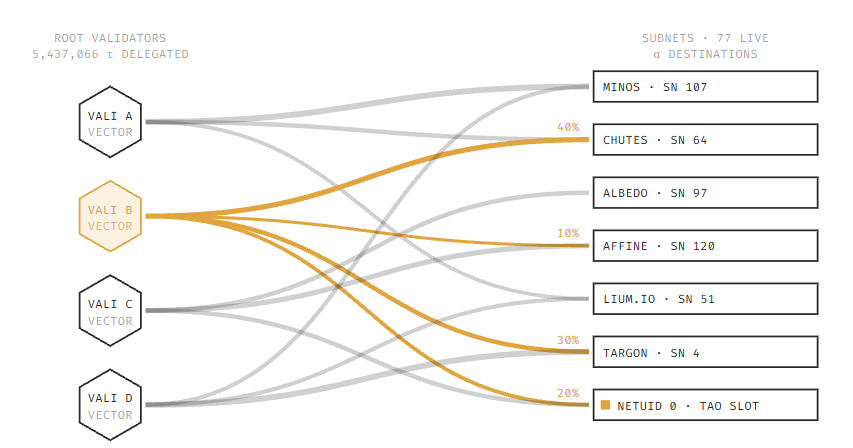
Root Reborn changes that structure by introducing per-validator baskets, operating as validator-linked funds of subnet alpha held by a chain-owned escrow account. Stakers accrue an entitlement to the fund based on their root stake, and a claim realizes the owed value back into TAO staked to root.
For readers who want the full background, we previously published a detailed explainer:
 Bart Hillerich
Why Root Reborn Changes TAO’s Yield Profile
The clearest change for TAO holders is that root yield now has more market exposure before it is claimed.
Under the old model, root yield was converted into TAO continuously. Under Root Reborn, unclaimed entitlement is linked to a validator’s basket, and the value a staker can realize depends on current pool conditions when claimed.
That means root staking remains denominated around TAO from the user’s point of view, but the mechanics behind yield are less passive than before. Principal remains plain TAO on root. Accrued yield, however, reflects the realized value of the basket exposure created by the validator’s fund.
"The parties [validators] with the deepest visibility into the ecosystem are, for the first time, paid to curate it — their vectors are public signals of where value is being created."
There is also a timing difference. The previous model realized yield continuously as subnet alpha was sold into TAO. Root Reborn makes realization more claim-driven. For some holders, that may make yield feel less like a simple automatic payout and more like an accruing position whose value depends on subnet basket performance and claim timing.
Importantly, the upgrade does not turn root stake into direct ownership of specific subnet alpha. A staker’s entitlement is a fraction of the whole validator fund, not a claim on a particular subnet holding. That allows baskets to be rebalanced or handled through protocol logic without assigning each staker a separate bundle of individual subnet positions.
What It Means for Subnets
Subnet teams now have a new environment to compete in.
The first phase is not yet a full validator-allocation market. Weight setting is gated off network-wide at launch, meaning every validator fund starts with the same null strategy: dividends accrue in place as the subnet alpha that paid them. Curation will open in a follow-up upgrade.
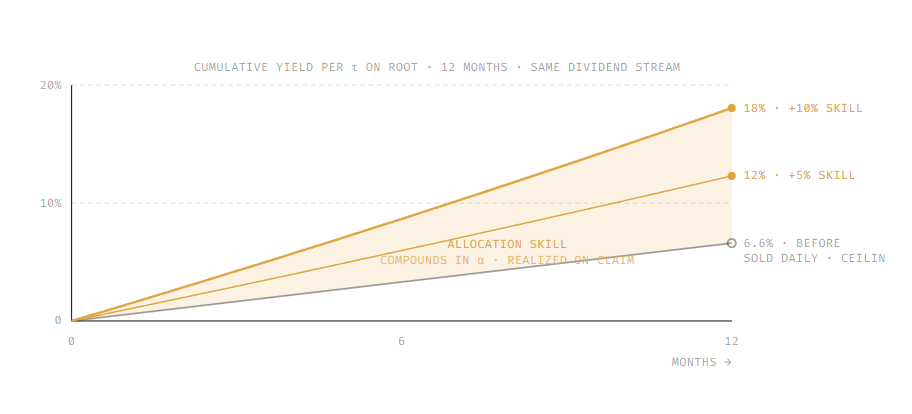
That means the immediate question for subnets is less about winning active validator allocation right away and more about proving they deserve attention before that market fully opens.
The next phase will be where things get more competitive.
Once validator weight setting is enabled, subnets will likely face a more explicit market for validator confidence. Validators will be able to choose where their funds deploy yield, and those choices will be public. Subnets that earn confidence could receive more reinvested capital, while those that lose confidence may receive less.
Technical quality, liquidity, product traction, emissions efficiency, community trust, and validator relationships will all matter more moving forward.
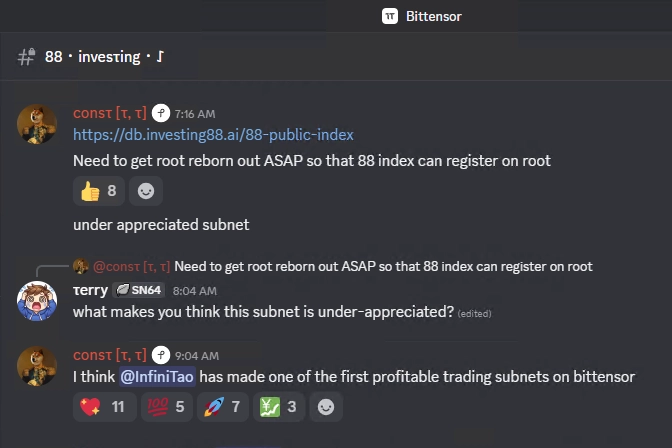
Some community members are already pointing to specific subnets that could benefit from that transition. Jesus Martinez argued that Investing88 (SN88) may be especially well prepared because its miners compete to allocate capital into strong portfolio strategies. Michael White also pointed to SN88, saying there is "no subnet better positioned to gain from this transition" as Root Reborn rolls out, including a Discord screenshot of Const pointing to Investing88 as one of the first profitable trading subnets on Bittensor.
What Comes Next for TAO, Subnets, and Root
Root Reborn is a big step for the Bittensor economy.
For TAO holders, your next step is to level-up your understanding of how validators are operating their baskets. As crypto's history has taught us, there's a lot more to investigate beyond the headline APY (stay frosty out there).
The full validator-allocation market is still ahead; stay tuned to Intelligence for future updates.