


Table of Contents
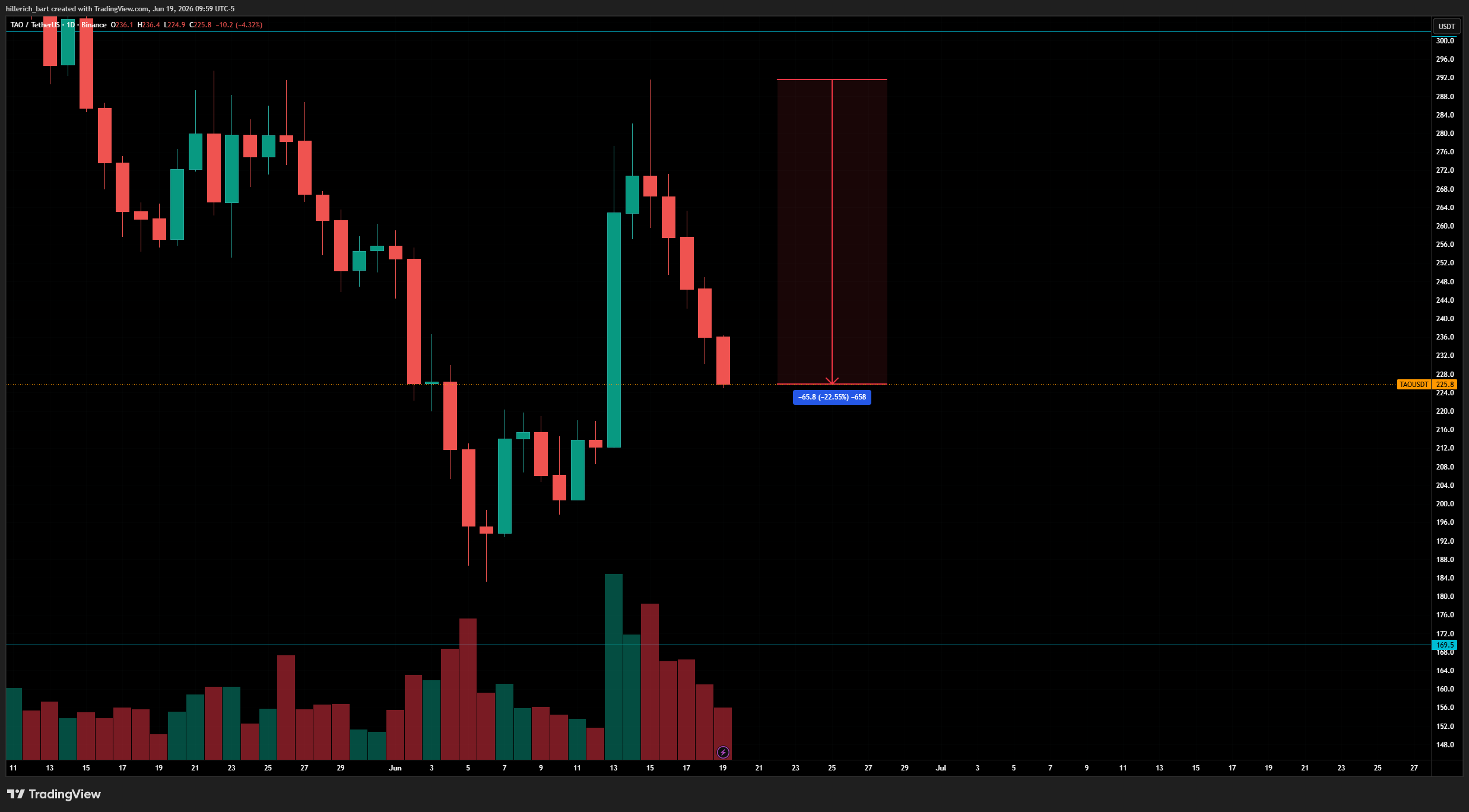
Bittensor's TAO token has retraced much of its recent Anthropic suspension-driven price surge, now down over 20% from its recent high as a combination of governance uncertainty, derivatives liquidations, and broader market weakness pressured the AI-focused cryptocurrency.
 Bart Hillerich
While the correction has coincided with weakness across risk assets, discussion surrounding Bittensor's proposed "Root Reborn" upgrade has become a major focal point for investors attempting to assess the network's future economic design.
TAO is now trading near $225 on June 19, down from its recent June 15 peak of $291.
Root Reborn Sparks Debate Across the Ecosystem
Root Reborn, a proposal from Bittensor co-founder Const, would fundamentally change how root staking rewards are distributed throughout the network.
Today, rewards earned through root staking are automatically converted into TAO before being distributed to stakers. Under Root Reborn, validators would instead direct rewards into validator-selected baskets of subnet tokens, creating continuously compounding portfolios of subnet exposure.
 Bart Hillerich
Supporters argue the mechanism could reduce persistent sell pressure on subnet tokens and transform root into a more efficient capital allocation layer for the ecosystem. Critics, however, have raised concerns about validator influence, liquidity dynamics, and the additional complexity introduced by the design.
The proposal remains under review and has not been activated on the network.
Key Ecosystem Participants Weigh In
Much of the recent discussion has centered on a detailed analysis published by Yuma, one of the ecosystem's largest infrastructure providers, which recently announced its validator had reached over 800,000 TAO staked.
The Yuma Validator just crossed 800,000 TAO staked. This is what happens when you:
— Yuma (@YumaGroup) June 17, 2026
✅ run top-performing in-house infrastructure
✅ calculate your own weights and optimize for durable yield
✅ commit to relentlessly growing the #Bittensor ecosystem
If you plan to offer $TAO (or… pic.twitter.com/wb5tPQbehc
In its assessment, Yuma argued that the proposal introduces "substantial unmitigated risk" and warned that validators could transition from neutral network operators into active capital allocators. The report highlighted concerns around potential conflicts of interest, regulatory uncertainty, liquidity risks, and long-term network incentives.
 Bart Hillerich
Yuma also called for a more structured governance process surrounding major protocol upgrades, including clearer roadmaps, release timelines, and opportunities for stakeholder feedback.
The discussion expanded further this week when Frank Schuil, founder and CEO of Safello, publicly shared similar concerns. He echoed Yuma's calls for predictability and broader consultation while questioning whether validator-managed subnet baskets should become the default experience for root staking.
Schuil argued that many investors still view TAO as an index-like exposure to the broader Bittensor ecosystem and suggested that introducing concentrated subnet allocations could make the asset more difficult for new and institutional investors to understand.
 Bart Hillerich
Liquidations Accelerate the Move Lower
Beyond governance discussions, derivatives markets also contributed to the recent decline.
According to CoinGlass data cited by crypto.news, TAO futures open interest fell more than 8% over a 24-hour period, dropping to roughly $252 million-$260 million. During the same period, more than $1.6 million in long positions were liquidated as prices moved lower.
Spot market participation has also cooled. Daily trading volume declined 14% to roughly $624 million as investors reassessed risk and awaited further discussion around Root Reborn's potential implementation.
For now, the Root Reborn discussion remains one of the most closely watched developments in the Bittensor ecosystem, with investors attempting to determine whether the proposal represents a meaningful improvement to network economics or a source of new risk for the platform.
Disclaimer: This article is for informational purposes only and does not constitute financial, investment, or trading advice. The information provided should not be interpreted as an endorsement of any digital asset, security, or investment strategy. Readers should conduct their own research and consult with a licensed financial professional before making any investment decisions. The publisher and its contributors are not responsible for any losses that may arise from reliance on the information presented.