

Table of Contents
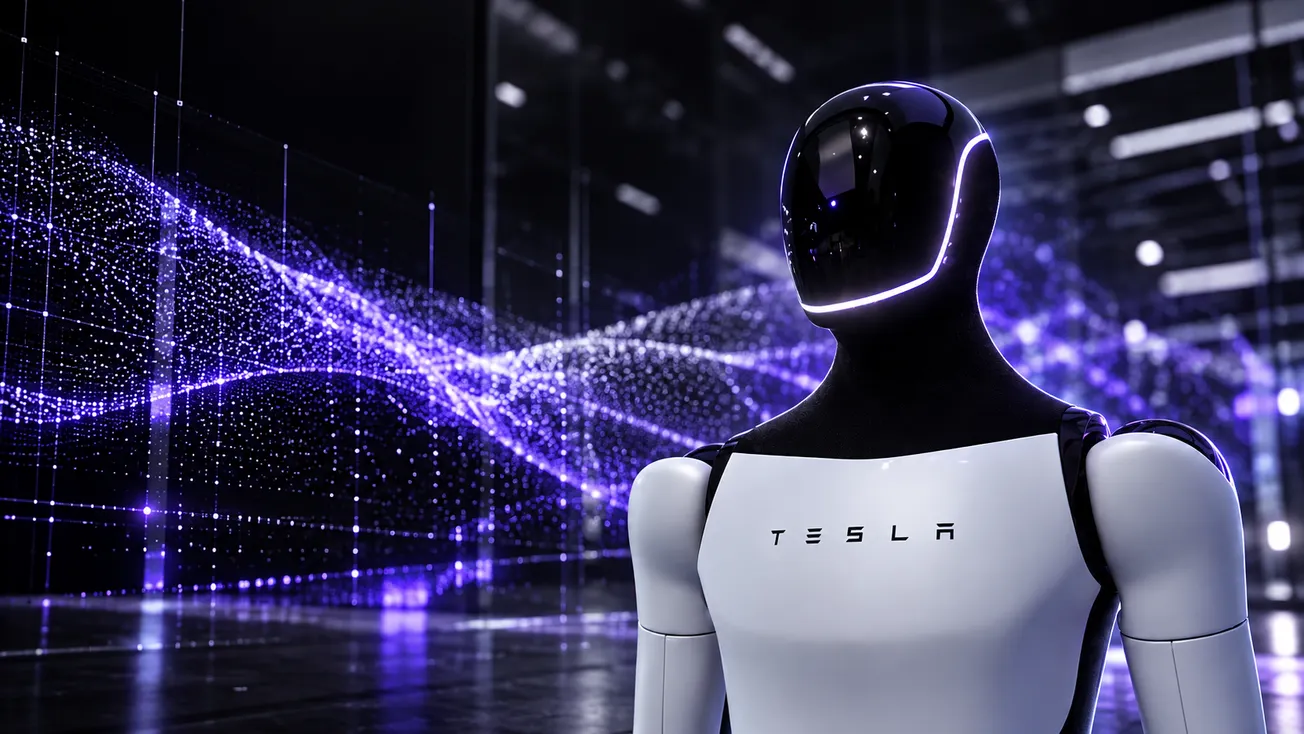
Tesla has begun producing Optimus humanoid robots on its high-volume lines in Fremont, California, with Elon Musk aiming to start deliveries to companies outside Tesla around the end of 2027.
The robots are the first production-quality units Tesla has manufactured. Its third-quarter shareholder update lists the California operation as an early ramp, with a second Optimus factory under construction in Texas.
Musk called the Fremont operation "early production" and said reaching 20,000 robots a week would take at least a year, possibly longer. External deliveries depend on further work on the robot's AI, electromechanical design, and operating life, which he expects to come together near the end of next year.
Fremont Ramps While the Hand Design Evolves
Most of the equipment for a Fremont line designed to produce roughly one million robots annually is already in place. The 20,000-unit weekly goal is a future production rate, equivalent to about one million units a year.
Musk described a slow, uneven start as Tesla coordinates a new supply chain, manufacturing equipment, and continuing design changes. Production can advance only as quickly as its most constrained component or process.
The update follows September reporting on Fremont's expanding internal Optimus production, when hands, forearms, and supplier readiness were among the reported constraints. Tesla is now building robots while refining the hardware and using the resulting units for training.
The hand remains the main electromechanical focus. Musk said the fingers need to withstand repeated use while remaining compliant enough to pick up delicate objects and protect their embedded sensors. Much of the rest of the electromechanical system has converged on a workable design, a Tesla engineer said on the call.
A robot intended for repeated industrial tasks must maintain its dexterity and sensing over extended use. Musk said Tesla is continuing to adjust the design so Optimus does not wear out after a month.
Optimus Academy Links Production to AI Training
Tesla's training strategy requires a larger physical robot fleet. Musk estimated that the company needs 10,000 to 20,000 Optimus units gathering experience through what he called self-play, with an "Optimus Academy" where robots practice a wide range of tasks.
Tesla's AI vice president, Ashok Elluswamy, described a learning cycle that begins with observing humans. The resulting base model is then deployed on Optimus, which practices in simulation and the real world to learn from its own experience.
This combines learning from demonstrations with reinforcement learning: the robot first acquires a starting behavior, then improves through repeated attempts and feedback. Watching a person perform a task supplies an initial reference, while practice teaches the system how to execute it with the robot's own joints, hands, and sensors.
That creates a direct connection between manufacturing and software development. Tesla needs more robots to generate training experience, even while the hardware those robots use continues to change. Musk said the company is developing the production system, supply chain, mechanical design, and AI in parallel.
The approach differs from Tesla's vehicle program, where a large customer fleet already supplies driving data. Tesla has also published safety data covering approximately 3.3 million Robotaxi miles without an onboard safety monitor. Optimus needs experience gathered through its own physical form and tasks rather than access to an equivalent installed robot fleet.
Tesla also plans to integrate its AI5 chip into Optimus around April 2027. Musk said AI5 would provide roughly an order of magnitude more compute than AI4, giving the robot more onboard processing capacity for coordinating its many moving joints and handling a wider range of tasks.
Industrial Customers Come Before Home Use
Musk expects the highest-value initial applications to be dangerous, repetitive industrial work, including tasks that can cause repetitive strain injuries or need to run around the clock. Home purchases would follow as production scales.
Taneja said Optimus manufacturing costs are moving toward the level Tesla expects for Cybercab, although continued design changes mean it is too early to say the company has reached its cost target.
The ramp is contributing to Tesla's investment spending. Taneja cited Optimus, Megapack 3, and Semi pre-production costs among the drivers of higher operating expenses and put companywide 2026 capital-expenditure guidance at approximately $20 billion. The investment cycle coincides with a 43% year-over-year decline in third-quarter net income, to $787 million.
Before external deliveries, Musk said Tesla may release an Optimus demonstration in one or two months. He wants it to show the robot performing tasks that are not preprogrammed, providing a closer look at the AI capabilities Tesla is developing alongside the production ramp.