


Table of Contents
SpaceX reported $14.6 billion in third-quarter revenue, up 161% from a year earlier, as its artificial intelligence business overtook satellite connectivity to become its largest revenue source. The company earned $4.4 billion, reversing a $1.1 billion loss, and forecast first-quarter 2027 revenue of $33 billion to $37 billion.
Selling AI computing capacity is quickly changing SpaceX's financial profile. Its Super Intelligence (SI) segment generated $7.56 billion in revenue, roughly 52% of the total, while Starlink's connectivity business delivered most of the company's operating profit. SpaceX's earnings release also detailed its first revenue-generating Starship mission and a sharp increase in AI infrastructure spending.
On the earnings call, Elon Musk confirmed that SpaceX and Tesla have formed independent board committees to discuss a merger. He supports a combination, but the committees have not agreed on transaction terms.
Revenue exceeded the $12.72 billion LSEG consensus estimate, and the Q1 forecast was well above the $22.2 billion average estimate reported by CNBC.
| Financial Measure | Q3 2026 | Q3 2025 |
|---|---|---|
| Revenue | $14.575 billion | $5.576 billion |
| Operating Income (Loss) | $2.791 billion | ($273 million) |
| Net Income (Loss) | $4.404 billion | ($1.054 billion) |
| GAAP Diluted EPS | $0.35 | ($0.36) |
| Adjusted EBITDA (Non-GAAP) | $8.809 billion | $2.169 billion |
| Capital Expenditures | $19.593 billion | $6.880 billion |
Net income benefited from $873 million in interest income, $1.025 billion in other income, and a $390 million tax benefit, partly offset by $675 million in interest expense, as detailed in the SEC-filed financial statements.
Cloud Contracts Drive the AI Business
SI, the renamed AI segment encompassing xAI, Grok, and Cursor, grew revenue 830% year over year and 195% sequentially. Solutions and infrastructure contributed $7.02 billion, with advertising adding $538 million.
New cloud services agreements were the main growth driver. Even excluding Cursor, solutions and infrastructure revenue increased 192% from the second quarter, CFO Bret Johnsen said on the earnings call. SpaceX is monetizing newly installed computing capacity while allocating the same infrastructure between outside customers, model training, and inference, the processing used to run AI products.
SI produced $431 million in operating income after $1.2 billion in Cursor-related share-based compensation. Its adjusted EBITDA reached $4.95 billion. Those measures treat substantial expenses differently: the EBITDA calculation excludes depreciation and amortization, stock compensation, and certain other costs.
The Cursor acquisition closed August 14 and contributed $608 million in revenue through September 30. The deal carried a $60 billion implied equity value; SpaceX recorded $42.5 billion in GAAP purchase consideration and separately valued equity awards tied to post-acquisition service at $23.4 billion. Johnsen said the retention-related awards would be expensed over roughly three years.
Grok Bot, the company's agentic assistant, reached 800,000 paid weekly users earlier in October, more than doubling over the preceding month, President and COO Gwynne Shotwell said. Business-to-business use was its fastest-growing category, and Musk expects broad enterprise deployment within weeks.
Grok enterprise customers exceeding $1 million in revenue run rate, including Cursor, increased 50% sequentially on a pro forma basis. The company also introduced a shared subscription for Grok, Cursor, and X Premium that connects its coding, agent, and social products under one usage system.


Compute Expansion Brings a Larger Spending Plan
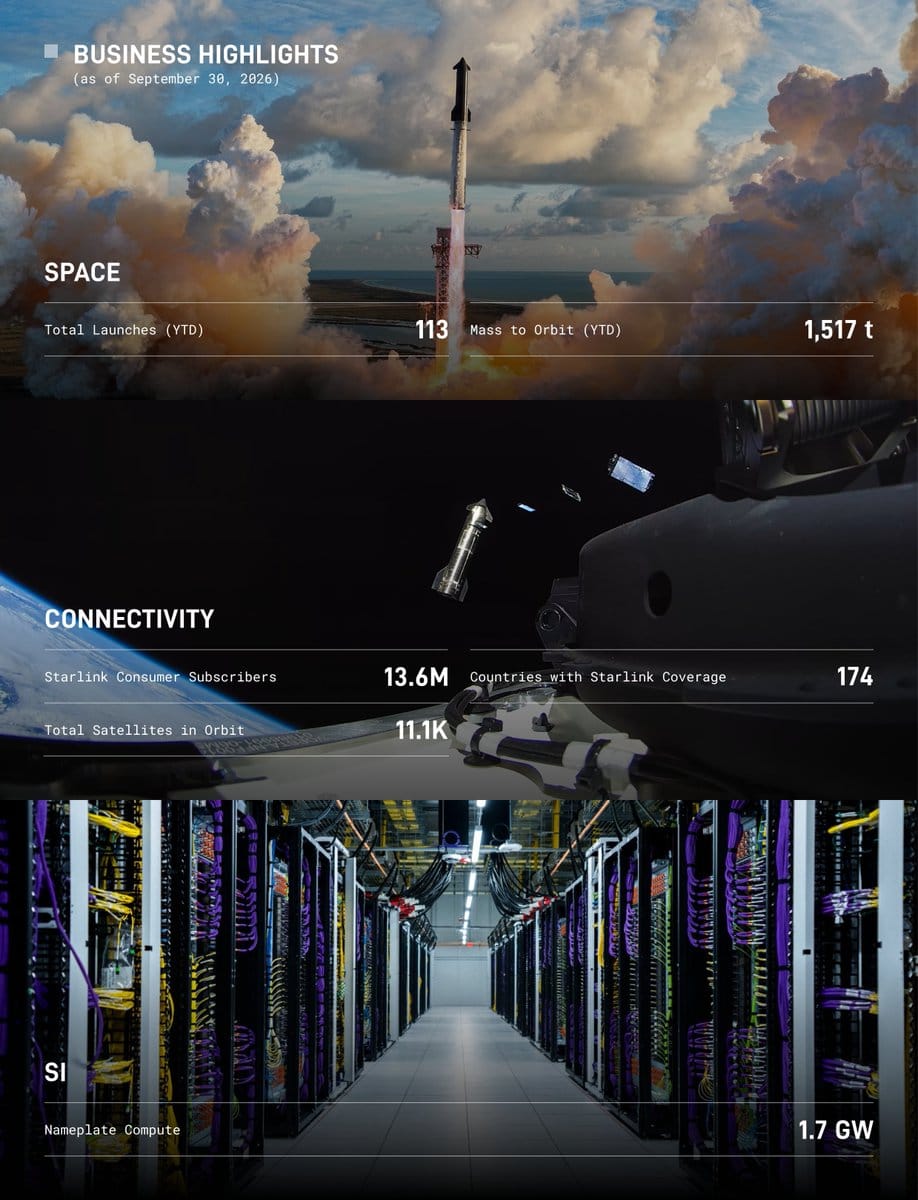
SpaceX ended September with 1.7 gigawatts of nameplate compute capacity, up from 1.4 GW in June. Management expects 2.5 GW to 3 GW by year-end and now plans $35 billion to $40 billion in fourth-quarter capital expenditures, following $19.6 billion in Q3. SI alone accounted for $16.4 billion of the quarter's spending.
Johnsen said compute pricing was slightly above the high end of the previously discussed $30-to-$50-per-watt range, with new deployments generating payback in less than a year. Musk said SpaceX aims to split compute roughly evenly between internal use and outside customers, with flexibility to shift the balance. He favors short-term contracts at market rates rather than locking capacity into long agreements.
“We could rent out our compute several times over if we said yes to everyone,” Musk said.
Power and cooling underpin the next expansion. Musk said he was highly confident of adding 10 GW of compute in 2027, bringing the total to roughly 13 GW. A separate plan calls for 20 GW of incremental power and cooling infrastructure, about 23 GW total, if execution goes well. That larger infrastructure ambition is distinct from his more confident compute deployment target.
SpaceX is using its rocket-engine casting capabilities to make turbine blades and vanes. Musk said those components arrive 12 to 18 months behind other turbine equipment, and that producing them internally could accelerate access to power by a similar interval.
He also proposed factory-built inference clusters with integrated power and cooling, distributed across multiple locations. For training, he targets a 440,000-unit Vera Rubin cluster by the end of Q2 2027. At Terafab, the internal goal is a functional test chip in Austin around May or June 2027, with volume production at Gibbons Creek an aspiration for the second half of 2028.
Johnsen tied the Q1 revenue forecast to increased visibility into the compute contract pipeline. Backlog totaled $63 billion, including $17.5 billion in deferred revenue, with approximately $42 billion expected to become revenue within a year.
Management maintained its $100 billion year-end revenue run-rate target, defined by annualizing December revenue. Musk separately outlined a $500 billion-to-$1 trillion annual run-rate ambition for the end of 2027, not a forecast for revenue earned across that entire year.
SpaceX held $51.3 billion in cash and $38.6 billion in marketable securities at quarter-end. Johnsen identified operating cash flow, debt markets, and vendor or customer partnerships as funding sources for expansion. He also expects Q4 gross margins to return closer to Q2 levels after Q3's favorable mix and one-time benefits.
Starlink Profits and Starship Capacity
Connectivity revenue rose 69% to $5.25 billion, producing $2.37 billion in operating income. Consumer revenue reached $3.12 billion, while enterprise and government revenue grew 91% to $2.13 billion.
Starlink added 1.6 million consumer subscribers, ending September with 13.6 million. Monthly average revenue per consumer subscriber rose to $69 from $66 in Q2, though it remained below $83 a year earlier. Connectivity's 55% gross margin included a roughly three-percentage-point one-time benefit, primarily from tariff refunds.
Aviation offers an installation pipeline beyond existing subscribers. More than 3,800 aircraft had Starlink installed at quarter-end, while Shotwell said roughly 12,000 planes were under contract. The broadband service operated in 174 markets.
Starlink Mobile reached 22 million monthly users, up 37% sequentially. SpaceX received FCC approval for 15,000 Mobile V2 satellites and expects its agreement to acquire up to 14 MHz of paired 800 MHz spectrum to close in the first half of 2027. Service using its expanded spectrum portfolio is targeted for early 2028.
The Space segment generated $1.77 billion in revenue, including $1.13 billion in launch services and $637 million in launch and development revenue. It recorded a $7 million operating loss as research and development spending, driven by Starship, reached $1.23 billion. SpaceX completed 35 launches and delivered 476 metric tons to orbit during the quarter.
Starship Flight 14 reached orbit and deployed 26 Starlink V3 satellites, adding approximately 10 times the downlink capacity of a Falcon 9 Starlink launch. Musk expects Flight 15 in November, with an attempt to catch both the booster and ship. Shotwell said the company expects the FAA license to permit both stages to return to the launch site for tower catches.
SpaceX plans a second-stage reflight and an on-orbit refueling attempt in early 2027. Musk targets weekly Starship flights during the first half of 2027 and twice-weekly flights during the second half. Shotwell expects a few hundred V3 satellites, potentially achievable by mid-2027, will be needed for sustained, noticeable improvements in user experience. The Louisiana spaceport's published first-launch target remains 2029, with 2028 an internal goal.
Independent Committees Weigh a Tesla Merger
Musk said the merger discussions began at shareholders' request and are being handled by special committees of independent directors. He cannot participate in their discussions because he is a conflicted party.
“Do I think it would be a good idea? Yes,” he said, citing cooperation in AI software, chip design, Terafab, robotics, orbital infrastructure, and connectivity.
The committees have not agreed on terms, and Musk said a transaction is not certain. He said approval on Tesla's side would require support from 50% of all shares, not simply a majority of shares voted. Any committee agreement would then go to shareholders.