


Table of Contents
TypeSafe AI has emerged from stealth with Jev, a new AI model designed to return typed software decisions instead of generated text, alongside a $40 million seed round led by DCVC.
The San Francisco startup is led by Diogo Almeida, a former OpenAI researcher who helped build the reinforcement learning from human feedback methods behind InstructGPT and ChatGPT. After two years in stealth, Almeida and TypeSafe are positioning Jev as the first "System One Model," a category the company says is built for fast, structured judgments that software can use directly.
In a launch post and company blog, Almeida framed the release as a response to a gap he saw after ChatGPT, where powerful language models became good at conversation but did not produce the automation wave many expected. TypeSafe's answer is an AI system that gives up open-ended text generation in favor of constrained decisions, probabilities, and confidence scores.
"Think of Jev as a frontier-intelligence function call: unstructured state in, typed probabilistic decisions out," Almeida wrote.
Jev Is Built for Decisions, Not Conversation
With Jev, a developer sends the model a state and a set of typed questions. The state can be a support ticket, document, log, database row, game state, policy, or other structured or unstructured context. Jev then evaluates the questions in parallel and returns outputs that code can inspect without asking another model to format, explain, or justify a prose answer.
TypeSafe exposes three primitives:
| Primitive | Question | Returns |
|---|---|---|
| Choice | Which option from a list? | Selected option, probability distribution, and confidence |
| Score | Where does this sit on a rubric? | Score, level probabilities, and confidence |
| Noul | Is this statement true? | A 0–1 probability |
The model is a way to turn judgment into something closer to a software primitive. Instead of prompting a chatbot to classify a ticket and then parsing its sentence back into a category, a developer can ask Jev to choose among predefined options and branch on the result directly.
Most production software does not need a paragraph when it is deciding what to do next. It needs reliable signals: whether a refund is being requested, which team should handle a case, how urgent a message appears to be, whether a policy violation is likely, or whether another AI system's output should be blocked.
TypeSafe argues that those decisions are poorly matched to conventional language models. LLMs generate strings one token at a time, which makes them flexible but relatively expensive, slow, and prone to output-format failures. Jev instead uses a new architecture, a parallel sampler, and a post-training method TypeSafe calls RLCD, or Reinforcement Learning for Calibrated Decisions.
TypeSafe's Thesis: Automation Needs Machine-Native AI
Almeida's launch argument is that RLHF made AI systems much better at responding to people, but not necessarily better at sitting inside software systems that need dependable machine-readable outputs.
In TypeSafe's framing, there are now three major post-training paths. RLHF optimizes for human-preferred chat and writeups. RLVR, or reinforcement learning with verifiable rewards, optimizes for outputs that can be programmatically checked, such as math or code problems. RLCD is TypeSafe's proposed third path: training models to return calibrated, constrained decisions that software can compose into larger workflows.
That is why Jev does not try to be a chatbot. It does not write replies, draft code, or generate explanations of its reasoning. Instead, it answers predefined questions with typed outputs and uncertainty estimates. TypeSafe says this removes type errors by construction because the answer space is defined before the model runs.
The design is aimed at "smart if-statements" in production software. A workflow could ask Jev several narrow questions about the same state, then combine those answers with deterministic business logic. For example, a support system might ask whether a customer is requesting a refund, how frustrated the message sounds, whether the refund policy applies, and which department should handle the case. Code can then route high-confidence cases automatically while escalating ambiguous cases for review.
This approach also gives developers control over how different signals are weighted. Instead of asking one general model to decide an entire workflow in a single prompt, TypeSafe encourages users to decompose the problem into smaller questions and compose the results in code.
The Speed and Cost Claims
TypeSafe is making aggressive performance claims for Jev. The company says the model runs at 70 milliseconds to 500 milliseconds end to end on System One queries, compared with three to 329 seconds for frontier LLMs on comparable decision work. TypeSafe describes that as roughly 20x to 200x faster.
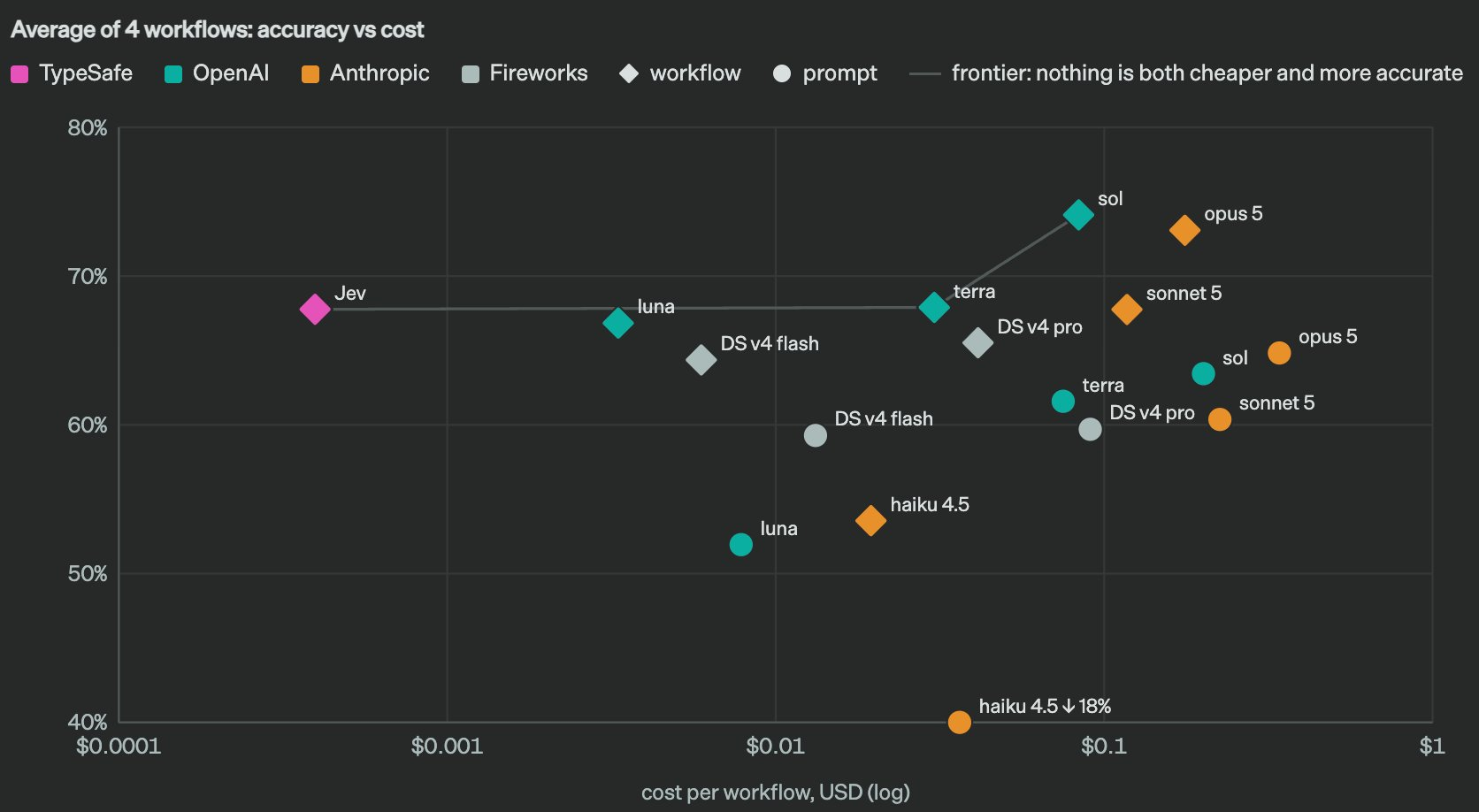
The startup is also pricing Jev at $42 per billion input tokens, or $0.042 per million input tokens. Output tokens are free, because Jev is not generating text in the usual autoregressive sense. TypeSafe says Jev is 193.6x faster and 444.6x cheaper on its published System One workflow comparisons.
Note that, here, Jev is not claiming to replace general-purpose LLMs across writing, coding, research, and reasoning. It is optimized for a specific class of task where a system needs many fast judgments instead of a long generated answer.
That narrower design is also what TypeSafe says enables new use cases. In one demo, Jev runs in a Doom decision loop at roughly 10 calls per second for about $7 per hour.
Jev Doom Demo
In another, the model plays a Wikipedia racing game by choosing among hundreds or thousands of possible links, a setup TypeSafe uses to illustrate high-cardinality choices where hallucinated options would break the task.
"Hallucination and type-safety are intrinsically related, and we think the latter is table stakes for automation. Having a hallucinated tool call is inconvenient in an agent, but is an absolute deal-breaker if it’s part of a system with latency guarantees or it’s buried several layers deep in a dependency chain. Existing models, no matter how smart, still hallucinate and have type errors."
The company also published workflow evals that compare models on production-style decision graphs rather than standard chat benchmarks. TypeSafe says Jev sits on the Pareto frontier for speed and cost at frontier decision quality, though the company notes the results depend on workflows created by its model capabilities team and may sit on the higher end of real-world gains.
A $40 Million Seed Round for Composable AI
Alongside the model launch, TypeSafe announced a $40 million seed round led by DCVC. The company was founded in 2024 by Almeida, CTO Erik Gafni, and COO Sasha Sheng. TypeSafe describes its broader category as machine-native, composable AI: intelligence that can be called, combined, and constrained by software rather than mediated primarily through a chat interface.
In the company's funding announcement, Almeida said most intelligence should eventually live inside software rather than only in human-facing assistants.
"I spent years working on models designed to make AI better at interacting with people," Almeida said. "But if AI is going to fundamentally change how work gets done, people can't be the only consumers of intelligence. Most intelligence should eventually live inside software, running quietly in the background. TypeSafe is building for that future."
James Hardiman, a partner at DCVC, said TypeSafe is targeting "one of the biggest remaining challenges in AI: turning increasingly capable models into technology that developers can reliably build into products at scale."
Early access for Jev is now open through a waitlist on TypeSafe's website, with documentation and a playground available for developers.