


Table of Contents
Bittensor’s subnet economy has grown rapidly in 2026, attracting millions of dollars in capital, coordinating large-scale AI infrastructure, and serving as investment opportunities through alpha tokens.
But until recently, subnet ownership came with a major blind spot: participants had limited visibility into whether the people running a subnet remained committed over the long term. Theoretically, a subnet owner could accumulate emissions, build community trust, and reduce or exit their position with little advance warning to investors.
That scenario came to life with Covenant AI’s high-profile departure from Bittensor in April 2026, when the team behind Templar (SN3), Basilica (SN39), and Grail (SN81) exited the network after selling approximately 37,000 TAO worth of alpha tokens, leaving investors rekt.
 Bart Hillerich
While Bittensor had already been discussing subnet governance upgrades, the event accelerated urgency around a solution.
Enter Conviction.
Conviction is Bittensor’s new subnet governance system designed to make subnet owner commitment visible on-chain and silent exits significantly more difficult. The system ties influence and ownership more closely to long-term economic commitment by automatically locking subnet owner emissions and creating public signals when operators begin preparing to exit.
In this guide, we’ll cover what Conviction is, why Bittensor introduced it, how it works, and what it means for subnet builders, alpha token holders, and the future of subnet governance.
What Is Conviction in Bittensor?
Conviction is Bittensor’s new subnet governance upgrade designed to make subnet ownership more transparent and better aligned with long-term commitment.
At a high level, the system changes how subnet operators interact with the economic rewards they earn. Instead of immediately receiving liquid emissions that can be sold at any time, subnet owner emissions are automatically locked as they enter their wallet. If an operator wants to access those funds, they must first begin an on-chain unlock process that becomes publicly visible to the rest of the network.
In practical terms, Conviction turns subnet owner exits into observable events rather than surprises.
Before Conviction, an alpha token holder could wake up to discover a subnet owner had sold a meaningful position with no advance warning. With Conviction, the process becomes visible in advance, giving market participants time to assess what is happening and decide how to respond.
The system also introduces a new way of thinking about subnet ownership.
Historically, launching a subnet effectively granted indefinite control unless a team voluntarily stepped away. Conviction shifts ownership toward something based more explicitly on demonstrated commitment. The longer and more meaningfully someone commits stake to a subnet, the greater their Conviction becomes.
In other words, Conviction is Bittensor’s attempt to answer one of the ecosystem’s hardest questions:
How do you measure whether a subnet operator is genuinely committed to what they are building?
Instead relying on promises, social trust, or marketing, Conviction aims to answer that question through visible, on-chain economic commitment.
Why Did Bittensor Create Conviction?
To understand why Conviction exists, it helps to first understand the problem Bittensor was trying to solve.
As Bittensor’s subnet economy expanded, individual subnets increasingly became meaningful financial ecosystems of their own. Builders earned emissions for operating subnets, alpha token holders gained financial exposure to those networks, and communities formed around them
But once a team launched a subnet and secured ownership, they could theoretically maintain control indefinitely while gradually reducing involvement, selling emissions, or exiting entirely. Alpha token holders had exposure to the upside of a subnet’s success, but little visibility into whether the people operating it remained economically aligned over the long term.
In passive cases, this dynamic created abandoned subnets: projects that slowly stopped shipping while remaining technically active. In more severe cases, critics worried it created conditions where founders could build credibility, attract capital, and leave without meaningful warning to investors.
The issue came into sharper focus in April 2026 following Covenant AI’s departure from Bittensor.
Covenant, the team behind Templar (SN3), Basilica (SN39), and Grail (SN81), exited the network citing governance and centralization concerns. Shortly afterward, the team sold approximately 37,000 TAO worth of alpha tokens while leaving the ecosystem.
While Conviction had already been under discussion before Covenant’s exit, the controversy accelerated urgency around getting a governance solution live.
How Does Conviction Work?
Conviction works by locking subnet owner emissions, making exits publicly visible, and measuring long-term commitment through stake duration and size.
The system may sound technical at first, but the underlying idea is relatively simple. If someone is running a subnet and benefiting from emissions, their commitment should be visible to everyone participating in that subnet.
Here is how it works in practice.
1. Subnet Owner Emissions Automatically Lock
Under Conviction Phase 1, every emission earned by a subnet owner is automatically locked the moment it enters their wallet. That means subnet operators no longer receive immediately liquid rewards they can sell at any time. Instead, those emissions enter a locked state by default.
Think of it similarly to equity vesting at a startup, but enforced at the protocol level.
You still earn the rewards, but you cannot immediately access the full position. The system creates a visible delay between earning emissions and being able to sell them. Subnet owners can also voluntarily lock additional holdings beyond their earned emissions, allowing them to demonstrate even stronger long-term commitment to the subnet.
2. Exits Become Public Events
If a subnet operator decides to reduce or exit their position, they must first submit an unlock transaction on-chain.
This is one of the most important changes introduced by Conviction.
Before the upgrade, a founder could quietly sell a meaningful position without warning. After Conviction, the unlock process becomes visible the moment it begins, giving participants a signal that an operator may be preparing to reduce exposure or leave entirely.
The unlocking process also happens gradually. After roughly 30 days, about 63% of unlocked tokens become available. Over the following weeks, additional liquidity unlocks until roughly 95% becomes accessible after around 90 days.
For alpha token holders, this introduces advance notice, fundamentally changing the alpha token investment risk equation. Instead of discovering a major founder exit after the selling already happened, participants now have time to evaluate the situation and make informed decisions.
3. Conviction Measures Commitment
Conviction is also the name of the on-chain score that measures commitment to a subnet.
The score reflects two primary variables:
- How much stake is committed
- How long that stake is locked
In simple terms, larger positions locked for longer periods create higher Conviction.
The system is designed to reward visible long-term alignment. Someone willing to lock meaningful capital for extended periods demonstrates greater commitment than someone maintaining only minimal exposure.
Over time, Conviction scores may become increasingly important as Bittensor expands subnet governance. Future phases are expected to allow subnet communities to direct Conviction toward alternative operators, creating a stake-weighted mechanism for subnet ownership transitions.
For now, Phase 1 primarily focuses on visibility, transparency, and accountability. But the groundwork for a more dynamic ownership system is already being laid on-chain.
What Is Locked Stake?
Locked Stake is the underlying mechanism that powers Conviction.
If Conviction is the governance upgrade users interact with, Locked Stake is the economic system working behind the scenes to measure commitment and eventually determine who controls a subnet.
Before Conviction, subnet ownership was largely permanent. Once a builder registered a subnet and gained control, there was no protocol-level requirement for continued participation or economic alignment. Ownership remained intact unless the operator voluntarily stepped away.
Locked Stake introduces a different model. Instead of ownership functioning as a permanent title, it gradually becomes something earned through visible stake commitment over time. Participants can lock alpha tokens toward a subnet operator, signaling support and increasing that operator’s Conviction score.
Eventually, this system is expected to become the basis for subnet owner elections.
In future phases of Conviction, participants will be able to direct locked stake not only toward the current operator, but toward alternative candidates they believe could run the subnet more effectively. Over time, the address with the strongest sustained Conviction may become eligible to assume subnet ownership.
What makes the system different from traditional governance voting is that participation requires real economic commitment. Voting power is not based on a one-time snapshot or temporary token ownership. Instead, influence is tied to capital that participants are willing to lock up for meaningful periods of time.
The system also includes safeguards designed to prevent sudden takeovers.
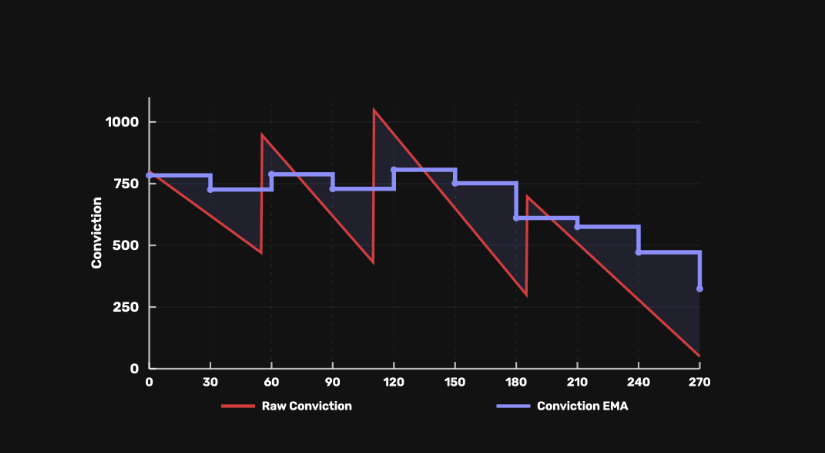
Conviction uses a smoothing mechanism known as an Exponential Moving Average (EMA), which gradually updates ownership influence over time rather than allowing immediate changes. In practice, this means subnet owners receive warning before losing control and have time to respond if community sentiment begins shifting elsewhere.
What Changes for Alpha Holders?
For alpha holders, Conviction has several key advantages:
- Earlier visibility into founder exits - Meaningful sell pressure becomes harder to execute silently.
- Better information for decision-making - Participants can evaluate whether they want to continue holding, reduce exposure, or reassess a subnet’s future.
- A stronger alignment signal - Operators who voluntarily maintain large locked positions demonstrate visible long-term confidence in what they are building.
- Potential future influence - As later Conviction phases roll out, alpha holders may eventually help shape subnet ownership through stake-weighted support.
Perhaps most importantly, Conviction changes the psychological model of subnet investing. Previously, evaluating a subnet often depended on social signals like founder reputation, Discord activity, roadmap promises, and community sentiment. Those signals still matter, but Conviction adds visible, provable economic commitment into the equation.
What Changes for Subnet Builders?
While Conviction introduces new protections for alpha holders, it also meaningfully changes the experience of running a subnet. For builders, subnet ownership now comes with greater transparency and greater expectations around commitment.
Before Conviction, subnet owners earned emissions that functioned similarly to liquid operating income. Those rewards could be sold immediately, used to fund infrastructure, pay contributors, or manage day-to-day costs with relative flexibility.
Under Conviction, that dynamic changes.
Because emissions automatically lock when earned, subnet operators must now think more proactively about treasury management and liquidity planning. Accessing earned emissions requires beginning an unlock process in advance, meaning builders can no longer treat rewards as immediately spendable capital.
For legitimate operators, this creates real operational considerations.
A subnet may still need to fund GPU infrastructure, contractor payments, research expenses, salaries, or cloud services. Builders launching new subnets, especially smaller teams without deep capital reserves, may feel liquidity constraints most acutely during early growth stages.
This has become one of the most common criticisms of Conviction from builders.
By treating both malicious actors and legitimate operators under the same rules, the system introduces friction that honest teams will feel as well. A founder building in good faith still loses some financial flexibility under the new model.
At the same time, Conviction also creates a new way for serious builders to prove credibility and trustworthiness.
Instead of relying entirely on marketing, community engagement, or reputation, builders can now demonstrate commitment directly on-chain through locked stake and emission behavior. Teams with strong Conviction scores may ultimately find it easier to attract long-term alpha holders because participants can independently verify economic alignment. In effect, Conviction shifts subnet building toward a model that looks more like long-term founder ownership in traditional startups.
Builders still benefit financially when the subnet succeeds, but commitment becomes visible and incentives become more clearly aligned with the people backing the network. For strong operators, that visibility may ultimately become an advantage rather than a burden.
Conviction Phase 1 vs. Phase 2
Conviction is not arriving all at once.
Instead, Bittensor is rolling out the system in phases, beginning with transparency and accountability (making commitment visible) before expanding into full subnet governance (making subnet ownership contestable).
Conviction Phase 1: Transparency and Locked Emissions
Phase 1, which launched in May 2026, focuses on one primary objective:
Making subnet owner commitment visible.
Under Phase 1:
- Subnet owner emissions automatically lock when earned
- Operators must submit public unlock transactions before accessing funds
- Exits become visible on-chain before meaningful sell pressure can occur
- Participants gain earlier signals when operators begin reducing exposure
- New subnet owners no longer receive an immediately liquid founder allocation
The emphasis here is transparency.
Phase 1 does not change who owns a subnet or how ownership decisions are made. Subnet operators still retain control, but their commitment becomes more observable to the market.
In many ways, Phase 1 functions as Bittensor’s accountability layer.
Conviction Phase 2: Subnet Owner Elections
Phase 2 introduces something much more ambitious:
Stake-weighted subnet governance.
Under the planned system, participants will be able to direct Conviction toward different operators they believe should run a subnet.
Instead of ownership remaining permanently tied to whoever launched the subnet first, control may eventually become contestable based on long-term economic commitment and community support.
At a high level, the process would work like this:
Participants lock alpha tokens toward an address they support. Over time, those commitments build Conviction. If another operator accumulates stronger sustained Conviction than the current owner, subnet ownership could potentially transition.
To be clear, the goal here is not to create constant leadership churn.
Bittensor’s use of mechanisms like Exponential Moving Averages (EMA) is designed to smooth transitions and prevent sudden hostile takeovers. Existing operators receive warning if support begins shifting elsewhere, giving them time to respond and rebuild confidence.
Does Conviction Stop Rug Pulls?
The short answer is no, but it makes them significantly harder to execute quietly.
Conviction does not eliminate the possibility that a subnet operator could abandon a project, lose interest, or decide to sell their position. Bittensor remains an open system, and builders still retain the freedom to leave.
Furthermore, Conviction is not a guarantee of quality.
A subnet owner can still build poorly, stop innovating, or gradually lose community trust. The system does not automatically prevent bad leadership or ensure technical success.
What Conviction does do is help reduce several key risks:
- Silent founder exits become harder: Large positions cannot immediately move without warning.
- Alpha holders gain more time to react: Participants can reassess exposure before meaningful liquidity unlocks.
- Builder incentives become more aligned: Operators now maintain visible economic exposure to their subnet over longer periods.
- Short-term opportunism becomes less attractive: Quickly extracting value becomes more difficult compared to sustained participation.
For these reasons, it's better to view Conviction less as an anti-rug mechanism and more as a risk reduction and transparency upgrade.
The Bigger Picture: Why Conviction Matters for Bittensor
Conviction is about more than preventing controversial exits.
At a deeper level, the upgrade reflects Bittensor growing into its next stage of maturity and represents a proving point of the network's resiliency. Whether Conviction ultimately fully succeeds is yet to be seen; like most meaningful governance systems in crypto, it will likely evolve through iteration, feedback, and real-world testing.
And that is progress. Risk has not disappeared, but Bittensor has crossed an important threshold, and subnet ownership has become far safer than before.
Frequently Asked Questions
What is Conviction in Bittensor?
Conviction is Bittensor’s new subnet governance upgrade designed to make subnet owner commitment more transparent. The system automatically locks subnet owner emissions, makes exits publicly visible on-chain, and lays the foundation for future subnet owner elections.
Why did Bittensor launch Conviction?
Bittensor introduced Conviction to improve accountability and alignment between subnet operators and alpha token holders. While the concept existed before Covenant AI’s departure in April 2026, the controversy accelerated urgency around deploying a governance solution.
How does Conviction work?
Conviction works by automatically locking subnet owner emissions and requiring public unlock transactions before funds become liquid. It also introduces an on-chain commitment score based on how much stake is locked and for how long.
Can subnet owners still sell their tokens?
Yes, but not immediately.
Under Conviction Phase 1, subnet owners must first initiate a public unlock process on-chain. After roughly 30 days, about 63% of unlocked tokens become accessible, with additional liquidity unlocking over time.
What is Locked Stake in Bittensor?
Locked Stake is the mechanism underlying Conviction. It ties subnet influence and future ownership eligibility to the amount of stake committed and the duration of that commitment, helping measure long-term alignment on-chain.
What changes for alpha holders under Conviction?
Alpha holders gain earlier visibility into subnet owner exits and stronger signals around builder commitment. Instead of silent exits, operators must begin a public unlock process before accessing meaningful liquidity.
Does Conviction stop rug pulls?
Not entirely.
Conviction does not prevent builders from leaving or selling their positions, but it makes large exits significantly harder to execute without warning. The system introduces transparency and advance notice rather than eliminating risk altogether.
What is the difference between Conviction Phase 1 and Phase 2?
Phase 1 focuses on locked emissions and public exit visibility.
Phase 2 is expected to introduce subnet owner elections, allowing participants to support alternative operators through stake-weighted Conviction.
Can alpha holders vote on subnet ownership today?
Not yet.
Conviction Phase 1 does not include elections. While participants can begin building Conviction records through locked stake, ownership transitions are expected to arrive in a later phase of the system.
What happens if a subnet owner loses community trust?
Today, subnet operators still retain ownership.
In future Conviction phases, communities may eventually be able to direct stake toward alternative operators, potentially allowing subnet ownership to transition based on sustained Conviction.
Why is Conviction important for Bittensor?
Conviction represents one of Bittensor’s biggest governance upgrades to date. As more capital enters the subnet economy, the system aims to improve transparency, builder accountability, and long-term alignment between subnet operators and participants.
Disclaimer: This article is for informational purposes only and does not constitute financial, investment, or trading advice. The information provided should not be interpreted as an endorsement of any digital asset, security, or investment strategy. Readers should conduct their own research and consult with a licensed financial professional before making any investment decisions. The publisher and its contributors are not responsible for any losses that may arise from reliance on the information presented