Table of Contents
Google has rolled out Gemini 4 Argon more broadly, bringing its newest frontier model to Google AI Pro and Ultra subscribers in the Gemini app and AI Mode in Search, Ultra subscribers in Google Antigravity, and paid developers and enterprises using the Gemini API through AI Studio and the Gemini platform.
The wider release comes 12 days after Google first introduced Argon with a phased, cyber-defense-first rollout aimed at long-horizon coding, enterprise knowledge work, cybersecurity, science, and agentic workflows. The company is now moving it into mainstream consumer, developer, and enterprise channels.
The most immediate benchmark for AI developers participants is price-performance. Argon is launching at an introductory price of $2 per million input tokens and $10 per million output tokens, with cached input tokens discounted by 95%. Google says pricing will rise to $4 per million input tokens and $20 per million output tokens after Nov. 30, 2026.
What Gemini 4 Argon Adds Across Google Products
The Gemini app rollout goes beyond a model picker update. Google said Argon answers more directly, hedges less, avoids unnecessary repetition, and reports progress more effectively during longer tasks.
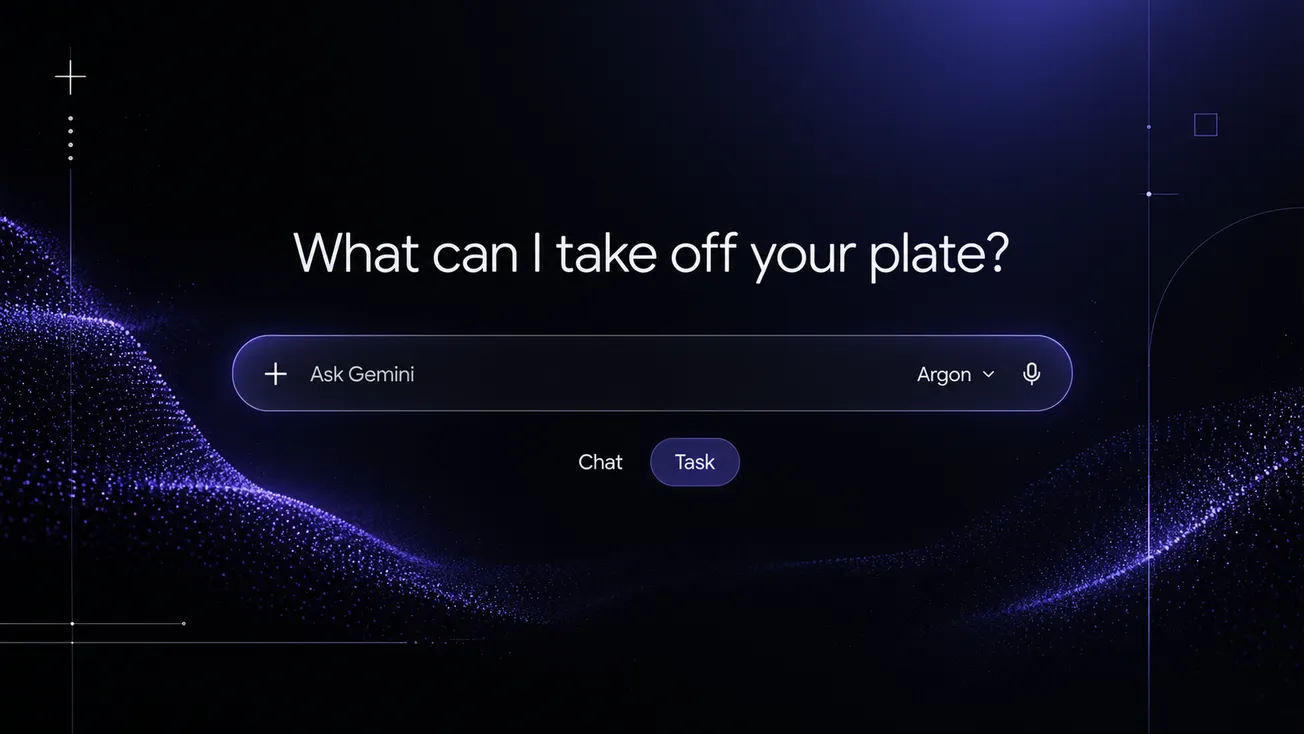
Google also added a Chat/Task toggle in Gemini that lets users switch from conversational use into background task execution, where Gemini can keep working while the user is away from the computer. Gemini now connects to more than 40 apps, including Instacart, OpenTable, Adobe, and Shopify, which lets it take actions instead of only chatting.
Argon Targets Long-Horizon Agent Work
Google built Argon for sustained work across software engineering, legal, finance, scientific, cybersecurity, and robotics tasks.
Google said Argon in Antigravity helped internal teams increase agentic code submissions by more than 35% while reducing code rollbacks by nearly one-third. The company also cited examples in Chrome refactoring, open-source Agent Development Kit optimization, quantum chemistry software, and vLLM work that accelerated Gemma 4 E2B inference throughput from about 37,900 to more than 108,000 tokens per second on an A100, with 100% token parity and no quality drop, according to Google.

Google’s benchmark table shows Argon leading on several company-reported evaluations.
Argon’s Robotics and Cyber Defense Push
In robotics, Google said Argon can use visual-semantic reasoning, physical understanding, and autonomous code generation to speed up robot training workflows. On the Embodied Reasoning benchmark, Google reported an 87% score. In a demonstration with Apptronik’s Apollo humanoid, Google said Argon watched a video of a person playing cornhole, mapped the scene, calculated whole-body joint movements, wrote simulation code, and transferred the resulting behavior to the robot, which then made seven consecutive shots in a real-world trial.
Gemini 4 Argon taught a robot to play cornhole just by watching a video.
— Google DeepMind (@GoogleDeepMind) October 13, 2026
It mapped the physics, coded its own simulation, and taught @Apptronik's Apollo humanoid to sink 7 throws in a row. pic.twitter.com/JIyoKnVc4q
The robotics demo points to models that go beyond generating language or code to turn observation into simulation, practice, and physical execution.