

Table of Contents
Grok Bot has reset weekly limits for all users after subscribers complained that their AI allowance was disappearing faster than before.
The official @bot account confirmed the reset Monday afternoon, Central Time. Product lead Matt Palmer followed minutes later, thanking subscribers and saying “the team is working around the clock.”
The reset follows Elon Musk’s Sunday-night round-table review, when he said fixes were being implemented overnight and users should notice “a dramatic improvement by tomorrow.” Palmer has also been answering hundreds of users directly. Separately, third-party fingerprint tests have again pointed to Claude Opus 5.5, though SpaceXAI has not confirmed claims that the service switched away from the model and then switched back.
Serving Costs and the Weekly Usage Pool
The usage complaints had already prompted Musk to acknowledge a cost problem. After a subscriber asked why weekly usage was disappearing so quickly, he wrote on Nov. 1: "The cost of serving Grok Bot was unsustainably high relative to revenue."
One user, @DogecoinNorway, reported reaching 100% usage with four days left before reset, despite normally staying below the limit. TechCrunch subsequently reported that some subscribers saw their meters jump from as low as 50% to fully exhausted over Halloween weekend.
On The X Subscription, Grok Bot draws from the same weekly AI allowance as Grok and Cursor. Heavy agent work therefore affects the pool available for other included AI activity.
On Sunday morning, Musk said work on token efficiency and smarter behavior was underway. Later that evening, Cursor builder Marco d'Amore identified usage limits and model routing as specific priorities, alongside improvements to the agent's harness and routines over the coming weeks.
The harness is the software around a model that manages its tools, context, and task execution. Improving that layer can help an agent complete work with fewer unnecessary model calls or less repeated context. d'Amore said the aim was to help subscribers get more from each plan while keeping the product sustainable.
What the Opus Fingerprint Tests Show
The model-routing dispute centers on tests shared by Hassan, who posts as @buildwithhassan and reviews AI coding agents. On Sunday, he reported that his bots' fingerprints matched gpt-6-astra/6.1-sol, after noticing a change in how they responded. On Monday morning, he reported that a new test matched Claude Opus 5.5 and wrote that Grok Bot was back on Opus, saying it looked like Musk "actually listened."
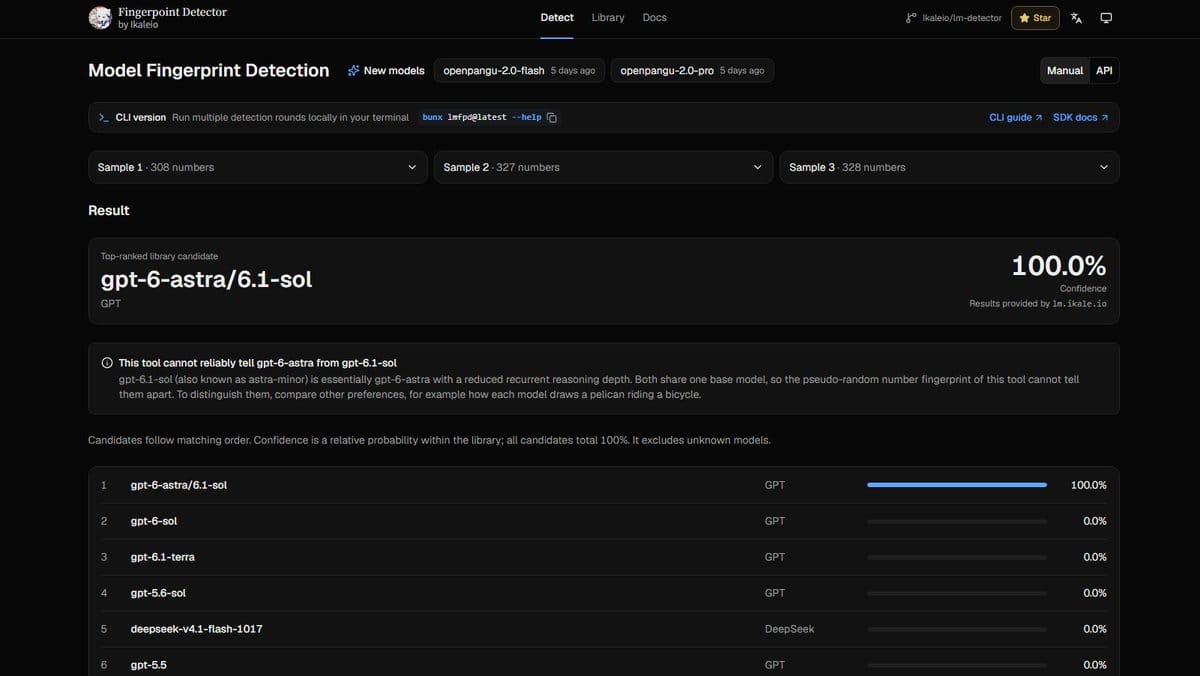
Fingerpoint Detector result for Grok Bot showing gpt-6-astra/6.1-sol, Nov 8 | Hassan (X). The tool does not reliably distinguish between those two GPT models.
Hassan used Fingerpoint Detector, which compares patterns in numbers generated by a model against a reference library. The screenshots he shared show 100.0% confidence for the GPT match and 99.9% for the Opus match. Those percentages are relative probabilities within the library, excluding unknown models, rather than probabilities that independently establish the provider's identity. The result page also says it cannot reliably distinguish gpt-6-astra from gpt-6.1-sol.
The tool's documentation explains that even a model outside its reference bank receives a closest candidate. Model versions, inference settings, prompts, and processing can affect the ranking. Neither Grok Bot nor SpaceXAI has confirmed either of the switches Hassan inferred.
Other tests have produced different results. On Monday, @parkgo\_dev reported that their own test still indicated GPT. Those individual samples cannot establish what every subscriber received, particularly because Grok Bot can choose a different model from one request to the next.
Grok Bot's official model-routing policy says it uses the backend most likely to deliver the best result, including first-party xAI models and third-party models. Users cannot see the model behind a request, select one, or block one. Usage records identify the activity as Grok Bot rather than naming the provider.
The same policy says routing a task to Opus 5.5 does not change the subscriber's per-token cost. How quickly an allowance is consumed depends on the work and the effort it takes. Model identity and the amount of work a subscription covers are therefore related user concerns, but the published policy does not assign a higher subscriber token price to Opus requests.
Palmer Fields Feedback as the Official Reset Lands
Palmer asked users to send feedback on Sunday, acknowledging that many had built important workflows around Grok Bot. By Monday morning, he said he had responded to hundreds of people and would continue monitoring comments. He plans to use Grok Bot to aggregate feedback for the engineering team while continuing direct conversations. "Every response comes from me!" he wrote.
Before the official announcement, some users already reported early meter refreshes. Jesse Nowlin said his allowance reset eight hours before its scheduled weekly refresh, with heavy overnight work using roughly 15% of the new quota. Others still saw fast burn. Daniel Ericksen (@Erickdanielson9) reported using 10% in 90 minutes.
Subscribers checking their own accounts can open Settings → Usage & Billing, per Grok Bot's FAQ. It also distinguishes The X Subscription's shared weekly pool from legacy Cursor and linked SuperGrok arrangements, where the applicable allowance depends on the account's plan.