
Table of Contents
NVIDIA has expanded its Isaac robotics platform with a new runtime, robot-learning software, simulation assets, and training workflows, while Agile Robots introduced Agile ONE SN, a research humanoid preconfigured with NVIDIA’s AI software and Jetson Thor onboard computing.
This affects several stages of robot development: assembling virtual environments, collecting demonstrations, training skills, and running those skills on physical hardware. Isaac Lab 3.0 is now generally available, and Agile ONE SN is scheduled for early 2027.
The reference humanoid gives researchers a common hardware-and-software starting point rather than requiring each lab to integrate its own development stack. NVIDIA says the preconfigured system can reduce setup time from weeks to days.
A Research Humanoid With GR00T Preinstalled
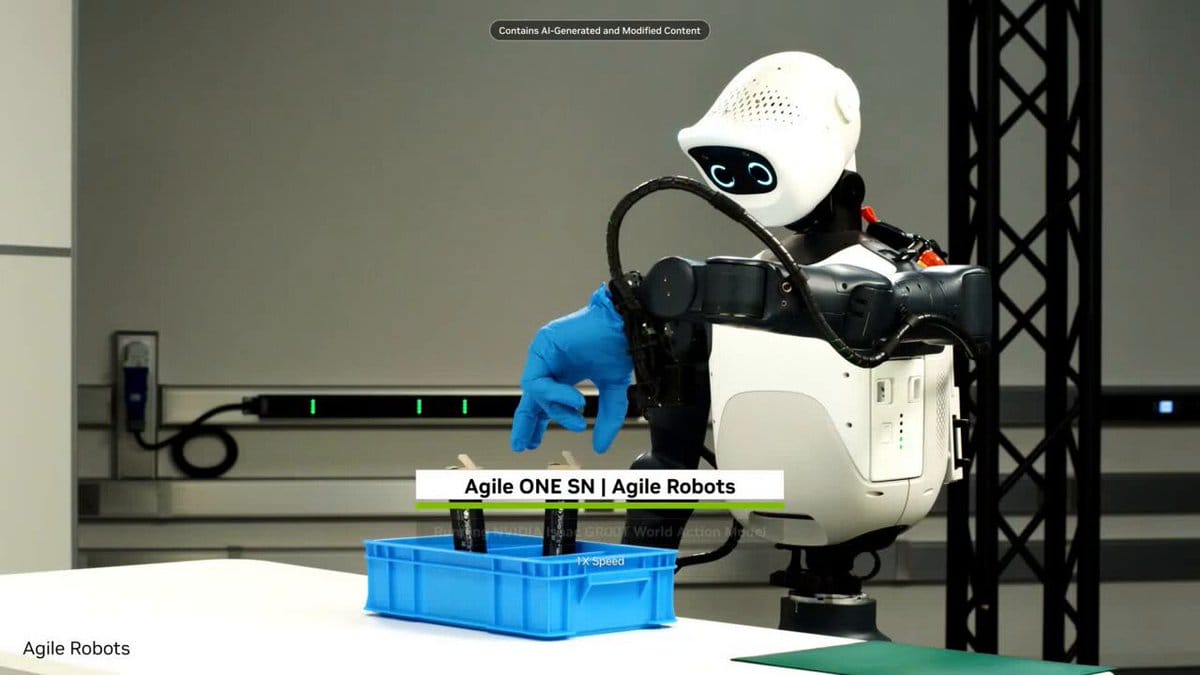
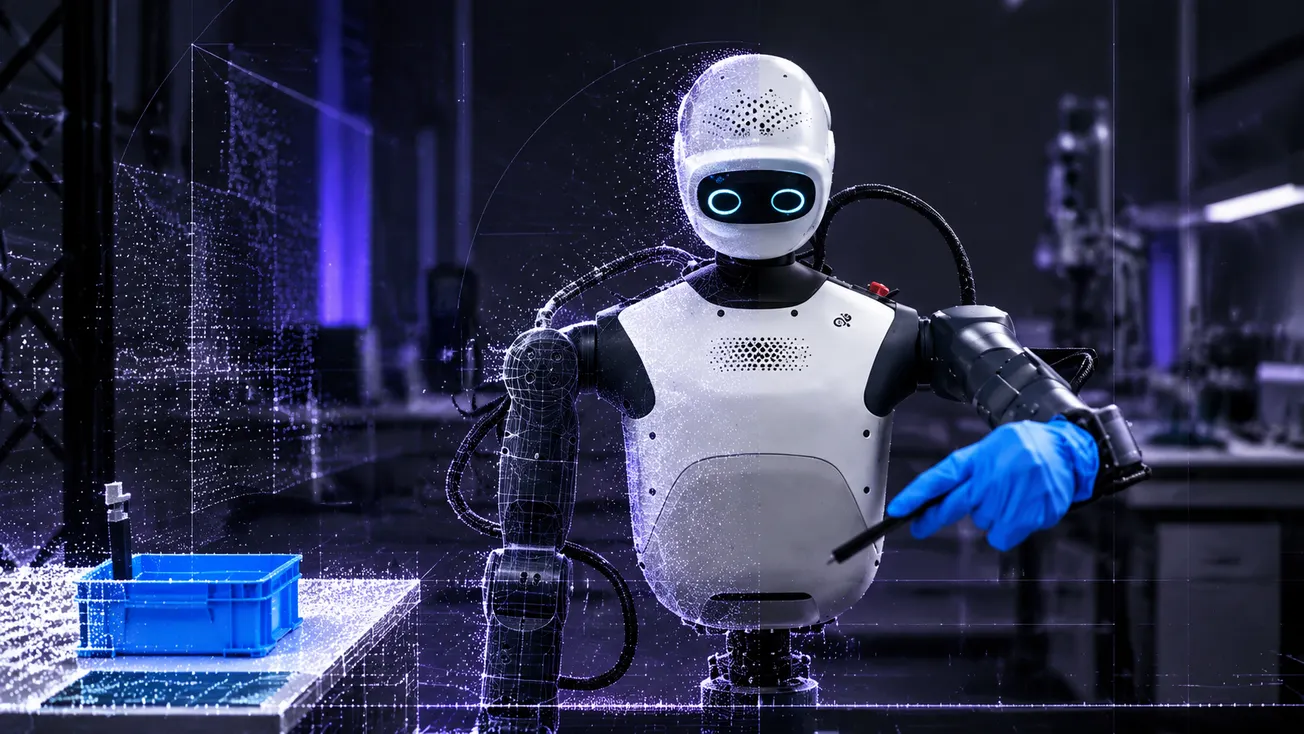
Agile ONE SN combines the 1.4-meter Agile ONE S body with two WUJI Hand 2 five-finger hands. The body has 31 degrees of freedom, and each hand adds 20, giving researchers independent control of the torso, limbs, and fingers. Payload capacity is up to 3 kilograms per arm.
The hands provide tactile sensing and 1 kHz force control, allowing manipulation research to incorporate contact feedback as well as camera observations. Head and wrist cameras, lidar, and inertial measurement units provide complementary information about objects, the surrounding space, and the robot’s motion.
Jetson Thor supplies 128 GB of unified memory and a rated 2,070 FP4 teraflops of onboard computing.
Agile Robots plans to ship the platform with preconfigured Isaac GR00T software, including the GR00T 1.7 vision-language-action model and whole-body control. A vision-language-action model connects visual observations and language instructions to robot actions, while whole-body control coordinates movement across the machine.
The reference workflow spans demonstration capture, data generation, simulation, training, evaluation, deployment, and physical testing. URDF and USD robot assets let teams bring the hardware’s representation into Isaac Sim and Isaac Lab. Researchers can use the complete workflow or selected components, and Agile Robots says they retain control of their data.
Stanford University and ETH Zurich are among the institutions that have expressed interest. Agile Robots also plans for skills and data developed on the compact system to transfer to Agile ONE, its full-size industrial humanoid.
Isaac Lab Trains Skills, While Isaac OS Runs Them
Isaac Lab 3.0 provides an open-source framework for training and refining robot policies, the learned behaviors that determine how a robot acts from its observations. The release supports multi-GPU workflows from desktop systems to data centers and physics engines including Newton and PhysX.
Simulation allows developers to repeat a task across virtual environments, vary conditions, and train behaviors before applying them to hardware. In reinforcement learning, a robot policy improves through repeated attempts guided by a reward signal, such as successfully grasping an object or maintaining balance.
Isaac OS addresses execution rather than training. Built on NVIDIA Holoscan, the new open-source runtime connects AI processing, sensors, controls, and robot hardware for deterministic, real-time operation. A control system must respond to sensor updates on a predictable schedule, so those components have to coordinate when they exchange information.
NVIDIA is also releasing three open-source reference workflows for DGX Station. They cover refining GR00T 1.7 models with reinforcement learning, training dexterous manipulation in Isaac Lab, and post-training Cosmos world models for synthetic data generation using ChatGPT Astra.
Those workflows link different kinds of learning work: adapting a robot model, practicing contact-rich hand skills, and generating additional training material with world models. NVIDIA lists 1X, Agile Robots, Humanoid, Maven Robotics, Mentee, MicroAGI, Rhoda, Sereact, and Skild AI among the companies whose solutions will support them.
Simulation Assets and Human Demonstration Data
The SimReady Central Library brings more than 2,000 simulation-ready assets to Hugging Face. Contributors include Comau, FANUC, Franka Robotics, LG Electronics, Robotiq, Standard Bots, Universal Robots, and Vertiv, covering equipment from robot arms and grippers to factory and computing infrastructure.
A simulation-ready asset contains more than visible geometry. Depending on its intended use, it can include collision shapes, mass, friction, joint limits, semantic labels, or sensor-related properties. These determine how an object behaves in a simulated task and how software identifies it.
SimReady profiles specify which capabilities an asset supports. Developers can select assets suited to their application and combine equipment from different suppliers in an OpenUSD scene, rather than preparing every model manually. NVIDIA’s USD Search enables natural-language discovery, and Hugging Face has integrated indexed USD properties and simulation metadata into its platform search.
The Human 1M Dataset adds human-activity recordings with synchronized video from three views and 3D hand tracking. Multiple viewpoints and tracked hand positions provide complementary observations of how people perform tasks. The dataset is available on Hugging Face, with access to the full collection limited to Cosmos Coalition partners.
Safety Integration and Industrial Workflows
Agile ONE SN’s planned Halos integration is part of a wider safety effort. Agile Robots is exploring the platform across hardware design, validation, and software, including NVIDIA IGX Thor.
Agility, Dexory, FORT Robotics, and KION are also integrating Halos into their safety architectures, while SICK is evaluating it for industrial robots that respond to changing conditions beyond fixed safety zones. Advantech and NexCOBOT are developing IGX-based industrial computing platforms, and Reynolds & Moore, Accenture, and TÜV SÜD are working on certification processes.
NVIDIA’s European robotics partners use the tools for applications beyond humanoid research. ABB Robotics is integrating Omniverse libraries into RobotStudio HyperReality for simulation and virtual commissioning before installation. KUKA is incorporating them into Visual Components FactoryLens for real-time factory rendering, while Sereact is using Isaac GR00T and Cosmos Transfer to train its Cortex goods-handling platform on Universal Robots arms.
Hugging Face and Pollen Robotics are using Isaac Lab, Isaac Sim, and Newton for Microduck, their small open-source robot. Flexion is using Isaac Lab and Newton to train Reflect, a model combining reasoning and whole-body movement across robot designs, and NEURA Robotics is using Isaac Sim and Isaac Lab for synthetic data generation and skill training for Neuron AI.
Agile ONE SN is scheduled for release in early 2027, and the robot is on display at NVIDIA’s booth and Agile Robots’ booth 3007 at GTC Berlin.