

Table of Contents
Agility Robotics is set to begin trading on Nasdaq under the ticker AGLT today after completing its merger with Churchill Capital Corp XI, bringing the Digit humanoid robot maker to public markets with approximately $465 million in gross capital from the transaction and related financings.
The company’s common stock and warrants are scheduled to trade as AGLT and AGLTW, respectively. Agility calls itself the first U.S. publicly listed pure-play humanoid robotics company with active commercial deployments. Its robots already work in logistics and manufacturing.
Agility enters the market with nearly three years of deployment experience and more than 65,000 hours of real-world operation. It has also secured more than $300 million in committed multi-year orders for its next-generation Digit 5, subject to contractual milestones, product features, and specifications.
From SPAC Merger to Public Company
The business combination closed yesterday, following Churchill XI shareholders’ approval at their November 2 meeting. Churchill XI was a special purpose acquisition company, a publicly traded vehicle formed to merge with an operating business.
The approximately $465 million total is before transaction expenses and includes a private investment in public equity, or PIPE, led by Foxconn, as well as $100 million in equity funding Agility received before closing. Agility plans to use the capital to fulfill customer orders, expand deployments, increase Digit production, and develop its robotics and physical AI platform.
Existing Agility shareholders are rolling all their equity into the combined company. Their shares, along with those held by the Churchill sponsor, are subject to a 180-day sales lock-up after closing, with provisions for early release tied to stock-price performance.
The financing follows a going-concern disclosure in Agility’s merger filing. That assessment reflected continuing losses and cash requirements without considering the proposed transaction’s proceeds. The completed capital raise now provides funding for the production and deployment expansion outlined in the company’s plans.
Commercial Work Expands Beyond the Initial GXO Site
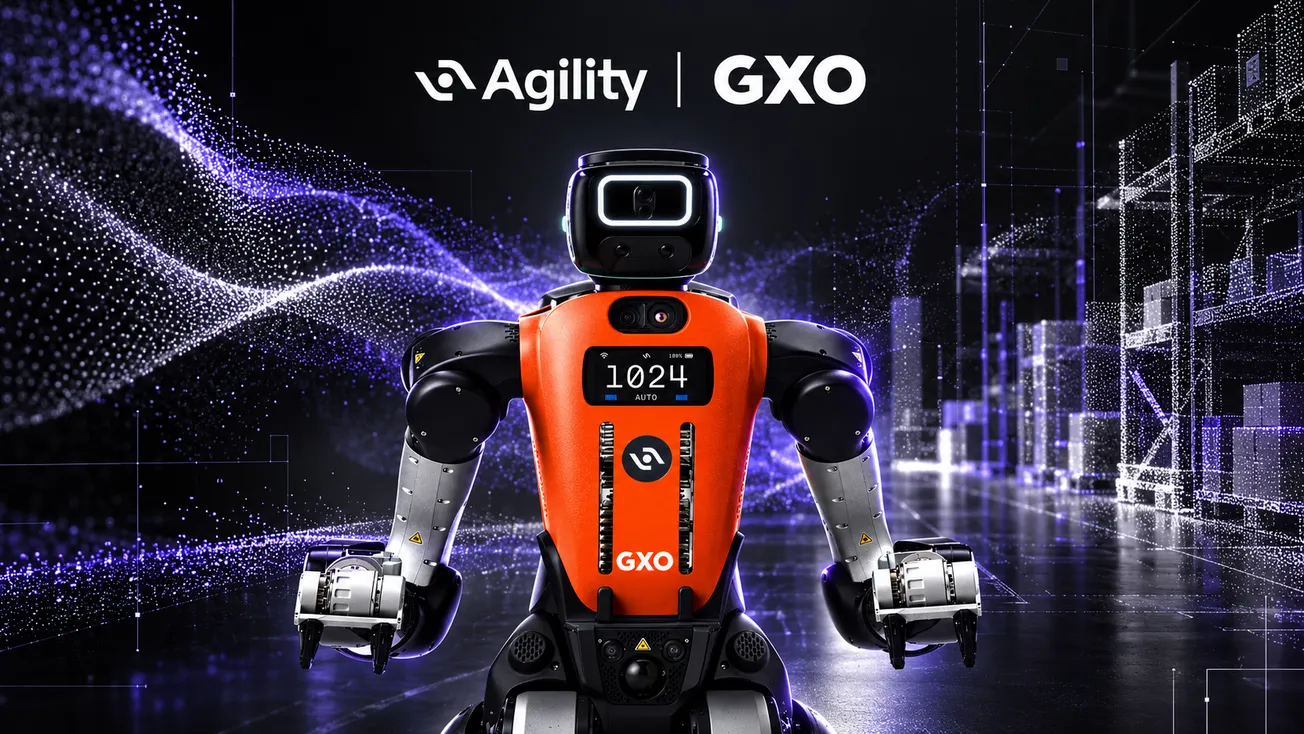
Digit is operating with GXO, Schaeffler, and Toyota Motor Manufacturing Canada, performing repetitive, physically demanding work in industrial settings. At GXO’s Flowery Branch, Georgia, facility, the robot has moved more than 100,000 totes, transferring containers onto conveyors alongside existing automation.
GXO’s expanded agreement adds deployments at two more U.S. logistics facilities in early 2027. The sites in Statesville, North Carolina, and Lebanon, Tennessee, are expected to start with Digit 4 before transitioning to Digit 5 when it becomes commercially available.
Agricultural equipment manufacturer AGCO has also signed a commercial agreement for a Digit pilot at its Hesston, Kansas, manufacturing facility, expected to begin in 2027.
Three additional manufacturing customers are participating in paid programs focused on particular applications: a major global automaker, an automotive technology and components developer, and a consumer products manufacturer. Separately, it reports a pipeline of more than 30 prospective customers across automotive, manufacturing, aerospace, logistics, consumer products, and defense.
The paid programs, planned pilots, and prospective customer pipeline are distinct from the multi-year Digit 5 order commitments. Those commitments represent potential business over several years, rather than current-period revenue, and depend on meeting the agreed milestones and product requirements.
Digit 5 Targets Heavier Loads and Closer Human Collaboration
Unveiled in September, Digit 5 has proprietary cycloidal actuators for repetitive lifting of up to 50 pounds. Actuators drive a robot’s joints; the new hardware is paired with interchangeable end effectors, the tools or grippers at the ends of its arms, and expanded manipulation capabilities for a wider range of industrial tasks.
Cooperative safety is another design focus. Agility is developing human-detection software and functional safety behaviors to let Digit work closer to people without external barriers. The company plans to standardize the robot’s onboard computing on NVIDIA IGX Thor and expand its integration of NVIDIA Halos safety technology, alongside safety-system work with FORT Robotics.
Nyobolt’s charging technology aims for a nine-minute recharge and more than 20 hours of productive work within a 24-hour day. These are Digit 5 performance targets that would reduce the time robots spend charging between work periods.
Production will draw on RoboFab, Agility’s 70,000-square-foot factory in Salem, Oregon, with annual capacity of up to 10,000 robots. Its Fremont, California, site focuses on hardware and physical AI, while a recently announced 50,000-square-foot Pittsburgh expansion will support software, AI, deployment, and customer service. Agility Arc, the company’s cloud platform, manages robot fleets and connects them with customer operations.
Early customer access to Digit 5 is expected in the first half of 2027, with general availability targeted for the end of the year.