Table of Contents
Key takeaways
- Bittensor mints new tokens every block and pays them out each tempo, which is a 360-block cycle, with market signals steering TAO across subnets and Yuma rewarding useful work inside them.
- Since the dynamic TAO upgrade, emissions run on two tracks, with TAO allocated across subnets by market signals that have moved between price and flow, and alpha tokens paying the participants.
- Inside a subnet, alpha emissions split about 41 percent to miners, 41 percent to validators and their stakers, and 18 percent to the subnet owner.
- Yuma consensus decides who earns what by turning validator scores into a stake-weighted agreement, which rewards honest scoring.
- The December 2025 halving and a series of 2026 emission changes, most prominently in June, tightened supply and concentrated rewards on the strongest subnets.
The Basics of Bittensor Emissions
Emissions are the newly created tokens that the protocol distributes to pay for useful work, and they arrive on a steady clock. The chain mints a base emission of one TAO per block, roughly every twelve seconds, and rewards are gathered and paid out each tempo, a cycle of 360 blocks. That rhythm is what turns a continuous stream of new tokens into regular payouts for the miners, validators, stakers, and subnet owners who keep the network running.
The supply behind those emissions is fixed, with a hard cap of 21 million TAO, no pre-mine, and no venture allocation, so every token in existence was earned through on-chain work. The first halving landed on December 14, 2025, cutting daily issuance from 7,200 to 3,600 TAO, which works out to about half a TAO per block today. Those halvings are triggered when total issuance crosses the midpoint of the remaining supply, not by a fixed block count, and because recycled registration burns are subtracted from issuance, burning tokens actually pushes the next halving further out.
The Two Tracks of Every Emission
Each emission splits into two different flows once it leaves the block. On the first track, newly minted TAO is injected into each subnet's liquidity pool, and how much each subnet receives has changed more than once since dynamic TAO went live. The original design set the allocation by price, so subnets with a higher moving-average price attracted a larger share of TAO emissions. Around November 2025, the network moved to a flow-based model, sometimes called Taoflow, that allocated emissions by net TAO staking inflows, not by price, and then in late June 2026 it largely returned to a price-based approach built on EMA prices, layered with extra factors like miner-burn penalties, active-mining gates, and a root proportion. As of late July 2026, the system is once again primarily price-oriented, now paired with mechanisms that concentrate emissions toward the strongest subnets. Through every version, the same idea has held, because capital follows the subnets that participants value most.
On the second track, each subnet mints its own alpha token, and those alpha emissions are what actually pay the people doing the work. Every subnet runs its own alpha token on a four-year halving schedule of its own, and contributors earn alpha for their subnet, not TAO directly. They can then hold that alpha, stake it, or sell it into the subnet pool for TAO, which is what lets a subnet team convert rewards into funding for their operations.
Who Gets Paid, and How Much
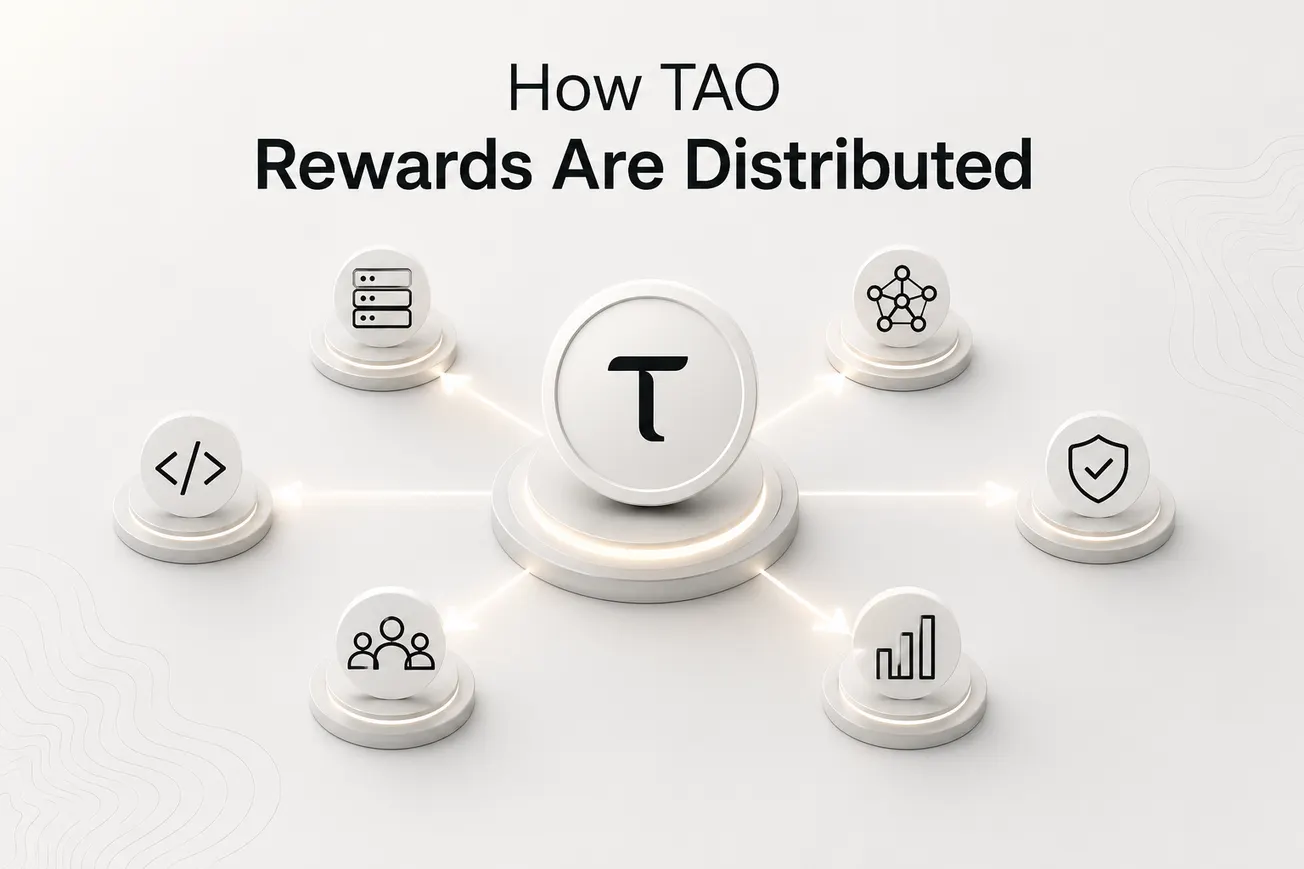
Within a subnet, the alpha emissions are divided among three groups on a fixed split, so the same rule applies whether a subnet is large or small. Miners and the validator side each take the largest share, and the team that owns the subnet takes the rest, which keeps every role that matters financially motivated.
| Recipient | Share of alpha emissions | What they do |
|---|---|---|
| Miners | About 41 percent | Produce the AI outputs the subnet is built to deliver |
| Validators and their stakers | About 41 percent | Score the quality of miner output and secure the subnet |
| Subnet owner | About 18 percent | Build, run, and improve the subnet and its incentive design |
The validator share is not kept by validators alone, because the people who delegate stake to a validator split that 41 percent with them. That is the reason an ordinary holder can earn yield without running any infrastructure, and depending on the subnet and validator, those staking returns have ranged widely and never settled at one fixed rate.
How Yuma Consensus Decides the Split
The fixed percentages describe how much each role earns in total, but something has to decide which individual miners and validators deserve a share, and that job belongs to Yuma consensus. Validators submit weights that score how useful each miner is, and the algorithm turns those weights into a stake-weighted agreement, so no single validator can dictate the outcome. A miner that most high-stake validators agree is valuable earns well, while a miner that only one outlier rewards earns little.
Validators are paid for scoring accurately, and their dividends are calculated from bonds multiplied by miner performance, so validators who recognize good miners early build bonds and earn more when the rest of consensus catches up. The design pays honest, early judgment and gives validators a reason to evaluate miners carefully and to avoid simply copying each other.
What Changed About Rewards in 2026
The distribution rules have kept evolving, and the concentration of rewards arrived through a series of steps, not a single event. The December 2025 halving already cut new supply in half, and across May and June 2026 the core team shipped a run of emission changes that blocked payouts to inactive or exploitative subnets and pulled the number of high-emission subnets down toward the range of 30 in later analyses. The most prominent effects landed in June, and further gating in July pushed emissions even harder toward the top performers, which reduced indiscriminate selling from the weaker ones.
Governance of the reward flow is also under active debate. A June 2026 proposal would push validators toward a role that resembles fund managers allocating capital across subnets, which would deepen their influence over where emissions land. That influence is exactly why critics watch the numbers closely, and analysts have pointed out that the largest subnet drew around 52 million dollars in annual emissions while producing far less in external revenue, a reminder that emissions currently subsidize activity that has not yet proven it can pay for itself.
Making Sense of the Reward Path
The path a Bittensor reward takes is more layered than most tokens, but it follows a clear logic once the two tracks are separated. New TAO flows toward the subnets the market values, and each subnet then mints alpha that splits about 41 percent to miners, 41 percent to validators and their stakers, and 18 percent to the owner. From there, Yuma consensus decides which specific contributors earn within those shares. The mechanics reward useful work and honest scoring by design, and the 2026 changes have made the system tighter and more selective, though the open question is still whether the work being paid for will grow into revenue that justifies the emissions.