
Table of Contents
Yuma Consensus is the mechanism that turns Bittensor’s subjective miner evaluations into a reward distribution.
In Bittensor, miners do useful work inside subnets, validators score that work, and the chain uses those scores to decide who earns emissions. Yuma Consensus is the within-subnet process that converts validator weights into miner incentives and validator dividends each epoch. It differs from blockchain consensus and from the market mechanism that routes TAO across subnets. It is the scoring engine that helps a subnet decide which participants should be paid.
Yuma is one of the most important concepts in the network for anyone trying to understand Bittensor, TAO rewards, subnet staking, or validator behavior. It explains why validators cannot assign arbitrary weights without consequence, why stake matters, and how Bittensor tries to reward useful work without relying on one central judge.
Yuma Consensus Summarized
Yuma Consensus is Bittensor’s stake-weighted method for turning validators’ miner scores into emission shares at the end of each subnet epoch. Validators submit weights that express how valuable each miner is, and the protocol calculates a consensus score for each miner using a stake-weighted median, with kappa defaulting to 32767/65535, or about 0.5. Weights above that consensus level are clipped down, which means a minority of stake cannot simply inflate rewards for a favored miner without being corrected by the broader stake-weighted consensus.
In short, Yuma takes many validator opinions, weights them by stake, clips outliers, and turns the result into rewards.
Where Yuma Sits In The Bittensor Stack
Bittensor is a Substrate-based Layer 1 blockchain that coordinates off-chain work. The chain records registrations, staking, validator weight submissions, emissions, and settlement, while the actual AI or digital work happens inside specialized subnets.
Each subnet is its own incentive market. A subnet may reward model inference, data collection, forecasting, storage, GPU compute, or another useful task. In most subnets, the basic structure looks like this:
- Miners produce the work the subnet is designed to reward.
- Validators evaluate miners and submit weights to the chain.
- The chain runs an epoch process that turns those weights into ranks, incentives, dividends, bonds, and emission shares.
Yuma is the mechanism inside that epoch process. The chain produces a block roughly every 12 seconds, while subnet rewards are gathered and distributed on each subnet’s tempo. A common default tempo is 360 blocks, or roughly 72 minutes.
Learn more about subnets in our dedicated guide:
 Tristan Hillerich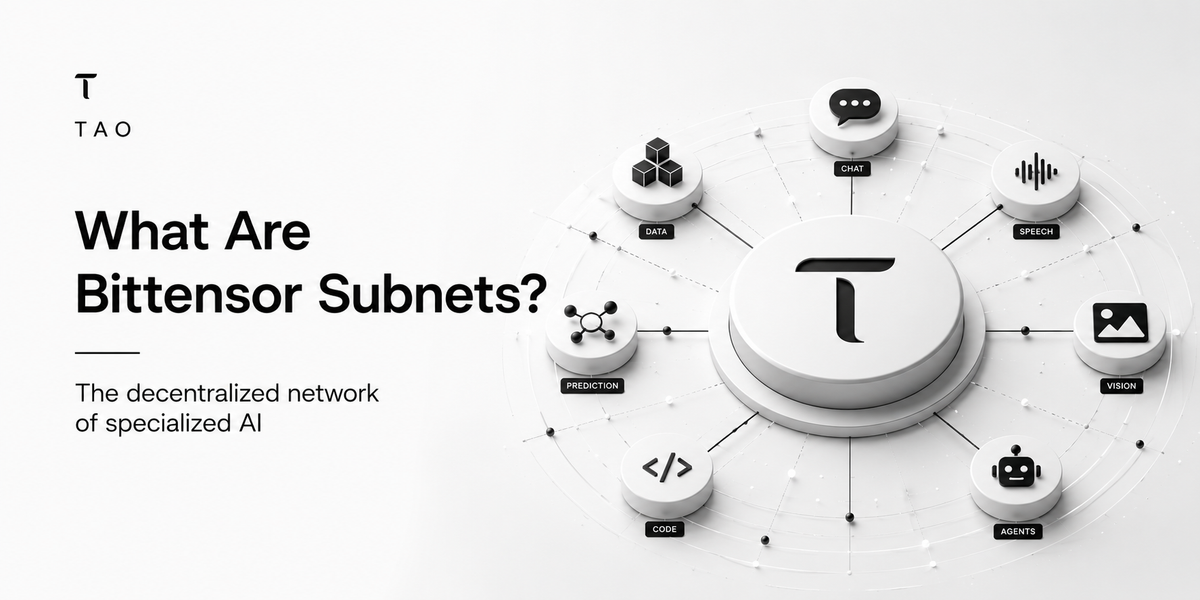
That makes Yuma an internal reward-allocation mechanism, not the base consensus mechanism for producing blocks. Substrate validators and blockchain consensus are responsible for chain security and block production. Subnet validators are different actors: they score miners inside a subnet and submit weights that affect rewards.
“Validator” can mean different things in different blockchain contexts. In Bittensor’s subnet economy, validators are evaluators, and Yuma turns their evaluations into an emission outcome.
For a higher-level view of the broader system, our guide to how Bittensor works explains how miners, validators, subnets, TAO, and Dynamic TAO fit together:
 Tristan Hillerich
The Problem Yuma Solves
Yuma exists because many forms of useful AI work are hard to measure with a simple, objective rule.
Some decentralized physical infrastructure networks can measure output with relatively direct metrics. A storage network can check whether data is available. A wireless network can measure coverage. A compute network may verify certain jobs with hardware or cryptographic proofs.
Bittensor often deals with more subjective forms of utility. A model response may be more helpful, faster, more accurate, more creative, or better aligned with a subnet’s scoring rules, but the quality judgment still depends on validators testing and evaluating miner outputs. That creates a problem: if validators control the scores, what stops them from over-rewarding themselves, friends, or a coordinated group?
Yuma’s answer is stake-weighted agreement. Validators with more stake have more influence, but their influence is not unlimited. The protocol looks for the maximum score supported by a threshold of active stake and clips weights above that level.
If a small group assigns an unusually high score to a miner that the broader stake-weighted validator set does not support, Yuma reduces that score to the consensus level. This is a protection against selfish weighting when the majority of stake is honest.
Yuma does not, however, make collusion impossible. Its security assumption is that majority stake behaves honestly enough to discipline minority outliers, and when that assumption holds, minority cabals have a harder time directing emissions toward themselves through inflated weights.
How An Epoch Uses Yuma
Yuma is easiest to understand as a pipeline. Validators do not simply vote once and get paid. Their weights go through filtering, stake weighting, clipping, ranking, bonding, and dividend calculation.
1. Validators Submit Weights
During a subnet epoch, validators evaluate miners and submit weights. A weight is a validator’s on-chain score for how much value a miner deserves relative to others on that subnet.
Those weights are not treated equally. They are interpreted through validator stake, permit status, activity, and the subnet’s current hyperparameters.
2. The Chain Calculates Stake Weight
A participant’s stake weight on a subnet is currently calculated as:
alpha_stake + tao_stake × tao_weight
In other words, stake weight includes alpha staked on that subnet plus root TAO stake scaled by the global TAO weight. tao_weight is currently 0.18 on mainnet and is governance-set (quick note: that value should be read as current rather than permanent).
This stake weight helps determine which validators have enough influence to receive permits and participate meaningfully in Yuma’s reward calculation.
3. Validator Permits Are Recalculated
Validator permits are recalculated every epoch. The protocol gives permits to the top validators by stake weight, up to the subnet’s MaxAllowedValidators, which the Bittensor documentation lists as defaulting to 128.
Only permitted validators can set weights over others in the Yuma process. The same emissions documentation also notes that validators below the chain’s stake threshold, currently 1,000 tokens’ worth, are zeroed, and neurons whose last weight update is older than the activity cutoff, defaulting to 5,000 blocks, are considered inactive and excluded from consensus.
Yuma does not average every possible score from every registered participant. It works with active, permitted validators whose weights survive the filtering rules.
4. Invalid Or Self-Serving Weights Are Filtered
Before consensus is calculated, the chain filters weights. Self-weights are removed except for the subnet owner, weights from non-permitted validators are removed, and weights set before a target neuron’s latest registration are removed.
The surviving weights are then row-normalized. That means the influence comes from stake-weighted allocation across miners, not from a validator simply using larger absolute numbers.
This is one reason Yuma is more than a popularity contest. Validators submit preferences, but the chain standardizes and filters those preferences before they affect emissions.
5. Consensus Is Calculated With A Stake-Weighted Median
For each miner, Yuma calculates a consensus value using a stake-weighted median. kappa is the fraction of active stake that must support a weight level for it to count as consensus.
The default value is 32767 out of 65535, or about 0.5. In practice, that means the consensus threshold is approximately a simple stake majority by default.
The mechanism asks: what is the highest weight level that is supported by at least kappa of active stake?
That consensus value becomes the ceiling for that miner’s score. A validator can score a miner below consensus, but if the validator scores the miner above consensus, the excess is clipped down.
6. Scores Above Consensus Are Clipped
Clipping is the central enforcement step. If a validator gives a miner a weight above the stake-weighted consensus value, the protocol reduces that weight to the consensus value.
This is how Yuma limits minority manipulation. A minority group can submit inflated weights, but if enough active stake does not support those weights, the scores are cut back. This is essentially clipping excess weight above the maximum weight supported by kappa-majority stake.
Consider an example:
| Validator Group | Stake Share | Score For Miner A | What Yuma Sees |
|---|---|---|---|
| Broad Validator Consensus | 70% | 0.30 | Majority-Supported Level |
| Minority Cabal | 30% | 1.00 | Outlier Above Consensus |
| Yuma Result | — | 0.30 | Inflated Score Is Clipped |
The exact math is more nuanced. A small group can express an aggressive view, but it cannot make that view the reward ceiling unless enough stake supports it.
7. Clipped Weights Become Miner Incentives
After clipping, the protocol calculates miner ranks from the stake-weighted sum of clipped weights. Those ranks are normalized into incentives, which determine each miner’s share of the miner emission pool.
This is where Yuma turns judgment into payment. Miners that receive strong, consensus-supported validator weights earn more. Miners that are only favored by outliers earn less.
That process sits inside the broader reward system. In our How TAO Rewards Are Distributed guide, we explain that alpha emissions inside a subnet are divided among miners, validators and their stakers, and the subnet owner, with Yuma deciding who earns within those roles.
Read that guide here:
 Tristan Hillerich
8. Bonds Help Determine Validator Dividends
Yuma also affects validators. Validators do not only earn because they have stake; they earn dividends based on how their scoring relates to miner incentives through bonds.
In the classic path, instant bonds are derived from validator weights and stake, then smoothed with an exponential moving average. The validator dividends are bonds multiplied by miner incentives.
Validators are rewarded for useful judgment. If a validator identifies a strong miner early and the broader consensus later agrees, that validator can build bonds and earn more when the miner receives incentives.
Bonds And Why Early Discovery Matters
Bonds are Yuma’s answer to a second problem: if validators are only rewarded for matching consensus, they may have an incentive to copy the crowd instead of finding useful miners early.
A bond tracks a validator’s relationship to a miner over time. When validators assign weight to miners, those weights can contribute to bonds. If a miner later receives strong consensus-supported incentives, validators with meaningful bonds to that miner can earn dividends.
This creates a reason to do real evaluation work. A validator that discovers a high-quality miner early may benefit if the rest of the subnet later recognizes that miner’s performance. A validator that blindly inflates scores for weak miners, by contrast, risks being clipped and earning weaker dividends.
The design rewards useful, early judgment as much as it discourages bad scores.
Yuma3 And Liquid Alpha
Yuma3 is a newer variant of the bond and dividend path inside the Yuma process. It is not a separate replacement for the entire idea of Yuma Consensus; it changes how validator bonds and dividends are computed.
yuma3_enabled switches a subnet from the classic Yuma bond computation to the Yuma3 variant. In the classic path, instant bonds are column-normalized, smoothed by a flat exponential moving average, and used to calculate dividends. In the Yuma3 path, bonds are handled through a fixed-point bond computation, and dividends are calculated differently before being scaled and renormalized.
Liquid alpha allows the EMA rate to become dynamic on a validator-miner pair basis, but the same documentation states that it only takes effect when yuma3_enabled is on. If Yuma3 is not enabled, the classic bond path ignores the liquid alpha toggle.
Yuma3 affects how validator conviction, early discovery, and dividend allocation work on subnets that use it.
At the same time, Yuma3 should not be described as universal across every live subnet without checking. It is a per-subnet toggle. A merged Subtensor pull request changed subnet registration so that Yuma3 is enabled by default for new subnets, but existing subnet configurations may still vary.
Does More Stake Always Mean More Control?
More stake gives a validator more influence, but it does not give unlimited control.
Stake affects validator permits and weight in the consensus calculation. A highly staked validator matters more than a lightly staked one. But Yuma still compares weights against the broader stake-supported consensus for each miner.
Stake is not ignored, because the network uses stake to make scoring economically meaningful, but it is not a blank check to set any reward distribution alone. A validator’s scores can still be clipped if they sit above the consensus level supported by the relevant stake threshold.
The honest-majority assumption matters here too. Yuma makes minority manipulation harder, but it does not remove every risk from subjective scoring.
What Happens If No Valid Weights Exist?
If no valid weights exist, emission falls back to stake proportions. That means a subnet can still distribute rewards even when the usual weight-based consensus process does not have valid inputs.
The fallback keeps the reward system from breaking entirely if a subnet has insufficient valid validator weights, though it is not the ideal steady state for a healthy subnet. A functioning subnet wants active validators evaluating miners and submitting useful scores, because that is how Yuma can reward actual performance rather than merely falling back to stake.
What Yuma Means For Learners
Learners can read “Yuma Consensus” this way:
Yuma is the within-subnet reward engine that turns validator scores into miner and validator rewards.
It answers a narrower question than Dynamic TAO. Dynamic TAO helps determine how emissions move across subnets through market mechanisms involving TAO and subnet alpha. Yuma helps determine who earns inside a subnet once that subnet has emissions to distribute.
That makes Yuma especially important for understanding:
- Why validators matter
- How miners compete for rewards
- Why stake influences scoring
- Why outlier weights can be clipped
- How validator dividends reward useful evaluation
- Why collusion resistance depends on honest majority stake
If Bittensor is a network of markets for machine intelligence, Yuma is one of the mechanisms that turns subjective evaluations inside those markets into economic outcomes.
Conclusion
Yuma Consensus is one of Bittensor’s core coordination mechanisms. It does not decide which subnets deserve network-wide attention, and it does not produce blocks for the chain. Instead, it operates inside subnets, where validators score miners, and the protocol must decide which scores should translate into emissions.
The design uses stake-weighted consensus, kappa-based clipping, validator permits, bonds, and dividends to make reward manipulation harder and useful evaluation more valuable. In one sentence, Yuma rewards miner performance when that performance is supported by stake-weighted validator agreement.
Yuma is the bridge between subjective judgments about useful work and the on-chain rewards that make Bittensor’s subnet economy function.
FAQs
What Is Yuma Consensus In Bittensor?
Yuma Consensus is Bittensor’s mechanism for converting validator scores into reward shares inside a subnet. Validators submit weights for miners, and Yuma uses stake-weighted consensus and clipping to determine which scores translate into emissions.
Is Yuma Consensus The Same As Blockchain Consensus?
No. Yuma Consensus is not the mechanism that produces blocks or secures the Subtensor chain. It is a within-subnet reward mechanism that turns validator weights into ranks, incentives, bonds, dividends, and emission shares.
What Is Kappa In Yuma Consensus?
kappa is the active-stake threshold required for a weight level to count as consensus. In Bittensor’s current documentation, the default is 32767/65535, or about 0.5, which means the consensus level is based on roughly a simple stake majority.
How Does Yuma Stop Validators From Cheating?
Yuma limits dishonest or self-serving scores by clipping weights above the stake-weighted consensus level. If a minority group gives an inflated score that is not supported by enough active stake, that excess score is reduced before rewards are calculated.
Can Validators Still Collude In Bittensor?
Validators can attempt to coordinate, but Yuma is designed to make minority collusion harder when the majority of stake is honest. It should not be described as making collusion impossible, because the mechanism depends on stake-weighted agreement and the honest-majority assumption.
What Are Validator Bonds?
Validator bonds are part of the dividend mechanism that connects validator scoring to miner performance over time. Validators that identify useful miners early can build bonds and may earn more if those miners later receive consensus-supported incentives.
What Is Yuma3?
Yuma3 is a variant of Bittensor’s Yuma bond and dividend calculation. It changes how bonds and validator dividends are computed, and liquid alpha only takes effect when yuma3_enabled is on for a subnet.
Does Yuma Decide Which Subnets Get TAO?
No. Yuma decides reward distribution within a subnet. Network-wide emission routing across subnets is handled by broader Bittensor mechanisms involving TAO, alpha, and Dynamic TAO, while Yuma determines who earns inside a subnet once emissions are allocated.